
October 19, 2026 | by Monica, SunAura Machinery Applications Engineering
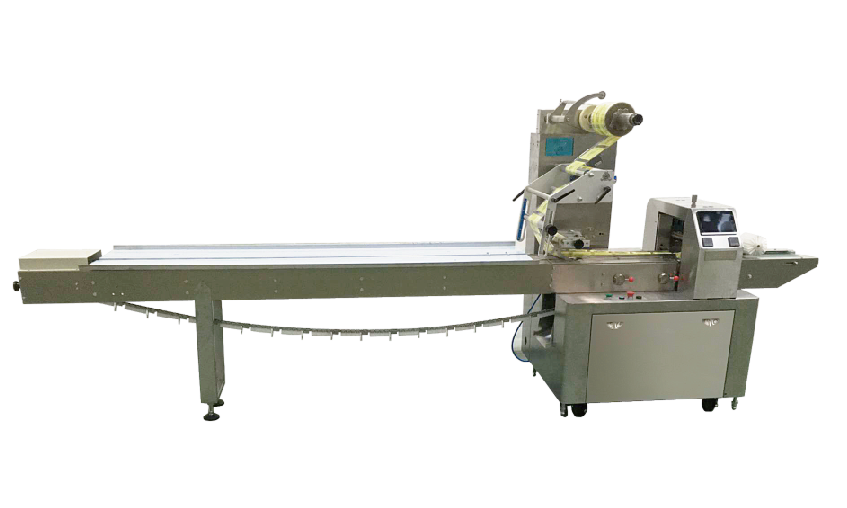
CHIANG MAI, Thailand — SunAura Machinery has shipped and commissioned a high-speed servo pillow packaging line for a snack producer in northern Thailand that packs roasted rice crackers, crispy pork snacks and coated peanuts for both the domestic market and export to Singapore and the Gulf. The company was running two older mechanical flow wrappers that needed an operator watching the film every few minutes, and the packs — particularly the nitrogen-flushed rice-cracker line — were losing crispness before the best-before date because the back seal and end crimps were not consistent enough to hold atmosphere. The new line is built around a ZW-580 servo pillow wrapper fed by an 18-head multihead weigher, and it has lifted the snack line from roughly 70 bags per minute effective to a sustained 140, with seal rejects falling from about 4% to under 0.5%.
Why the Old Mechanical Wrappers Could Not Hold the Product
Thai snack producers face a specific problem that temperate-market buyers underestimate: the plant is hot and humid for much of the year, and fried or roasted snacks are hygroscopic. A rice cracker that leaves the fryer at the correct moisture will pull water out of the air through any weakness in the seal, and the bag will go soft two or three weeks before the printed date. On the old machines the film was advanced by a mechanical chain and clutch, so the eye-mark drifted as the film roll wore down and as the machine warmed up; the operator repeatedly nudged the registration by hand. That drift produced end crimps that were slightly off the film’s sealant layer, which was enough to open a slow leak that emptied the nitrogen headspace.
The second issue was nitrogen. The old wrappers were flushed with a loose gas tube that was either overpowered, wasting nitrogen and inflating the bag irregularly, or underpowered, leaving pockets of oxygen. The customer had no measurement of residual oxygen, only complaints. The new line uses a servo-driven gas-flush system synchronized to the film jaw cycle, with an optional in-line residual-oxygen check, so the headspace is replaced consistently on every cycle rather than “flooded and hoped.”
What the Line Includes
The delivered line is a complete horizontal flow-wrap system rather than a single machine, which is where most snack packaging projects go wrong when buyers treat the wrapper as an isolated purchase.
- 18-head multihead weigher: an 18-head multihead weigher portions the snacks by weight into the cross-feed bucket. For irregular, fragile rice crackers the weigh-hopper timing and bucket drop were tuned to reduce breakage, not merely to maximize speed.
- Servo pillow wrapper: the high-speed servo pillow packaging machine controls film feed, jaw movement and the cutting knife on independent servos, so the bag length, seal jaw timing and gas-flush timing are stored per SKU rather than set by hand.
- Rotary / reciprocating jaw option: for the more delicate crispy pork snacks the line was configured with a high-speed horizontal pillow packaging line head that can switch between a rotary jaw for speed and a reciprocating jaw for gentler handling of large or fragile products.
- Film and discharge: a motorized film shaft with automatic tension, a finished-bag take-away conveyor, and a connection to an existing metal detector and checkweigher.
The full range of formats is in the pillow packaging machines hub. For the smaller, lower-volume artisanal packs the customer also kept a medium-speed pillow flow wrapper for short runs, because running a 140-bag-per-minute machine for a single pallet of a seasonal SKU is wasteful in both film and changeover time.

The Changeover and Film Data That Matter
The plant runs four core SKUs across three bag widths and two film structures, and changeover time was eating into the afternoon shift. The comparison below reflects the time-and-motion data recorded during SAT.
| Parameter | Mechanical wrappers (before) | Servo line (after) |
|---|---|---|
| Effective speed (rice crackers) | ~70 bpm | 140 bpm sustained |
| Seal / registration reject rate | ~4% | <0.5% |
| Film-register correction | Manual, every few minutes | Automatic, closed-loop |
| SKU changeover | 35–50 minutes | 8–12 minutes (recipe) |
| Residual-oxygen control | Untimed gas tube | Jaw-synchronized flush |
| Operators per line | 2 wrappers + 1 film minder | 1 operator, line-wide |
Film choice was the other half of the conversation. The customer was buying a single metallized OPP/PE laminate for everything, which sealed adequately but was slow and ran at a hotter jaw than necessary. For the roasted snacks that need barrier but not maximum shelf life, the team kept the metallized structure; for the export rice-cracker bags that travel by sea for weeks, the line was qualified on a clear high-barrier OPP/EVOH/PE structure. The jaw temperature and dwell time were set per film and saved in the recipe, which is the practical way to avoid the classic Monday-morning problem where a weekend roll change is followed by two hours of leaking bags.
Humidity, Fragility and the Weighing-Upstream Lesson
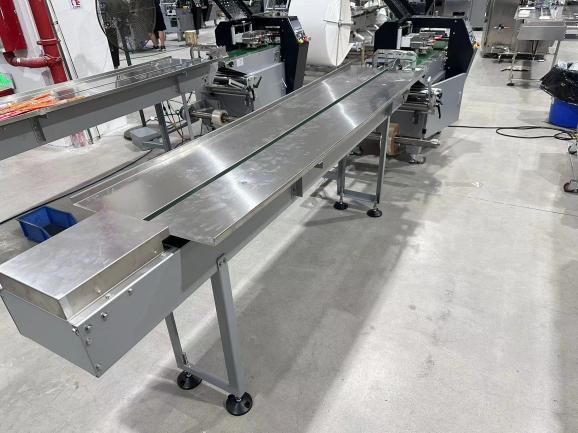
Snack packs are won and lost upstream of the wrapper. The most common cause of crushed product in a pillow bag is not the sealing jaw but the transfer from the weigher to the former, where a steep drop lets the product free-fall onto the crimp. The infeed was rebuilt with a short, angled timing bucket so the crackers arrive at the former in a controlled layer. The feeding and transfer geometry is visible on the machine in the line’s detail shots.
Humidity is handled in two places. First, the plant’s air-conditioning and dehumidification around the weighers and film shaft was specified, because film that absorbs moisture and snacks that absorb moisture are both bad inputs. Second, the gas flush was positioned so the headspace is replaced after the product is already in the tube, immediately before the end crimp closes, rather than flooding the whole forming area where the nitrogen simply escapes.
Downstream of the Wrapper: Detector, Checkweigher and Case Packing
A filled bag is not a finished unit until it has passed the inspection stations, and the layout after the discharge conveyor matters as much as the wrapper itself. The line was arranged so that bags leave the wrapper single-file, pass over a metal detector with an automatic reject arm, and then cross a checkweigher that flags any bag outside the target weight band. The two devices are deliberately kept separate; mounting a metal detector too close to the discharge flap creates a moving-metal signal that drives false rejects. Underweight bags are almost always a weigher-timing or upstream-feed problem, not a wrapper problem, so the checkweigher was connected to the same recipe system as the weigher, letting the operator see whether short weights track a particular product or a particular bucket.
After inspection the bags are collated and fed into the existing case-packing area. For the snack export business, bag orientation in the carton matters because the foil laminate must not be crushed at the carton corners during sea freight. A simple accumulation conveyor with a buffer was added so that a brief downstream stoppage does not force the wrapper to keep producing bags onto a stopped belt; the buffer also decouples the high-speed wrapper from the slower case-packing pace, which is the standard way to keep the most expensive machine on the line running continuously.
Training, Spare Parts and the First Month
The plant’s own maintenance team was trained on the handful of consumable parts that govern a pillow wrapper’s uptime: the sealing jaws and their Teflon-coated bands, the film cutter, the timing belts and the forming shoulder. Forming shoulders are not usually considered wear parts, but a dented or film-abraded shoulder drags the laminate and produces a visible score line that becomes a leak path, so the customer kept a spare former for the two most common bag widths. The HMI tracks jaw cycles and flags the service interval for the seal bands rather than waiting for the first burst bag. During the first three weeks the main adjustment was to the multihead-weigher bucket timing on the crispy pork SKU, which was shedding small pieces; once the fine bucket was slowed and the drop angle reduced, giveaway and reject rates both settled.
Export Requirements and the Payback Calculation
Because roughly half of the customer’s volume is exported to Singapore and the Gulf, the line had to satisfy more than the Thai domestic standard. The multihead weigher and the contact surfaces are food-grade stainless steel, the film and any inks were specified for the destination market’s food-contact requirements, and the metal detector was validated with a test-card routine that is recorded for every shift. Export customers also audit the weight-control system, so the checkweigher was set up to log both underweight and overweight rejects rather than only counting them; the weight log is the document that answers the first question in a buyer’s quality audit. The line is therefore specified as a production tool and a traceability system at the same time, which is often overlooked when a plant buys a wrapper only on speed.
The payback arithmetic was straightforward. The customer recovered the bulk of the investment from three line items: the labor saved by running one wrapper and one operator instead of two machines and three people, the film and product giveaway saved by closed-loop registration and weighing, and the soft but real reduction in customer returns and short-shelf-life claims. On a single-shift basis the project penciled out at roughly 18 months; on a two-shift export schedule it shortened to under a year. The most under-counted saving was the regained floor time: changeover at 8–12 minutes rather than 40 minutes effectively added several hours of weekly running capacity without adding a machine or a person.
Questions From the Factory Floor
When do I need a servo wrapper instead of a mechanical one?
Choose servo when you run multiple SKUs or bag lengths, use film that must register to a printed mark, flush with gas, or need to protect fragile products. A mechanical wrapper is cheaper up front but cannot hold registration and changeover at the same standard; once the line is above 60–80 bags per minute or changes film more than once a shift, the servo machine typically pays for itself in film and labor.
Does a faster wrapper automatically give me more output?
Only if the weigher, infeed and take-away can keep up. The wrapper is rarely the true bottleneck after automation. Matching the multihead weigher head count and bucket timing to the product is what turns a rated machine speed into a sustained line speed; this line’s 140 bpm is only achievable because the 18-head weigher and the timed infeed were specified together.
Rotary jaw or reciprocating jaw?
Rotary jaws run faster and suit small, consistent products like coated peanuts and candies. Reciprocating (box-motion) jaws move with the film for a longer dwell and suit large, soft or fragile products that a fast rotary jaw would crush. A machine that can be configured for either, as this line can, is the most flexible for a multi-SKU snack plant.
How much nitrogen does a pillow bag really need?
That is measured by residual oxygen, not by the sound of the gas. A well-controlled snack bag usually targets a residual O₂ level in the low single digits, and the target depends on how sensitive the product is and the required shelf life. The correct approach is to measure the headspace and tune the flush to a number rather than to “looks full.”
Planning a Snack or Pillow Line
For dry, solid, flow-wrapped products — snacks, baked goods, confectionery, instant noodles and small hardware — the line starts with the product’s fragility, target bag weight, film structure and shelf-life requirement, then the weigher, infeed and wrapper are matched as one system. That is a different machine family from wet products; if you also bottle sauces or beverages, the decision logic changes entirely, and our liquid filling machine buying guide on gravity, overflow, piston and flow-meter filling explains how to size that side of the plant. For bottled liquids the closure is sealed after filling, which is the subject of the inline induction cap sealing line SunAura commissioned for a Brazilian agrochemical producer. If you are expanding a snack line, send the SunAura Machinery team your bag sizes, weights, film and target throughput for a matched layout — request a quotation and layout proposal.