Net-Weight vs Volumetric Filling: How to Choose Between Load-Cell, Piston and Flow-Meter Filling
You have the container, the cap and a target output, and the filling-machine supplier asks the question that quietly decides your material cost for the next decade: do you want the machine to fill by weight or by volume? It sounds like a technical detail, but it is the single choice that governs how much product you give away, how often you fail a weights-and-measures check, and how badly a batch that came in slightly warmer or thicker than the last one drifts off target. This guide separates the two filling philosophies — net-weight gravimetric filling against volumetric filling in its piston, flow-meter, auger and timed-flow forms — where each one earns its keep, and where specifying the cheaper option is a decision you will pay for every shift.
At SunAura Machinery we configure liquid and solid filling lines across food, beverage, edible-oil, personal-care, agrochemical and household-chemical plants, and the honest starting point is that neither method is universally more accurate. A load cell is not magic, and a piston is not imprecise. Each assumes something different about your product. Gravimetric filling assumes mass is the quantity you actually sell and that density may move; volumetric filling assumes your product fills at a stable, repeatable density so that a fixed volume reliably equals the declared weight. Get that assumption right and the machine pays for itself; get it wrong and you either overfill expensive product into every container or underfill and risk the regulator.
The Core Difference: Weighing Mass Against Dispensing Volume
Net-weight or gravimetric filling puts the container, or a holding chamber, on a load cell and doses product until the measured mass reaches the target. The controller runs a fast bulk stage and then a slow dribble stage, shutting off as the scale approaches the set point so the in-flight product does not overshoot. Because the machine measures mass directly, the fill is unaffected by changes in density, temperature, viscosity, entrained air or foaming — a kilogram of honey is a kilogram whether the honey is cold and stiff or warm and runny. The trade-off is that weighing takes a finite settling time, load cells need a stable mechanical environment, and the equipment carries more instrumentation than a simple volumetric filler.
Volumetric filling instead meters a fixed volume and assumes that volume converts to the declared net content. The piston draws a set cylinder stroke and pushes that volume out; a flow meter counts the volume passing through the line and closes the valve at the target; an auger turns a fixed number of flights; a timed valve opens for a set interval against a constant pressure. These systems are mechanically simple, fast and highly repeatable shot to shot, and they cost less to buy and maintain. Their accuracy, however, is only as good as the stability of the product’s density. If the next batch is aerated, settled, concentrated or filled at a different temperature, the same volume now contains a different mass, and the drift shows up as giveaway or underfill rather than as an alarm.
Net-Weight Filling: Where the Load Cell Earns Its Cost
Gravimetric filling is the right default when the product is valuable, the density varies, or the cost of giveaway is the dominant number in the calculation. Cooking oils, premium sauces and pastes, honey and syrups, paints and coatings, agrochemical concentrates, detergents and bulk dry goods all fit the pattern: the raw material is expensive enough that even a fraction of a percent of overfill across millions of containers is a larger sum than the price premium of the load-cell machine. Industry estimates place well-tuned gravimetric fill accuracy in the region of roughly plus or minus 0.1 to 0.5 percent, and because the target is mass, the machine holds that tolerance even when a warm batch is less dense than the cold batch it followed.
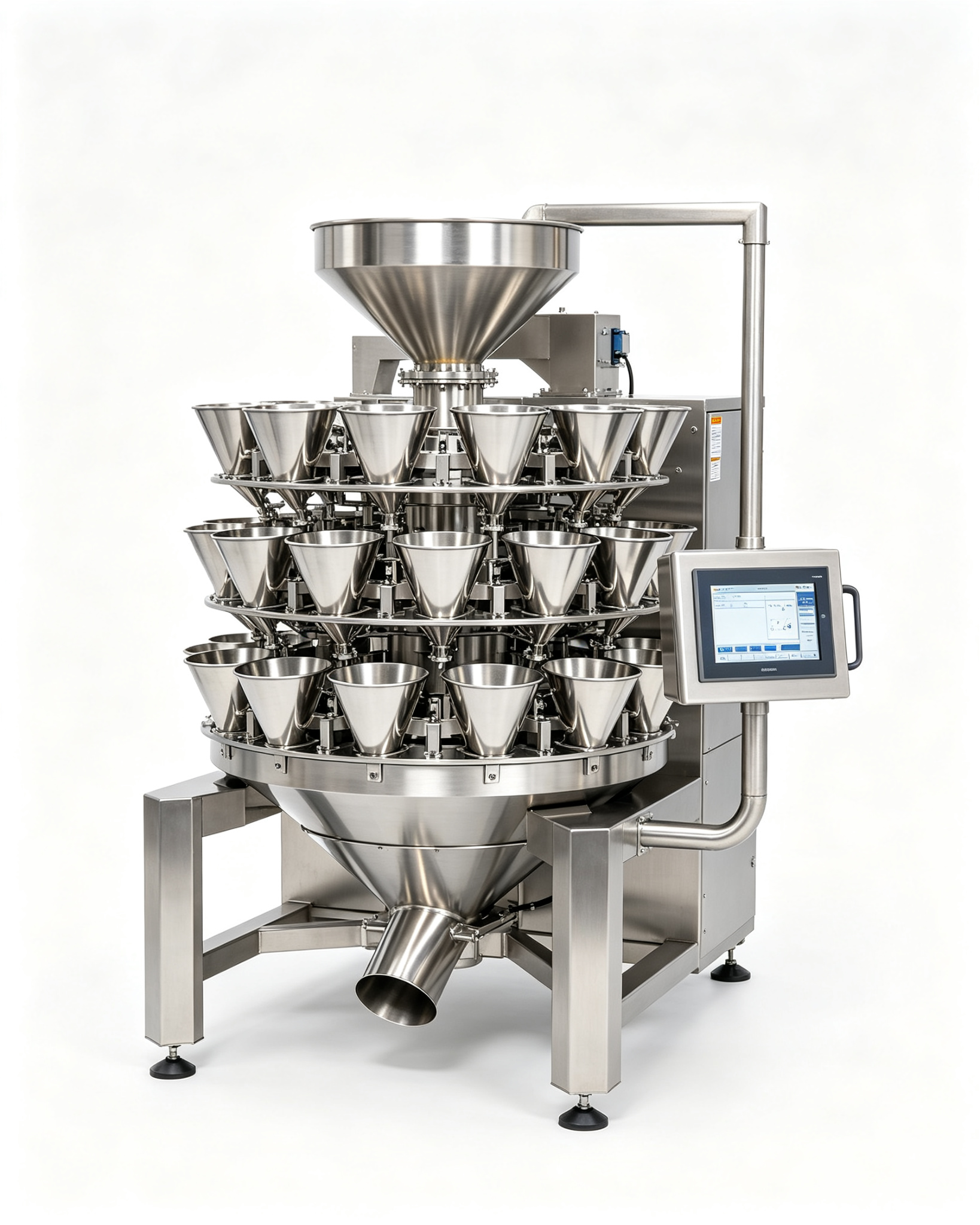
Net-weight systems also handle the products that defeat volumetric logic. Foaming liquids, chunky salsas where the ratio of solid to liquid varies, aerated creams and products that entrain air during filling all change density and volume unpredictably; a scale simply weighs whatever landed in the container. For solids, the same principle appears in multihead weighers, which combine a bank of independently weighed hoppers so the control system selects the combination that lands closest to the target, a method that copes with irregular, sticky or fragile pieces that no fixed cup could meter consistently. If your line runs large pails or drums, gravimetric filling is almost always specified because a single overfill on a 20-liter container is a large absolute loss and the slightly slower cycle is irrelevant at those sizes.
The discipline is in the installation. A load cell measures everything on the platform, including vibration from a nearby machine, air currents, a tugging fill hose or a bump from the conveyor, so gravimetric fillers need a rigid frame, flexible or decoupled connections, and a controlled settling window. Scales require scheduled calibration with traceable weights, and the bulk-to-dribble ratio has to be tuned per product so the machine is both accurate and fast. Specify gravimetric when the product economics justify it, but budget for the calibration routine and the mechanical environment it needs rather than treating the load cell as a fit-and-forget component.
Volumetric Filling: The Fast, Repeatable, Lower-Cost Family
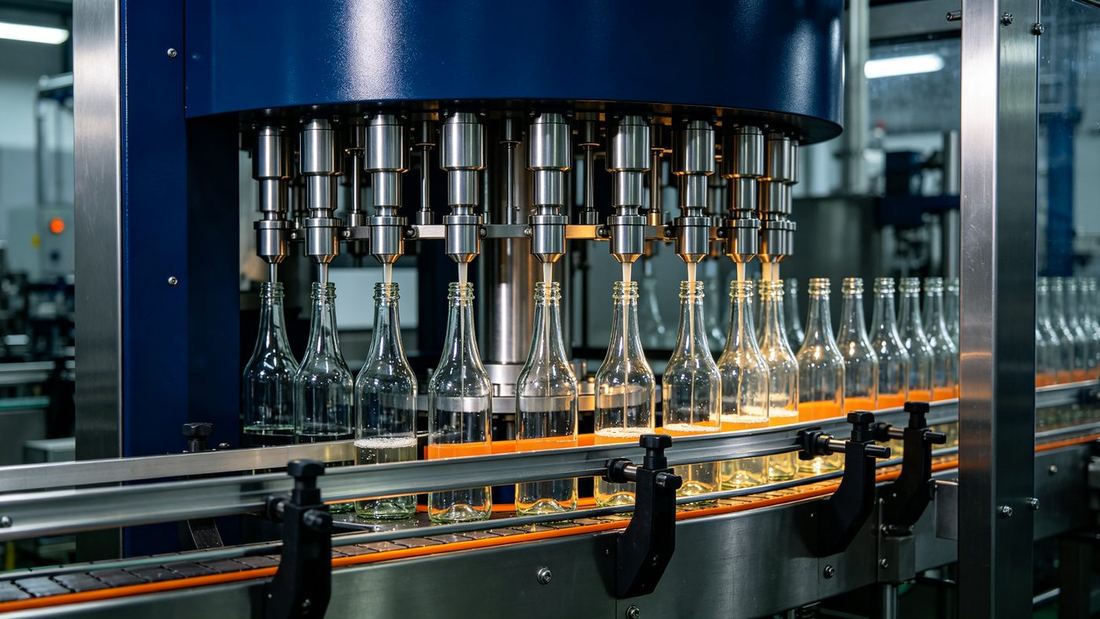
Volumetric filling is not a single technology but a family, and the choice inside the family is driven by product viscosity and behavior. The piston filler is the workhorse for viscous and semi-viscous products — pastes, sauces, creams, gels and products with soft particles — because the positive cylinder action handles thick material and gentle chunks while delivering a precise, repeatable volume on every stroke, and the closed chamber keeps drips controlled. A servo-driven piston lets the operator set the shot volume from the HMI and adjust draw and fill speed to handle flaky or chunky product without shearing it. For free-flowing, low-viscosity liquids, a flow-meter filler is cleaner and faster: a magnetic or mass-flow meter measures the moving stream with no mechanical chamber to fill and clean, which suits high-speed lines and frequent changeovers.
Gravity and overflow fillers cover the thin, foamy products where the visual fill level matters more than the exact volume — water, juices, light chemicals — with overflow filling holding every bottle to the same level even when the internal volumes of the containers vary slightly. Auger fillers handle powders and dry solids by metering a fixed number of screw flights, and cup or timed-flow systems provide the lowest-cost option for uniform, stable products. What all of these share is speed and simplicity: no weigh-and-settle pause, fewer electronic components, lower capital cost, and a shot that repeats tightly as long as the product density stays where it was when the machine was set. According to industry material, a stable volumetric line can hold shot repeatability tight enough that, on a single consistent product, it is indistinguishable from gravimetric in day-to-day use.
The vulnerability is always density drift. Liquids expand and contract with temperature, so a volume metered warm weighs less than the same volume cold; aerated product occupies more volume per kilogram; settling powders change their bulk density. The machine keeps dispensing the identical volume while the declared weight drifts, and because there is no mass measurement, the problem is invisible until a checkweigher or a regulator catches it. Volumetric filling therefore demands tight control of incoming product — temperature, aeration, batch consistency — and a downstream checkweigher to catch the drift rather than a blind trust in the fixed shot.
Selection Table: Gravimetric and Volumetric Filling Side by Side
| Dimension | Net-weight / load-cell filling | Piston volumetric | Flow-meter volumetric |
|---|---|---|---|
| Quantity measured | Mass directly on a load cell | Fixed cylinder volume | Volume counted in the stream |
| Estimated accuracy | Roughly ±0.1–0.5%; holds across density changes | Tight repeatability at stable density | Tight at stable density; no contact chamber |
| Relative speed | Moderate; needs weigh-and-settle time | Moderate to high; stroke per cycle | High; continuous metering |
| Relative price | Highest; load cells and controls | Mid; mechanical cylinder | Mid; meter and valve |
| Changeover difficulty | Recipe-based; recalibrate for new targets | Adjust stroke/volume; clean chamber | Set target on HMI; easy CIP |
| Best product fit | High-value, foamy, chunky, variable-density, bulk pails | Viscous pastes, sauces, creams, soft chunks | Free-flowing thin liquids, high-speed lines |
| Maintenance burden | Calibration, load-cell protection, controls | Seals, cylinder, valves | Meter calibration, valve service |
| Typical industries | Edible oil, honey, paints, agrochemicals, detergents | Food, cosmetics, personal care, condiments | Beverage, water, chemicals, pharmaceuticals |
When Not to Buy Each One
A trustworthy supplier will name the wrong-fit cases before the order is signed, and you should demand them. Do not buy a load-cell filler for a single, low-cost, free-flowing product with a rock-stable density and a very high line speed; you pay for instrumentation and accept a weigh-and-settle pause that the product does not need, and a flow-meter or overflow machine will run faster and cheaper for the same result. Do not put a gravimetric head on a vibrating, unstable platform or a layout where the fill hose tugs the scale and there is no room to decouple it; a load cell in a poor mechanical environment reads noise and can be less reliable than a simple volumetric shot. And do not specify gravimetric capacity you never use across every head of a multi-head line if only one or two products genuinely need it; weigh those heads and keep the rest volumetric to control the capital spend.
The reverse errors are equally expensive. Do not buy a piston or timed-flow volumetric filler for a high-value product whose density, temperature or aeration moves between batches, because the fixed volume will silently give away product or underfill with no alarm to warn you. Do not rely on a volumetric machine for foaming or chunky products where the entrained air and solid-to-liquid ratio change the mass per volume on every shot. And do not trust volumetric filling alone for legal metrology without a checkweigher downstream; if you sell by declared weight and meter by volume, you need an independent mass check to prove the conversion stayed valid as the product varied. In both directions, the mistake is choosing on machine price instead of on the giveaway cost and the realistic density stability of your actual process.
Cost, Giveaway and the Payback Math
The payback on a gravimetric filler is almost never about speed; it is about giveaway. Every filler is set above the declared net content to avoid underfill, and a volumetric machine with wider shot variation needs a larger safety margin to stay legal. When the product is expensive and the density drifts, that margin multiplied by annual containers is a substantial stream of product shipped for free. A load-cell machine tightens the variation because it measures mass, so the average fill can sit closer to the declared target, and the recovered overfill alone often clears the equipment premium in a period that is usually measured in months rather than years for high-value liquids. Run the calculation with your own numbers: annual containers, product cost per unit, and the realistic difference in average fill between the two methods.
For a low-cost, stable, high-volume product, the arithmetic flips. There is little giveaway to recover, the capital premium is harder to justify, and the volumetric machine’s speed and simplicity win. Remember also to cost the operating environment: gravimetric lines need calibration labor, a stable foundation and protection from vibration and air movement, while volumetric lines need a disciplined incoming-product temperature and density regime plus a checkweigher. The full comparison is total cost of ownership — machine price, giveaway, calibration, scrap and downtime — not the figure on the quotation. For a complete line, the filling method has to be specified together with the downstream automatic bottle capping machine and the integrated edible-oil filling, capping and labeling line, because the dosing tolerance only holds if the containers and closures that follow are handled consistently.
Frequently Asked Questions
Is net-weight filling always more accurate than volumetric?
Not automatically. On a single product with a stable, controlled density and temperature, a well-tuned piston or flow-meter filler repeats shot to shot as tightly as a scale. The gravimetric advantage appears when density, temperature, aeration or viscosity varies, because the load cell measures mass and ignores those changes while a volumetric machine drifts. Accuracy is a property of the whole installation, not the measuring principle alone.
Will a load-cell filler slow my high-speed line?
There is a weigh-and-settle step that a pure volumetric meter does not have, but modern controllers use bulk-and-dribble dosing and fast load-cell sampling to keep the cycle short. The penalty is usually small on moderate lines and irrelevant on large pails and drums. At very high speeds on thin, stable liquids, a flow-meter or overflow machine is still the faster choice, which is why high-speed water and beverage lines tend to stay volumetric.
Can I switch a product line from volumetric to gravimetric later?
Sometimes, depending on the frame. Some filling platforms accept both dosing modules, so a volumetric head can be replaced with a load-cell station if the product mix changes, but the frame, conveyor and control system have to be designed for it from the start. If you anticipate moving to high-value or variable-density products, specify a convertible frame up front rather than assuming a retrofit will be cheap or clean.
How do I stay legal if I fill by volume but sell by weight?
Control the variables that change density — temperature, aeration, batch consistency — and install a checkweigher downstream so every container is independently verified against the declared mass. Treat the volumetric fill as the dosing method and the checkweigher as the compliance gate, with rejection of any container below the legal target. Without that independent mass check, density drift is invisible until it becomes a regulatory failure.
Summary: Match the Measuring Principle to the Product Economics
The decision is clearer than the brochures make it sound. Choose net-weight load-cell filling when the product is high-value, the density or temperature moves, the product foams or carries variable chunks, or you fill large containers where giveaway is expensive; the scale measures mass directly and holds tolerance across the variation that volumetric machines cannot see. Choose piston volumetric for viscous pastes and creams at stable density, and flow-meter volumetric for fast, free-flowing thin liquids where consistency is tight and speed matters. When the product is cheap and stable, the volumetric machine is the lower-cost, faster buy; when the product is valuable and variable, the gravimetric premium is recovered through reduced giveaway. The practical starting point is the full range of liquid filling machines and, for solid and irregular pieces, the precision of multihead weighing and dosing equipment.
The filling method also sits inside a wider packaging decision. If your product is going into flexible bags rather than rigid bottles, our companion guide explains how to choose between pillow bags, stand-up pouches and quad-seal formats, and if protecting the container after filling is the priority, see how to choose between induction seals, pressure-sensitive liners and shrink bands. If you want the dosing method selected against your real product cost, density data and line speed rather than a generic recommendation, send us your pack list and a sample of the worst-case batch and we will run the giveaway calculation, confirm the tolerance and quote the configuration — contact SunAura Machinery to start the review.