


September 30, 2026 | by Frank, SunAura Machinery Service Engineering
A packaging line doesn’t fail on day one. It fails gradually — a seal that’s slightly too cold, a chain that hasn’t been lubed in six months, a sensor that’s drifted out of alignment — until one shift everything stops at once. The cost of that one stoppage is almost always higher than the cost of the maintenance that would have prevented it. Industry benchmarks put the average food plant’s unplanned downtime at 5–10% of production time, and for packaging lines the number climbs to 15–20% in plants with no formal preventive maintenance (PM) program.
After commissioning and servicing more than 200 packaging lines across 60+ countries, we’ve boiled the maintenance schedule down to the tasks that actually matter. This is the checklist we hand to every new customer during operator training.
The Three Maintenance Frequencies
We organize PM into three tiers. Daily tasks take 10–15 minutes and are done by the line operator at shift change. Weekly tasks take 30–60 minutes and are done by a designated maintenance technician. Quarterly tasks take 4–8 hours and are scheduled during a planned production window.
| Frequency | Who | Time Investment | Goal |
|---|---|---|---|
| Daily (every shift) | Line operator | 10–15 min | Clean, inspect, catch obvious issues |
| Weekly | Maintenance technician | 30–60 min | Lube, check sensors, review alarms |
| Quarterly | Maintenance + SunAura remote | 4–8 hours | Deep inspection, belt wear, calibration |
Daily Tasks (Every Shift)
1. Clean the sealing jaws and film path
On any flow wrapper or vacuum sealer, melted film residue builds up on the sealing jaws within a few hours of production. This residue causes weak seals, inconsistent crimp patterns, and eventually burnt film that smokes. Wipe the jaws with a brass brush (never steel wool — it scratches the Teflon coating) while the machine is warm but off.
2. Check the HMI alarm log
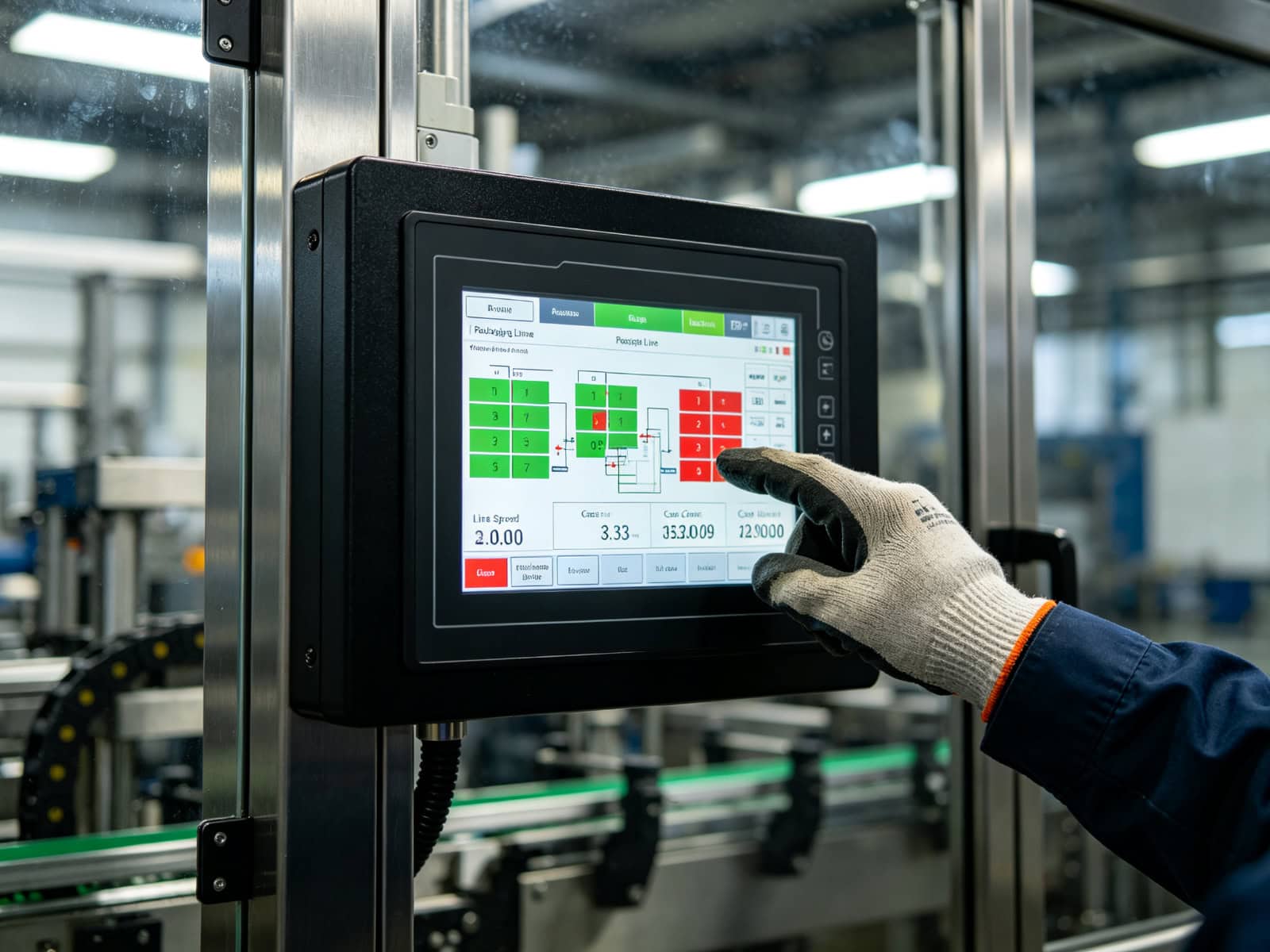
The HMI records every minor fault — a momentary sensor block, a low-pressure warning, a film-end alert — even when production didn’t stop. Spend two minutes scrolling the alarm history. A fault that repeats three or four times a shift is a warning sign. This is the single highest-return task on the list.
3. Inspect seal quality on the first five packs
Pull five packs off the line at start-up and cut them open. The seal should be uniform, about 8–10 mm wide, with no gaps or wrinkling. If the first five look good, the rest of the shift usually will too. If they don’t, adjust jaw temperature or pressure before running a full batch.
Weekly Tasks
4. Lubricate chains, bearings and linear guides
Conveyor chains, machine slide rails and palletizer bearings all need scheduled lubrication. Use the grease specified in the manual — mixing greases with different thickeners causes them to break down. A common failure we see: plants over-lubricate (grease attracts dust, which is worse than no grease) or under-lubricate (bearings seize). Two shots of the right grease per chain per week is usually right.
5. Check and tighten conveyor belts and timing belts
A loose belt drifts off-center and causes product jams. Press on the belt mid-span — it should deflect about 10–15 mm under firm thumb pressure. On servo-driven machines, check timing belt tension with the gauge in the maintenance manual; too tight and the bearings wear out prematurely.
6. Verify sensor alignment
Photoelectric sensors that detect product presence, film registration mark and case flap position drift out of alignment over time as machines vibrate. Test each sensor by placing a test product in front of it and confirming the HMI shows a signal. Clean the lens with a dry microfiber cloth — compressed air can drive dust into the lens housing.
7. Check pneumatic air pressure and filters
Most packaging machines run on 6–8 bar compressed air. Check the regulator gauge weekly and drain the water trap at the bottom of the filter. Moisture in the air line causes solenoid valves to stick — one of the top three causes of unplanned downtime we see in the field. If your compressor is more than 50 meters away, install a second filter regulator at the machine end.
Quarterly Tasks
8. Inspect and replace sealing wires and Teflon cloth
The PTFE cloth covering the sealing jaws on a flow wrapper has a life of roughly 200–500 hours of production. When it starts to discolor or tear, replace it — don’t wait for it to burn through. Sealing wires (the thin Nichrome elements) stretch and weaken over time; keep two spares on the shelf. Changing these is a 30-minute job that prevents a 4-hour unplanned stoppage.
9. Examine drive belts and gearboxes for wear
On strapping machines, case erectors and shrink tunnels, the drive belts and gearboxes take the most load. Inspect for cracks, glazing on the belt surface, and unusual noise when running. If a gearbox makes a whining noise that rises with speed, plan a replacement before it seizes.
10. Calibrate load cells and checkweighers
Multihead weighers and checkweighers drift by 1–2% per quarter due to temperature changes and mechanical stress. Run the calibration test with the test weights supplied with the machine. If you don’t have test weights, weigh 20 packs on a calibrated bench scale and compare to the machine reading.
11. Inspect electrical connections and fans
Open the electrical cabinet and check for loose terminal screws, burnt wires and dust buildup. Vacuum (never blow out) the interior — compressed air drives dust deeper into contactors. Check that cabinet cooling fans are running. A failed fan in a sealed cabinet can trip the PLC on a hot afternoon.
12. Review the spare parts inventory
Every line should have a minimum spare stock: sealing wires, Teflon cloth, drive belts, photo eyes, solenoid valves, and a backup PCB for the HMI. We see plants that wait until a part fails to order it — then wait two weeks for international shipping. Keep the critical spares on the shelf. Our after-sales service team provides a recommended spare parts list with every machine.
Need help building a PM schedule for your line? SunAura provides a customized maintenance checklist with every turnkey installation, plus remote diagnostics that flag component wear before it becomes a stoppage. If you’re specifying a new line or retrofitting an existing one, send us your equipment list through the contact page and we’ll recommend the right PM interval. Browse our full range of packaging equipment and integrated lines to see what’s covered under each service plan.
The bottom line: a well-run PM program costs about 2–3% of the equipment’s purchase price annually — and it cuts unplanned downtime by 60–80% in the first year. The plants that treat maintenance as a cost center are the ones we see standing still at 2 a.m. on a Saturday, trying to find a spare solenoid valve.