Top-Film vs Bottom-Film (Inverted) Flow Wrappers: Choosing Film Orientation by Product Rigidity, Speed and Seal Position
A horizontal flow wrapper is specified by its speed, web width and jaw size, and one detail that looks mechanical rather than commercial is where the film roll sits. On a conventional machine the roll is mounted above the infeed and the product is pushed into the wrapping section by a flighted chain, with the longitudinal seal formed underneath. On an inverted machine the roll is mounted below, the product is placed onto the film itself and carried into the wrapping section without being pushed, and the seal is formed on top. That change in orientation decides which products run cleanly, how fast the line can go, where the seal sits on the finished pack and how much handling damage the product suffers. Buyers who treat the two as the same machine with a different roll position end up with jams, sticky messes and broken pieces. This guide compares top-film and bottom-film flow wrappers, where each earns its place, and why the product rather than the price should make the choice.
At SunAura Machinery we build horizontal pillow and flow-wrapping lines in both orientations, and the honest framing is that the film position is fixed by the product’s handling characteristics. A rigid, regular item that can be pushed along a bed at high speed is a top-film job. A soft, sticky, fragile or irregular item that cannot tolerate being pushed, or that sticks to the bed, is a bottom-film job. The rest of this guide works through how the two arrangements actually move a product, where the seal and the trade-offs land, and how to avoid buying a fast machine that your product cannot run on.
How Film Orientation Changes the Way a Product Moves
Both machines take a flat web, form it into a tube around the product, run a longitudinal seal along the overlap and then close the ends with rotating end-seal jaws. The difference is the geometry that gets the product into that tube. On a top-film machine the web is fed from above and formed around the product as it is pushed forward by the lugs, or flights, of a chain conveyor; the product itself is driven mechanically into the wrapping section, and the film wraps over and under it, with the longitudinal seal ending up on the bottom where it is hidden from the shelf-facing side. On an inverted machine the web is fed from below and the product is simply placed onto the moving film, which carries it into the forming section; there are no push lugs in contact with the product, the film wraps up and around it, and the longitudinal seal ends up on the top.
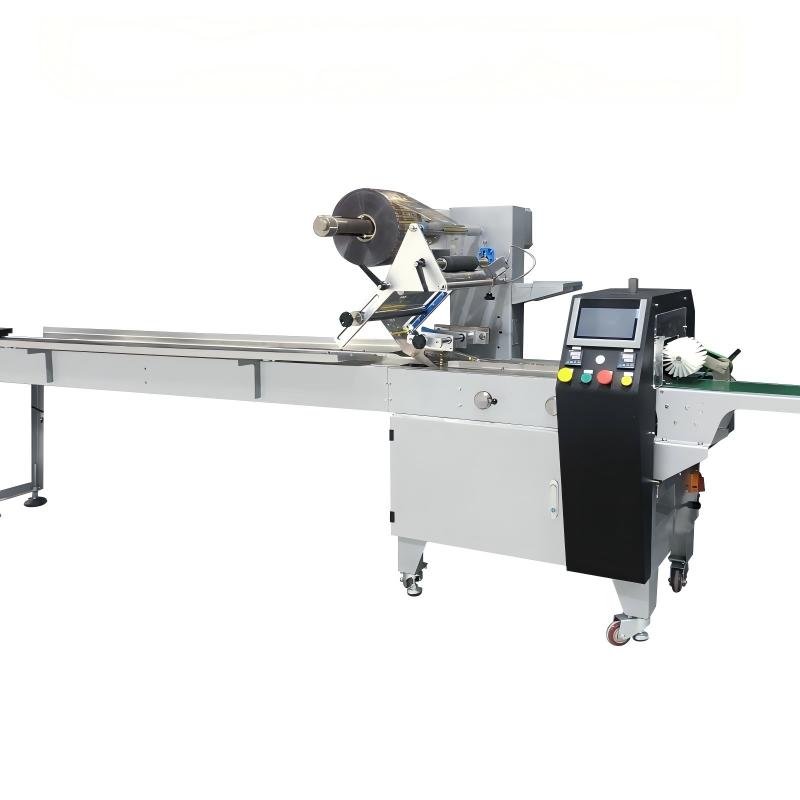
Top-Film Flow Wrapping: High Speed for Rigid, Regular Products
The top-film arrangement is the default for a reason, and its strength is the mechanical certainty of the push. Because the flighted chain controls each product and drives it into the wrapping section at a fixed pitch, the machine can run at high speed with precise timing between the product and the end-seal jaws, and the bottom seal keeps the overlap hidden on the underside so the retail-facing top stays clean. This is the family for rigid and regular items that can be pushed along a bed without damage: biscuits and cookies in trays, chocolate bars, baked goods, bread and buns, instant noodles, solid confectionery, hardware and household items, soap bars and the broad run of products that hold their shape and present a consistent footprint. The high-speed servo versions tighten the timing further and can run a long, steady shift with minimal handling loss.
The boundaries are set by what the push and the bed do to a difficult product. A soft item can be deformed or crushed by the lugs, a fragile item can chip or break, and a sticky or tacky product can adhere to the infeed bed or the chain rather than moving cleanly, which causes jams and a cleaning burden. Irregular or unstable items can also shift out of pitch as they are pushed, so the end-seal jaws catch them at the wrong moment. The bottom seal is an advantage for shelf presentation but means the machine is built around the over-and-under film path, and a product that cannot be pushed will not be rescued by running the same machine more slowly. For those products the orientation itself has to change.
Bottom-Film Inverted Wrapping: Gentle Handling for Soft, Sticky and Fragile Products
The inverted arrangement removes the push that causes the damage. Because the product rests on the film and is carried rather than driven, nothing mechanical shoves it into the wrapping section, and the web supports the product from underneath as it forms up and around it. There is no hard bed for a sticky product to cling to, and soft, fragile or irregular items keep their shape because they are not being pushed or compressed. The longitudinal seal is formed on the top, which also makes the seam accessible and easy to inspect on products where the seal is a quality point. This is the family for soft bakery and fresh products, sticky or glazed items, fragile goods that chip under pressure, wet or lubricated products, and irregular or multi-piece items that cannot be held at a fixed pitch by lugs.
The trade-off is speed and the visible seal. Inverted machines generally run at a slightly lower output than the fastest top-film lines, because the product is carried on the film rather than positively driven and the timing has to accommodate items that are not held to a rigid pitch. The top seal is also visible on the shelf-facing side, which is either an advantage for inspection or a presentation consideration depending on the product. The benefit is fewer jams, less product damage and a cleaner, easier-to-clean handling path for products that would otherwise fight the machine. The inverted layout is over-specified for a rigid, regular item that could run faster on a conventional top-film line, where the slower cycle and the visible top seal add nothing.

The choice sits inside the wider pillow-packaging range and is closely tied to how the product is fed. The pillow packaging machines cover both orientations, and the upper-film flow wrapper is the conventional top-film configuration for rigid, regular items, while the high-speed servo pillow wrapper shows the throughput that positive flighted timing can reach. Where the product is weighed before it reaches the wrapper, the multihead weighers portion fragile and irregular items accurately so the infeed presents them consistently.

Selection Table: Top-Film vs Bottom-Film Flow Wrappers
| Dimension | Top-film (conventional) | Bottom-film (inverted) |
|---|---|---|
| Film roll position | Above the infeed | Below the infeed |
| Product movement | Pushed by flighted lugs | Carried on the film |
| Longitudinal seal | Bottom, hidden | Top, visible |
| Speed | Highest, fixed pitch | Slightly lower, gentle timing |
| Product support | Hard bed and chain | Film supports the product |
| Jamming risk | Higher for soft or sticky | Lower, no push contact |
| Changeover | Standard film path | Inverted film path |
| Maintenance cost | Moderate, chain and lugs | Moderate, film-driven path |
| Price range | Lower to mid | Mid, inverted handling |
| Retail presentation | Clean top, seam hidden | Seam on top, inspectable |
| Typical products | Bars, biscuits, bread, hardware | Soft, sticky, fragile, irregular |
| Typical industries | Bakery, confectionery, goods | Fresh food, glazed, multi-piece |
When Not to Choose Each Orientation
Do not rely on a top-film machine for a soft, sticky, fragile or irregular product, because the flighted push will deform or break it, the sticky surface will cling to the bed and cause jams, and running the same machine slower does not remove the contact that causes the damage. Do not pay for an inverted machine for a rigid, regular item that could run faster on a conventional line, because the slower cycle and the visible top seal add cost without changing a pack the top-film machine already makes well. Do not treat the seal position as purely cosmetic, since the top seam on an inverted machine is also an inspection point and a real factor for some products. Do not assume the film orientation can be switched on a running line, because the roll mount, forming path, product handling and seal station are built around one geometry. Finally, do not choose the orientation in isolation from the infeed: an irregular product still needs consistent presentation, and the feeding and weighing upstream have to be specified together with the wrapper.
Cost, Downtime and the Real Throughput Logic
The headline speed on a brochure is not the number that matters, and the comparison should be framed around the good packs the line actually produces in a shift. A fast top-film machine running a product that jams, sticks or breaks loses its advantage to stoppages, cleaning and rejected packs, so the effective output can fall below a slower inverted line that runs the same difficult product continuously. The inverted machine carries a somewhat higher build cost for the lower film path and the carrying arrangement, and a lower nominal speed, but it earns the difference on handling loss and downtime for the products that need it. The practical risk is buying on the highest rated speed and discovering the product cannot be pushed at all, which is more expensive than matching the orientation to the product at the start. Ask for a running trial on the actual product, and measure good packs rather than the jaw cycles, because the two numbers are not the same.
Film and sealing details deserve the same scrutiny. The longitudinal overlap has to be held at a consistent width regardless of whether it lands on the top or bottom, and the end-seal timing has to clear the product so the jaws never cut into it. On inverted lines the film is doing the carrying, so the web tension and the forming box matter more, while on top-film lines the flighted chain and the infeed pitch are the critical settings. A supplier that can explain the seal position, the carrying path and the realistic good-pack output for the specific product, and that will demonstrate it on real material, is showing the engineering support that separates a reliable line from one that only runs at ideal conditions.
How This Connects to the Rest of the Line
The wrapper is one step in a sequence, and matching it to the upstream and downstream equipment avoids a capable machine running empty or jammed. Where the product is a rigid tray rather than a flexible-wrapped item, the upstream forming choice is covered in the guide to thin-gauge versus heavy-gauge thermoforming. Where the product has to be portioned accurately before wrapping, especially fragile or irregular items, the weighing decision is set out in the comparison of a linear weigher versus a multihead weigher. Keeping the order straight, product handling first, then orientation, then weighing and feeding, prevents the common error of buying the fastest wrapper the product cannot use.
Frequently Asked Questions
What is the difference between a top-film and a bottom-film flow wrapper?
A top-film machine mounts the roll above, pushes the product with flighted lugs and seals underneath, while a bottom-film inverted machine mounts the roll below, carries the product on the film without pushing and seals on top. The choice is set by whether the product can tolerate being pushed at high speed.
Which orientation is better for sticky or fragile products?
An inverted bottom-film machine is the better fit because the product rests on the film and is carried rather than pushed, so there is no hard bed to stick to and no lug to deform or break it. The trade is a slightly lower speed and a visible top seal.
Are inverted flow wrappers slower?
Their nominal speed is generally a little below the fastest top-film lines, but the meaningful measure is good packs per shift. On a product that jams or breaks on a conventional machine, an inverted line can deliver more usable output by running continuously with fewer stoppages.
Can a machine be switched between top and bottom film?
The roll mount, forming path, handling and seal station are built around one geometry, so the orientation is specified at order time rather than changed on a running line. The reliable approach is to run the actual product and confirm the orientation and good-pack output before purchase.
Sources and Further Reading
The handling and seal-position descriptions draw on published supplier and packaging guidance comparing top-film and bottom-film horizontal flow wrappers, including Soontrue’s comparison of the two film orientations and its guide to choosing a horizontal flow packing machine, alongside the Zonesun and Keypack overviews of pillow-pack film feeding and the differences between upper and lower film machines. The speed and handling points are presented as supplier and industry observations rather than universal guarantees, and the correct output for any application should be confirmed on the actual product.
Conclusion: Let the Product Set the Film Orientation
The decision is clear once the product’s handling is described honestly. If the item is rigid and regular, holds its shape and can be pushed along a bed at high speed, a conventional top-film wrapper with a hidden bottom seal gives the highest output and the cleanest shelf face. If the item is soft, sticky, fragile or irregular, cannot be pushed without damage or sticks to the bed, an inverted bottom-film wrapper carries it on the film with fewer jams and less handling loss, accepting a slightly lower speed and a visible top seal. Match the orientation to the product, measure good packs rather than rated speed, and specify the feeding and weighing together with the wrapper. To confirm the film orientation, seal position and realistic output for your product, contact SunAura Machinery and we will run the selection against the actual item.