Why a Ready-Meal Producer Chose Servo-Driven Thermoforming Over a Pneumatic Machine
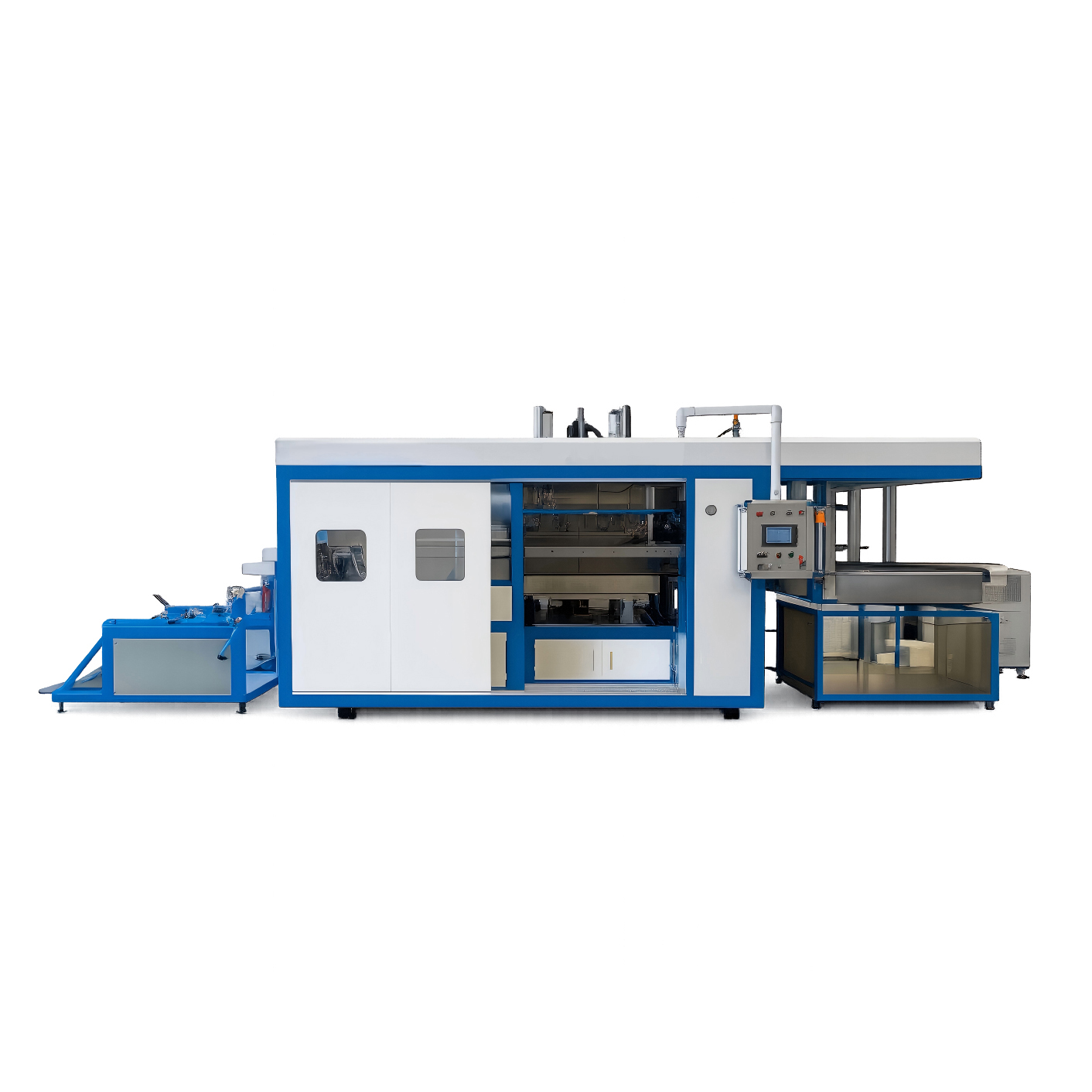
A thermoforming machine is a ten-year commitment. It sits at the heart of a roll-fed packaging line, forming and sealing trays or cups around the clock, and the drive system that moves its platens and indexes its film quietly determines how much energy the line burns, how much scrap it produces, and how stable the process stays as the day wears on. When a ready-meal producer asked SunAura Machinery to help specify a new high-utilization line, the pivotal choice was between the familiar pneumatic machine that had defined the category for decades and a fully servo-driven alternative. The two are often presented as a simple price-versus-feature decision, but the real distinction is in repeatability, cycle control, and where the energy on a thermoforming line actually goes. This article turns the project into a selection lesson: how the drives differ, what the data supports, and why the customer’s high-volume, multi-shift profile made servo the defensible choice rather than an automatic one.
The same reasoning applies to any roll-fed or sheet-fed thermoforming investment in food, medical, or consumer packaging, and it matters most when the line runs hard enough that small per-cycle differences compound into large annual numbers.
What the Production Profile Demanded
The customer ran multiple shifts producing sealed ready-meal trays in a range of materials, including recycled and more temperature-sensitive resins. The line was expected to hold tight forming and indexing tolerances across long runs, keep scrap low as film and ambient conditions varied, and switch between products without sacrificing the morning’s stability by the afternoon. Three factors therefore drove the decision: precise and repeatable motion rather than speed alone, energy consumption across a high-duty-cycle operation, and the ability to run sustainable materials whose forming windows are narrower than traditional polymers. The drive choice had to be judged against all three, not against a single headline cycles-per-minute figure.
The Pneumatic Machine: Simple, Proven, and Compromised
Pneumatic thermoforming machines use compressed air to drive platen movement through cylinders. The architecture is mechanically simple and well understood, the upfront cost is lower, and for straightforward products with forgiving tolerances and modest duty cycles it is entirely capable. It remains a sensible entry point for smaller operations and simple containers where the quality bar is lenient and the budget is tight. The weaknesses follow directly from the physics of compressed air. Air is compressible, so motion is sensitive to pressure fluctuations; cylinders move in a characteristic “bang-bang” stroke rather than a controlled profile, and the resulting mechanical oscillation has to settle before the next operation. Positioning is therefore less precise and less repeatable, typically on the order of several tenths of a millimetre, and the system depends on a compressor running continuously, with leaks and inefficient duty adding to the energy bill over time.
Those small variations add up. Even a fraction of a millimetre of error in film indexing, repeated over thousands of cycles, becomes material waste and misaligned trim. Pressure fluctuations can produce uneven wall thickness and webbing, and minor instability can ruin batches rather than isolated parts. Maintenance also sits with the compressor, hoses, and valves, which require regular attention and replacement. None of this makes pneumatics obsolete; it defines the boundary where they stop being the lower-cost option once utilization and precision requirements rise.
The Servo-Driven Machine: Controlled Motion and Energy Recovery
A servo-driven machine replaces the air cylinders with electric servo motors controlling the machine’s motions, including platen movement and film indexing. Motion is programmable, so instead of a hard bang-bang stroke the platen follows a smooth S-curve profile, accelerating and decelerating under closed-loop control with positioning repeatability reported around ±0.05 millimetres. The motors draw power when they move rather than relying on a constantly pressurized system, and modern drives add energy recovery: braking energy from one axis is fed back to other drives, other consumers on the line, or even the heating system, recapturing a share of the drive energy that would otherwise be lost.
The benefits cascade into the product. Precise indexing keeps film and trim aligned over long runs, smooth motion reduces vibration and extends mold life, and the machine does not wait for mechanical oscillation to settle, which shortens the cycle. Consistent, repeatable forming produces uniform wall thickness and tighter webbing, so less plastic is used per part and scrap falls. Industry technical material commonly reports servo systems using roughly 30 to 35 percent less energy, running 50 to 60 percent faster cycles, and cutting scrap by 30 percent or more against pneumatic equipment, with the higher upfront cost — typically 30 to 50 percent more — recovered through energy, output, and waste savings within a payback window often quoted around 12 to 18 months in high-duty settings. These are typical ranges, not guarantees, and should be validated against the specific application.
A Note on Vacuum and Pressure Forming
The drive question is separate from, but related to, how the part is formed. Vacuum forming pulls the heated sheet onto the mold using negative pressure and is well suited to simpler shapes and shallower draws. Pressure forming introduces compressed air above the sheet for sharper detail, finer features, and tighter tolerances. A servo-driven machine can run either process with tighter control, and the choice between them should follow the product’s geometry and detail requirements rather than being assumed from the drive. Specifying the drive and the forming method together avoids discovering late that a high-detail part needs pressure forming that the quoted configuration does not deliver.
Selection Table: Servo and Pneumatic Drives Compared
| Dimension | Pneumatic thermoforming | Servo-driven thermoforming |
|---|---|---|
| Cycle speed | Steady but slower; motion must settle | Faster cycles, commonly 50–60% quicker in reported ranges |
| Positioning precision | Around several tenths of a millimetre | Repeatable around ±0.05 mm |
| Relative price | Lower upfront | Roughly 30–50% higher upfront |
| Changeover / recipe | Mechanical adjustment; stored recipes limited | Software recipes and controlled profiles ease switching |
| Energy use | Continuous compressor; leaks and duty losses | Power on demand plus energy recovery; ~30–35% lower in reported ranges |
| Maintenance cost | Compressor, hoses, valves need regular work | Fewer wearing parts; focus on drives and software |
| Scrap / material | Higher scrap from pressure and index variation | Scrap reduced by 30%+; tighter webbing uses less plastic |
| Typical industry fit | Simple containers, low-volume, budget-constrained | High-volume multi-shift food, medical, sustainable resins |
Why the Customer Chose Servo
Again, the decision was not that pneumatics are bad equipment. It was that the customer’s utilization made the per-cycle advantages of servo decisive. Across multiple shifts, the energy difference and the reduced scrap became large annual figures rather than marginal percentages, and the precise index and platen control held the process stable through long runs and narrower forming windows on recycled resins. The smooth S-curve motion also reduced vibration and mold wear, which protects tooling over the life of the line. When the supplier modeled the higher upfront cost against the recurring savings in energy, scrap, and avoided downtime, the premium was recovered within the kind of payback window the industry reports for high-duty operation, after which the advantages continued to accrue.
The key was that the line actually ran hard enough to realize those savings. A machine that sits idle for much of the day cannot pay back an energy and efficiency premium, and the customer’s high OEE was precisely what made the servo case close. That is the lens to keep on every drive comparison: the savings are real but only materialize at the duty cycle that uses them.
Where Pneumatic Still Makes Sense
For a smaller producer, a startup, or a line making simple, forgiving containers at lower volume and single shift, the pneumatic machine is the honest economic choice. Its lower upfront cost protects scarce capital, and its capability is sufficient where tolerances are lenient and the quality bar is modest. The higher ongoing energy and maintenance costs have to be factored in, but they may never grow large enough at low utilization to justify the servo premium. Choosing servo in that setting would be spending for efficiency the line will not consume.
When Not to Buy the Servo Machine
Do not buy servo purely because it is the newer technology if your line runs simple products at low utilization; the premium will not find the recurring savings to pay it back. Do not treat the quoted percentages as guaranteed — energy, cycle, and scrap figures depend on the machine, material, and settings, and they should be demonstrated for your application rather than assumed. Do not overlook the rest of the energy balance: the drives are only one part of total consumption, and on many thermoforming lines the heaters and the compressed air used for forming itself are larger consumers than the motion drives, so a servo upgrade does not eliminate those. And do not specify the drive in isolation from station configuration, thermal zone control, and the vacuum-versus-pressure method the product needs.
Cost, Payback, and Procurement Risk
The financial case rests on compounding. The servo premium is paid once; the energy, scrap, and downtime savings recur on every cycle, which is why high duty cycles close the payback and low ones do not. Industry analysis also notes that energy is typically a small percentage of an individual product’s cost yet amounts to substantial annual expenditure per shift, and that a meaningful reduction in energy consumption can translate into a productivity gain of several percent when products are calculated on tight margins. That framing is useful in procurement: do not evaluate the drive on the purchase price alone, and do not evaluate it on energy alone either. Build the model from energy, scrap, output, mold life, and maintenance against the real planned utilization.
On the RFQ, ask for the energy and scrap figures demonstrated on a comparable material and duty cycle, not a generic best case. State the resins you intend to run, including recycled and bio-based materials, and ask how the heating zones and index control handle their narrower windows. Confirm the station configuration, the forming method, and the lead time, and ask for standardized, locally serviceable components. A supplier who ties the numbers to your utilization and materials is building a credible case; one who quotes a universal payback without them is selling optimism.
These drive decisions sit within the wider line. The same precision and integration logic applies to the thermoforming machines at the core of the project, the packaging lines they form part of, and the liquid filling machines that often precede the sealing stage in a coordinated ready-meal or cup line.
Frequently Asked Questions
How much energy does a servo thermoformer save?
Industry technical material commonly reports around 30 to 35 percent lower energy use than pneumatic drives, because the motors draw power on demand and can recover braking energy. The actual figure depends on the machine, material, and duty cycle and should be validated for your application.
Is servo worth the higher upfront cost?
At high, multi-shift utilization, yes: the recurring energy, scrap, and output savings typically recover the premium within a payback window often quoted around 12 to 18 months. At low utilization on simple products, the premium is unlikely to pay back and pneumatics remain the rational choice.
Does servo reduce scrap?
Reported ranges put scrap reduction at 30 percent or more, because precise indexing and repeatable platen motion keep film and trim aligned and produce uniform wall thickness and tighter webbing. Pressure and index variation on pneumatic machines is the main source of the avoidable waste.
What is the difference between vacuum and pressure forming?
Vacuum forming uses negative pressure to pull the sheet onto the mold for simpler shapes, while pressure forming adds compressed air above the sheet for sharper detail and tighter tolerances. A servo machine can control either process; the method should follow the product’s geometry.
Are the drives the biggest energy consumer on the line?
No. The motion drives typically account for only a portion of total thermoforming energy, with the heaters and the compressed air used for forming often consuming more. Servo control is a meaningful saving, but it should be considered alongside thermal and forming-air efficiency rather than treated as the whole energy picture.
Conclusion: Let the Duty Cycle Decide the Drive
Servo and pneumatic thermoforming are both legitimate, and neither is universally superior. Choose pneumatic for simple, forgiving products at lower utilization where its lower upfront cost protects capital and its capability is sufficient. Choose servo for high-volume, multi-shift production, tighter tolerances, and sustainable resins whose forming windows demand precise, repeatable, energy-recovering motion — and build the case from demonstrated energy, scrap, output, and maintenance figures against your real planned utilization. The ready-meal producer chose servo because the line ran hard enough to compound every per-cycle advantage into a recovered premium, and that duty-cycle test is the correct decision rule for every thermoforming drive purchase.
Evaluating a thermoforming line and need an honest drive recommendation tied to your materials and utilization? Share your product range and shift pattern and we will model it before you commit — contact SunAura Machinery.
Related Selection Guides
If the line also operates in a wet, sanitized hall, see how to choose between 304 vs 316 stainless and IP69K washdown construction. For the upstream component-feeding decision, read the comparison of flexible, vibratory bowl, and centrifugal feeders.
Sources
This article draws on published technical material on thermoforming drive systems, including a Hao Feng (AIHOFEN) selection guide covering station configuration and servo versus pneumatic motion, Wylong and Mesoforming comparisons of energy, precision, scrap, and ROI, and an ILLIG technical paper on energy efficiency and electric drives with energy recovery. Reported percentages are typical industry ranges that vary with machine, material, and settings and should be confirmed for the specific application.