
RAJKOT, Gujarat — October 22, 2026 | by Admin, SunAura Machinery Export Projects
SunAura Machinery has commissioned an integrated multihead weighing and pillow bagging line for a salted-snacks producer in Rajkot, Gujarat, whose namkeen range — bhujia, sev, chivda and roasted mixtures — sells across India and into export packs for Gulf retailers. The line pairs an 18-head multihead weigher with a high-speed servo pillow wrapper and nitrogen-flush packaging, and it replaced a volumetric cup filler that was giving the producer giveaway of 3–5% and a high percentage of broken product. Since start-up the line holds ±0.3 g on the 200 g pack and ±0.8 g on the 1 kg family pack, packs 70–85 bags per minute depending on the product, and has cut product breakage from over 6% to under 1.5%. The project is a practical case for why oily, fragile, mixed-density snacks are among the hardest products to weigh and pack consistently.
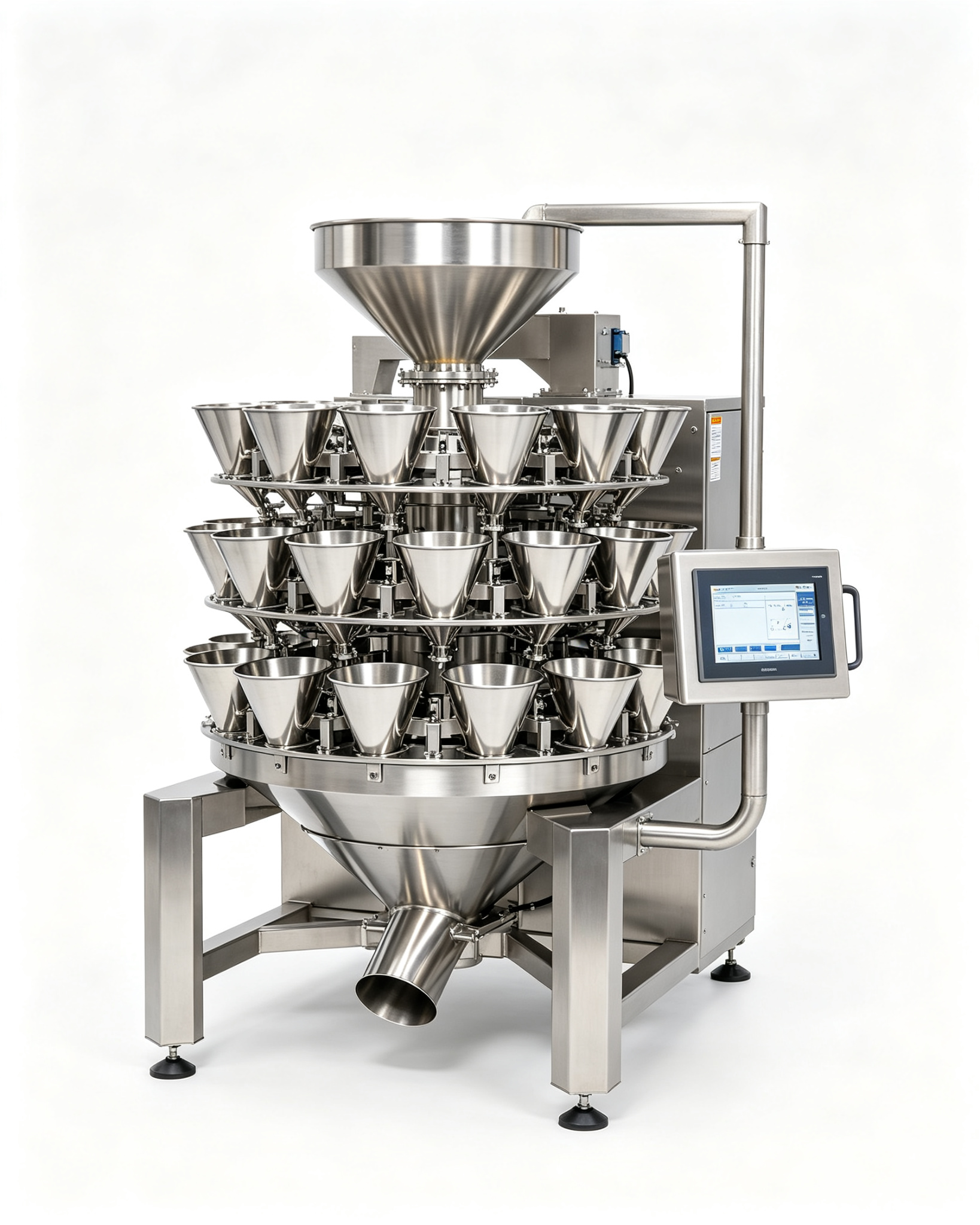
Why a Cup Filler Could Not Weigh Namkeen
Volumetric cup filling assumes that a fixed volume of product always weighs the same. Namkeen breaks that assumption in three ways. The bulk density varies between batches because the snack is fried in oil, so the same cup of a lightly oiled batch and a drier batch weigh different amounts; the product is a mixture of strands, lentils, peas and nuts of different sizes and densities, so no cup represents the same mix twice; and the fried strands are fragile, so the agitation a cup filler uses to settle the product creates the fines that customers see at the bottom of a bag. The producer had been accepting the resulting 3–5% overfill and the complaints about crushed snacks, because the only alternative was hand weighing, which could not keep up with the line.
Multihead weighing removes the volume assumption by weighing small portions and combining them electronically. Each product is split across a set of weigh buckets; the controller runs the combinations and chooses the subset that lands closest to the target weight. Because the machine selects from many buckets rather than filling one measure, it handles mixed and variable-density products without settling or agitation. The 18-head configuration is the right choice for namkeen because more heads mean more combinations and a tighter average — the decision behind the 18-head multihead weigher in this line, drawn from the multihead weighers range.
Line Configuration
- 18-head multihead weigher. Dimpled (embossed) contact buckets and booster hoppers to stop oily namkeen sticking, with the vibration feed tuned per product and a 5-inch or 7-inch touch controller holding separate recipes for bhujia, sev, chivda and mixtures.
- Z-type infeed elevator. A cleated, low-drop elevator that carries the snack from the seasoning area up to the weigher without tumbling, the single biggest change for reducing breakage.
- Servo pillow bagger. A high-speed servo pillow packaging machine synchronized to the weigher discharge, forming metallized laminate bags with a gas-flush tube for nitrogen.
- Nitrogen flushing and seal check. Residual oxygen is targeted at under 2% for crispness and shelf life, with the bagger’s seal temperature and jaw dwell set for the metallized film.
- Outfeed and reject. A takeaway conveyor and a check-weigh diverter that removes any out-of-tolerance bag before the case packing station.
The full bagging arrangement is the high-speed horizontal pillow packaging line layout, with the weigher and bagger mounted as one timed system rather than as two separate machines joined by an uncontrolled belt.
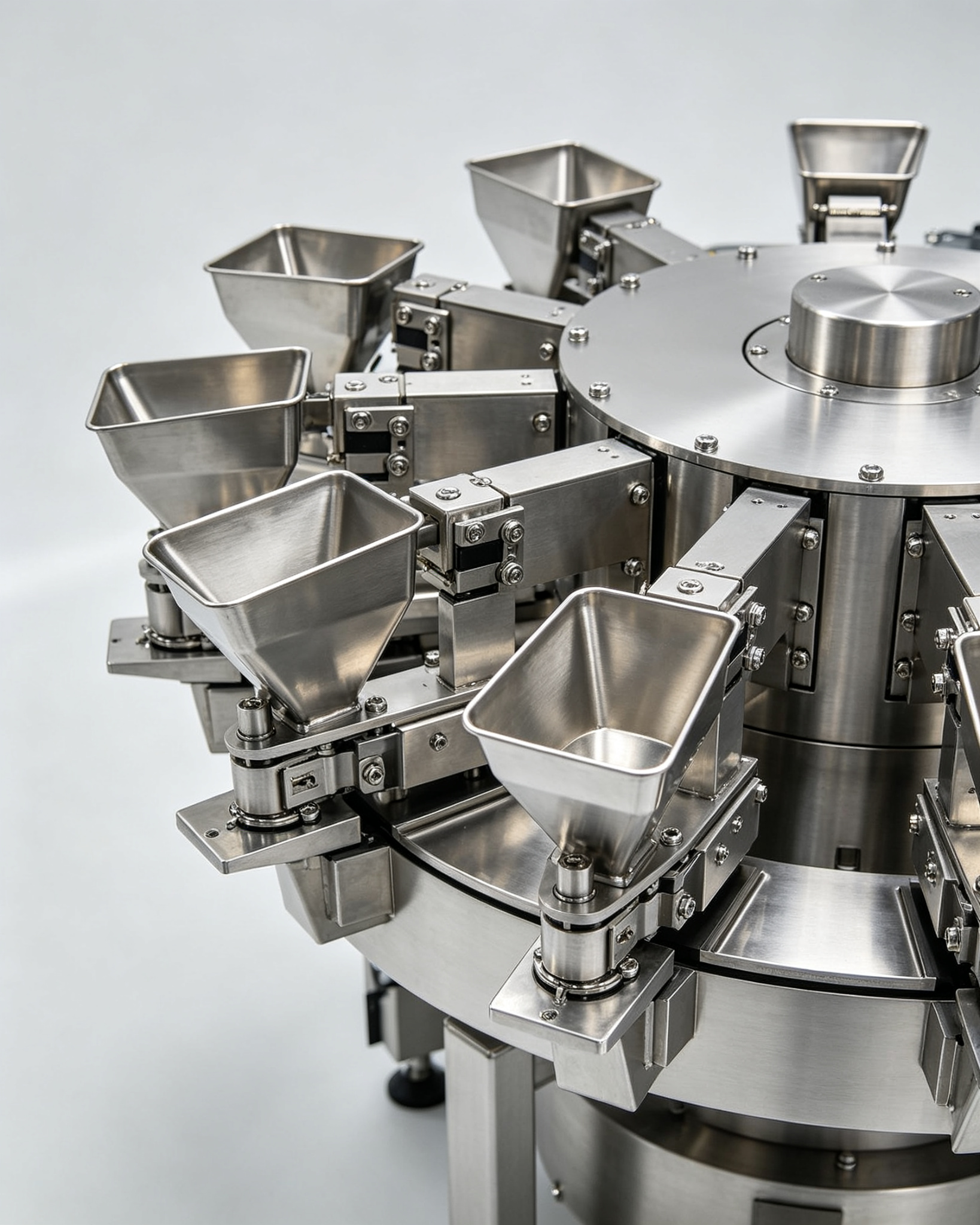
The Two Hard Parts: Oil and Breakage
Oily products defeat the ordinary smooth bucket: a strand of sev or a coated peanut sticks to the wall, the discharge is incomplete, and the next weigh is thrown off by the residue until the bucket is cleaned. The line therefore uses dimpled contact surfaces and lightly vibrated booster hoppers so that the product leaves the bucket cleanly on every discharge, with the contact parts sloped and accessible for wash-down at the end of the shift. Breakage is controlled by geometry rather than by speed: every drop height from elevator to pool, pool to bucket, bucket to discharge, and discharge to the bag is minimized, and the discharge chute is angled to deliver the snack into the bag rather than dropping it. On the old cup line, the producer measured breakage at more than 6% by weight; on the integrated line it is under 1.5%, and the fines at the bottom of the bag — the detail that drives returns in a premium snack brand — have largely disappeared.
Head Count, Speed and Weighing Accuracy
The number of heads is the main lever for accuracy and speed on mixed products. Eight- and ten-head weighers suit free-flowing uniform products; fourteen heads handle most snacks; eighteen heads are justified when the product is irregular and the target weight is small, because the combination math improves sharply with the number of buckets. The trade-off is footprint and price, so the head count should follow the product rather than a preference for the biggest machine. On this line the weigher holds the tighter tolerance on the smaller 200 g pack and runs the 1 kg family pack at a slightly wider window, while the bagger speed is paced to the slowest product — the long-strand bhujia discharges less cleanly than the small sev and sets the line’s floor at around 70 bags per minute.
| Measure | Old cup filler | Weighing and bagging line |
|---|---|---|
| 200 g pack tolerance | ±5–8 g (3–5% giveaway) | ±0.3 g |
| 1 kg family pack tolerance | ±15–25 g | ±0.8 g |
| Bagging speed | 40–50 bpm | 70–85 bpm |
| Product breakage | 6%+ | <1.5% |
| Residual oxygen (nitrogen pack) | Not controlled | <2% |
| Recipe changeover | Mechanical cup change | HMI recipe |
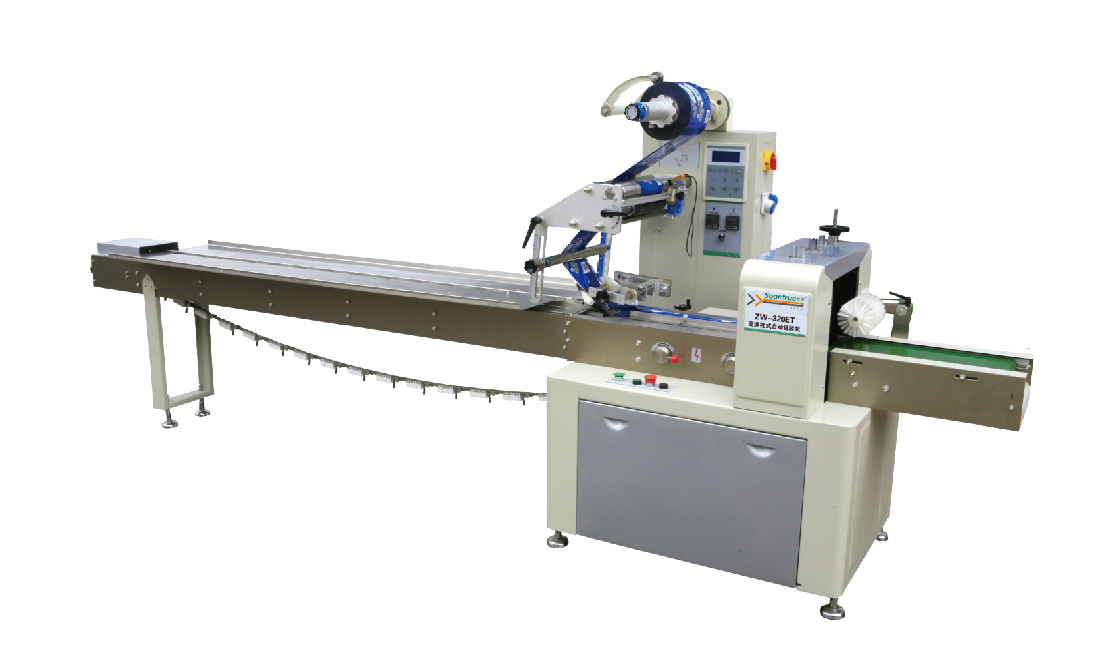
Discharge Timing and Why the Whole Line Has to Be One System
A multihead weigher and a pillow bagger only perform as a system when their timing is linked. The weigher must have a qualified combination ready exactly as the bagger opens its former, and the bagger must not advance if the discharge is incomplete or empty. On a mechanically joined pair this is handled with timing belts and a fixed rate; on a servo line the bagger and weigher communicate over a standard bus, the bagger waits a few milliseconds for a good combination when the product is irregular, and the line runs faster on average without producing empty or short bags. This electronic handshake is the same servo capability that decides the architecture debate in the servo vs mechanical pillow packaging comparison guide, and it is why a weighed snack line is effectively always a servo line. The commissioning focused on this timing for each product rather than on the headline speed of either machine.
Film, Nitrogen and Shelf Life
Namkeen is fried and oxidizes quickly, so the bag is as much a freshness system as the weighing is an accuracy system. The line runs metallized laminated film with a nitrogen flush before the end seal, holding residual oxygen below 2% to extend the crisp shelf life the export market requires. The film also has to seal around a slightly oily product, so the seal jaw temperature and dwell time are set conservatively and the product is kept out of the seal area by the former and the discharge timing. The servo bagger holds these settings in recipes, which matters because the producer runs several products at two pack sizes and a manual re-set on every changeover would reintroduce the seal failures the line was bought to eliminate.
Commissioning and the First Production Weeks
The first two weeks were spent product by product, because the vibration feed, the number of buckets pooled and the discharge timing are different for every snack. The long-strand bhujia needed the most tuning to discharge cleanly and reach the 70-bag floor, while the small sev and roasted chana ran fastest. The line was accepted only after each product held its tolerance over a full shift, and the give-away saving on the first month’s output alone — the difference between 3–5% overfill and ±0.3 g — was large enough to cover a substantial part of the operator training. The producer is now planning a second line for export 50 g single-serve packs, where the same weigher and servo bagger logic applies at a higher speed. The same integrated approach is shown in the high-speed servo pillow line for an Indonesian instant noodle producer, where the bagger is pre-wired for a later weighing stage.
Cleaning and Changeover in an Oily Plant
Fried snacks coat every contact surface with a fine oil film, and on a multihead line that oil is the main enemy of accuracy: as the buckets and chutes build up residue, the discharge gets progressively less complete and the weights drift until the next clean. The design response is partly mechanical and partly procedural. The contact parts are quick-release and tool-light — dimpled buckets, the pool, the chutes and the discharge tube all come off without a spanner — and the open frame keeps the surfaces reachable rather than boxed in, so the end-of-shift wash can be done in the time the plant actually allows. The weigher’s recipe store then remembers each product’s vibration and pooling settings, so the clean does not turn into a re-commissioning the next morning. The producer’s cleaning log records a strip-down and a check of the weigh cells at the end of every production day, which is the rhythm that keeps the ±0.3 g tolerance stable for months rather than for the first week.
Changeover between products follows the same logic. A cup-filler change meant physically swapping cups and re-settling the machine; on the weighing line the recipe recalls the target weight, the number of pooled buckets, the vibration feed and the bagger speed, and the operator only adjusts the contact parts and confirms the film and gas-flush settings. The metallized film itself is common across most of the range, so the most common changeover is a recipe and a label change rather than a film and forming-shoulder change, which is why the line can be switched between two snacks in the time it took the old line to change cups. The two large pack sizes that need a different bag width and forming shoulder are scheduled into longer blocks rather than run through the short changeovers.
Frequently Asked Questions
Why do namkeen and fried snacks need a multihead weigher?
Because they are oily, mixed and vary in bulk density, so a volumetric cup both overfills and breaks them. A multihead weigher combines separately weighed portions, holds tight tolerances without agitation, and moves the product through low-drop chutes to minimize breakage.
How many weighing heads do snack products need?
Uniform free-flowing products can use eight to ten heads; most snacks use fourteen; irregular mixtures and small target weights justify eighteen heads because the combination logic gives more choices. The head count should follow the product and the pack size, not the machine brochure.
What speed can a weighed snack bagging line run?
This line runs 70–85 bags per minute, set by the slowest product to discharge cleanly. The bagger itself is capable of more, but the long-strand product and the weigh-ready cycle govern the sustainable rate.
How is a nitrogen-flush snack bag controlled?
The bagger injects nitrogen before the end seal and targets residual oxygen below 2%, using metallized laminate that keeps the gas in. Seal temperature and dwell are set for the slightly oily product and stored in recipes.
Can a multihead weigher be added to an existing mechanical wrapper?
Not cleanly. A weigher needs the bagger to pace to its discharge over a communication bus, which a servo wrapper does and a mechanical wrapper generally cannot. The timing integration is why weighed snack lines are specified as complete servo systems rather than retrofitted.
Specify the Weighing and Bagging as One Line
For oily, fragile, mixed-density snacks, the weighing, the product handling and the bagging are one problem and should be specified as one system. The line in Rajkot took giveaway from 3–5% to under a gram, broke far less product, and put a nitrogen-flush seal around a brand that competes on freshness. Send SunAura Machinery your snack types, pack sizes and target weights, the oil and moisture profile, and your bags-per-minute target, and the engineering team will size the head count, tune the contact surfaces for oil and breakage, and match the weigher to the servo bagger. Request a line layout and quotation, review the multihead weighers and pillow packaging machines ranges, and compare wrapper architectures in the servo vs mechanical guide.