

QINGDAO, China — October 3, 2026 — SunAura Machinery has completed delivery of a fully automatic edible oil filling, capping and labeling production line for a bottling facility in the Middle East. The line combines a servo-driven 8-head tracking filler for viscous liquids, a capping station, and an integrated labeling module, running PET and glass bottles from 250ml to 1L at up to 45 bottles per minute.
The project grew out of a problem familiar to edible oil producers: filling by hand or with semi-automatic gravity fillers left the bottles uneven, the caps loose, and the labels misaligned — and every inconsistency showed up at the retail shelf. The customer had outgrown manual filling for a 5,000-ton annual capacity of sunflower and olive oil, and needed a line that held fill accuracy, cap torque, and label position within tight tolerances across two shifts.
Line Configuration and Throughput
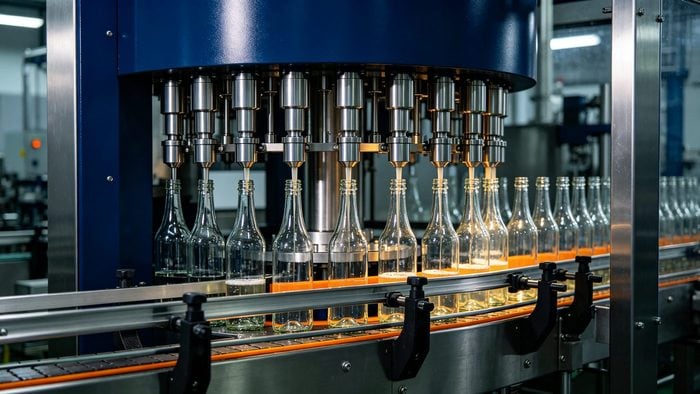
The delivered line is built around SunAura’s servo piston and tracking filling platforms, with the stations arranged in a compact in-line layout:
| Station | Equipment | Key Specification |
|---|---|---|
| Bottle infeed | Automatic air conveyor with star wheel | Handles PET 250ml–1L, glass 250ml–750ml |
| Filling | 8-head servo tracking filler (nozzle-down) | ±1.5g fill accuracy at 45 BPM |
| Capping | Automatic rotary capper with torque control | Torque 1.5–3.0 Nm, adjustable per cap type |
| Labeling | Self-adhesive labeler, servo-driven | ±0.5mm label placement |
| Outfeed | Checkweigher and reject station | Rejects over/underweight bottles |
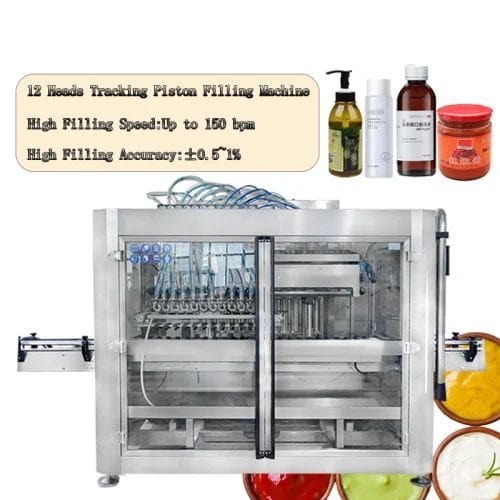
The line runs a single HMI with recipe storage for 20 bottle formats. Changeover between 500ml and 1L formats takes under 15 minutes, including star wheel and nozzle adjustment. For producers running viscous or particulate products, the same filling platform is available in the 8-head tracking filling machine for edible oil and viscous liquids and in piston configurations up to 12-head piston filling machines.
Why Filling Accuracy Decides the Purchase
For edible oil, fill accuracy is not a quality metric — it is a cost line. A 1L bottle overfilled by 5ml loses roughly 0.5% of product value on every bottle. Across a 5,000-ton annual capacity, that overfill equals a meaningful six-figure product loss per year in most markets. Underfill, on the other hand, risks regulatory penalties in markets that enforce average fill legislation.
The servo tracking filler addresses both directions. Nozzle-down filling with servo-driven flow control holds the fill volume regardless of bottle speed variation, and the checkweigher rejects out-of-tolerance bottles before they reach labeling. The result is a measurable reduction in giveaway compared to gravity or volumetric fillers — typically 40–60% less overfill, based on commissioning data from recent SunAura edible oil installations.
Buyers evaluating edible oil filling equipment should ask suppliers for three numbers before comparing quotes: fill accuracy at the target line speed, changeover time between their two largest bottle sizes, and the reject rate at commissioning. All three are verifiable during a factory acceptance test with the customer’s own bottles and product.
Capping and Labeling: The Stations That Decide Shelf Appeal
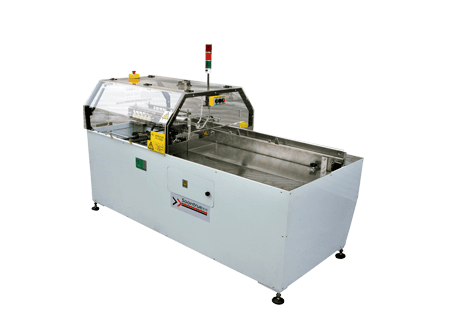
Filling gets the attention, but the capping and labeling stations determine whether the bottle survives transit and looks right on the shelf. The delivered line includes two details that matter more than their cost suggests:
Servo torque-controlled capping: cap torque is set per cap type and held within ±0.2 Nm. Too tight, and the cap liner deforms and leaks in transit; too loose, and the cap backs off during shipping. The servo capper eliminates both failure modes — a common cause of return claims for oil producers shipping long distances.
Label registration on uneven surfaces: oil bottles often have molded handles or panels that make labels wrinkle. The labeler’s servo-driven applicator and buffer roll handle curved and handled bottles without bubbles. Label position is held to ±0.5mm, which keeps the batch code and nutrition panel readable and compliant.
For producers running tamper-evident bands or induction seals, the same line can be extended with a capper-mounted shrink band station or an induction sealer downstream. SunAura’s complete fully automatic edible oil filling, capping and labeling production line page covers the full station options and layout drawings.
Commissioning Lessons from the Middle East Installation
Three commissioning findings from the recent delivery are worth sharing, because they apply to most edible oil projects:
Viscosity changes with temperature: sunflower oil filled at 25°C flows differently than the same oil at 15°C in a winter warehouse. The filler’s flow compensation curve was tuned during commissioning, and the customer now monitors oil temperature at the tank and lets the PLC adjust the fill curve automatically. Facilities planning a line for a climate with seasonal temperature swings should specify this option from the start.
Bottle quality varies between suppliers: the customer changed PET bottle suppliers during the project, and the new bottles had slightly wider neck finishes. The star wheel and capping chuck needed adjustment at commissioning. Buyers should send final production bottles — not samples — to the factory acceptance test.
Label adhesive reacts to oil residue: tiny oil films on the bottle surface reduce label adhesion. The line’s labeling station includes a static eliminator and an optional air wipe; the customer added the air wipe after the first week’s label lift at the bottom edge. This is a low-cost station that prevents a high-visibility quality complaint.
Budget Reality: What an Edible Oil Filling Line Costs
Edible oil filling line prices vary widely with configuration, and comparing apples to oranges wastes everyone’s time. As a planning reference from recent SunAura projects:
| Configuration | Speed Range | Typical Price Range | Best For |
|---|---|---|---|
| Semi-automatic gravity/piston filler + manual capping | 5–12 BPM | $8,000–$20,000 | Small facilities, artisan production |
| Automatic 4–8 head filler + capper | 20–35 BPM | $35,000–$70,000 | Mid-size bottlers, 1–3 SKUs |
| Full line: filler + capper + labeler + checkweigher | 40–60 BPM | $80,000–$160,000 | Export-oriented producers, multi-SKU |
| High-speed line with rinser, filler, capper, labeler, bundler | 80–150 BPM | $250,000–$600,000 | Large bottlers, private label contracts |
These ranges are planning figures, not quotes — the final price depends on bottle formats, cap types, labeling requirements, and the scope of ancillary equipment. The full liquid filling machine range, including piston and servo filling options, is documented on the liquid filling machine product page.
Buying Advice: Specification Checklist for Edible Oil Lines
When comparing quotes for an edible oil filling line, SunAura’s sales engineers recommend checking these specification points in writing:
- Fill method and accuracy: confirm the filler type (gravity, volumetric, piston, or tracking) and the guaranteed accuracy at your line speed, not at the machine’s maximum speed.
- Product contact materials: oil requires food-grade stainless and seals compatible with edible oils — confirm wetted parts are 304/316 stainless and gaskets are oil-resistant (NBR or Viton).
- Changeover documentation: ask for a changeover procedure with time estimates for your two largest formats. A quoted “under 15 minutes” is only meaningful if it is written into the proposal.
- Spare parts and service lead times: check the availability of nozzles, capping chucks, and labeler rollers — the parts that wear with oil products.
- Factory acceptance test scope: confirm the FAT includes your bottles, your oil, and your cap/label materials, with agreed acceptance criteria for accuracy, torque, and label position.
Facilities planning the line layout around the filler should also review floor space and aisle requirements before the equipment arrives. Our recent guide on packaging line layout design: footprint, aisles and clearance rules covers the space planning method in detail — it applies directly to filling lines, where the filler, capper, and labeler each need service access on both sides.
Operating Considerations for Edible Oil Lines
Once the line is running, three operating habits determine whether it keeps producing at the rated speed or slowly degrades:
Daily nozzle and valve flushing: edible oil leaves a film inside the filling nozzles and valves that thickens overnight. A 10-minute hot rinse at the end of each shift — circulating hot water or food-grade solvent through the fill circuit — prevents nozzle clogging and keeps fill accuracy stable. Facilities that skip the flush typically see fill accuracy drift within two weeks, and the drift shows up first as increased giveaway, not as machine failure.
Cap torque verification on the first bottle of each batch: cap and liner batches vary slightly between deliveries. The operator should check cap torque on the first bottle of every new batch and adjust the capper setting if it falls outside the accepted range. This is a one-minute check that prevents a full shift of loose or overtight caps.
Labeler calibration after bottle supplier changes: as the Middle East installation demonstrated, a new bottle supplier can change neck finish and surface properties. After every bottle lot change, run three test bottles through the labeler and check label position and adhesion before starting production. Document the acceptable settings in the recipe so the next changeover starts from a known point.
These habits are not machine options — they are operator procedures that come with the commissioning training. SunAura includes them in the operator training delivered with every edible oil filling line, because the machinery is only as good as the routine that surrounds it.
Frequently Asked Questions
Can the line handle both sunflower oil and olive oil?
Yes. Both products run on the same line with recipe selection. The differences — viscosity, fill temperature, and bottle format — are handled by the PLC recipe: the fill curve, nozzle position, cap torque, and labeler settings switch with the recipe. Viscous oils like olive oil may need slightly slower fill cycles and a wider nozzle; the 8-head tracking filler covers both with nozzle selection.
What is the minimum order volume or factory size for this line?
The line is sized to throughput, not order volume. A practical entry point is 15,000–20,000 bottles per shift month — roughly 1,500–2,000 tons of oil per year — which supports the investment in an automatic filler and capper. Smaller volumes usually justify a semi-automatic piston filler with manual capping.
How do you prevent oil leakage during filling?
Three mechanisms work together: nozzle-down filling positions the nozzle below the bottle rim so no spray escapes, a drip tray and anti-drip nozzle tip catch residual oil between cycles, and the fill valve seals shut when the bottle is not in position. Oil residue on the bottle neck is then removed by the optional air wipe before capping, which also protects label adhesion.
Can we add induction sealing or shrink banding later?
Yes. The line is built with provision for downstream modules: an induction sealer can be inserted between capping and labeling, and a shrink band station can be added after labeling. The conveyor lengths are sized for these future modules, and the PLC has spare I/O for the additional stations.
What after-sales support does SunAura Machinery provide for overseas lines?
Every line ships with commissioning support — SunAura engineers supervise installation and operator training on site. After commissioning, remote diagnostics access to the PLC is available for troubleshooting, and spare parts are dispatched from stock. The warranty covers 18 months on mechanical and servo components.
Availability and Next Steps
The edible oil filling, capping and labeling line configuration is available for order with 6–8 week lead times depending on station options. SunAura Machinery welcomes product samples for a factory acceptance test before production, so the fill accuracy and changeover numbers are verified on your actual bottles and oil. To discuss your bottle formats, target speed, and budget with the sales engineering team, contact SunAura Machinery. For a broader view of how filling lines fit into complete packaging operations — including the line integration work SunAura recently completed for an Indonesian snack producer — see the Indonesia snack packaging line commissioning story.
About SunAura Machinery
SunAura Machinery is a packaging equipment manufacturer based in Qingdao, China, exporting to more than 100 countries. The company’s liquid filling range covers servo piston fillers, tracking fillers, and complete filling-capping-labeling lines for edible oil, beverages, sauces, and household chemicals, all CE certified.
Editorial note: Specifications and price ranges are subject to change without notice. Contact SunAura Machinery for current configuration options.