
SunAura Runs Factory Acceptance Trial of the ZW-3000E Servo Flow Wrapper Paired with the YC600W Reciprocating Packer
SunAura completed a factory acceptance test (FAT) on a ZW-3000E servo-driven horizontal flow wrapper matched to a YC600W servo reciprocating packaging machine, running the customer’s own sample products through a staged speed ramp, seal check and film-consumption review. The trial took place in the SunAura assembly area over two working days, with the customer’s production and maintenance representatives attending for the sample runs and the final acceptance review. This report records the machine configuration, the trial schedule, the measured figures from the runs, the adjustments made on the floor, and the items carried into installation and commissioning.
The figures below are specific to this FAT: the product samples, film rolls and line settings used on the day. They are presented as trial records, not as general machine specifications. Capacity, seal temperature and film consumption change with product shape, film type, pack size and line layout, and should be confirmed on the customer’s own materials during site commissioning. The machines in the trial sit in the horizontal pillow packaging machine range.
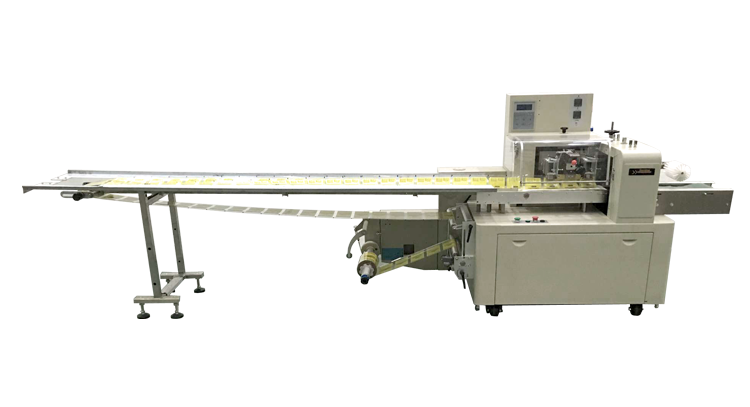
Customer Product and Trial Objective
The customer supplies wrapped bakery and snack products to retail and food-service channels and needed a line that could run two pack sizes on the same wrapper without a full mechanical rebuild between changes. The products in the trial were regular rectangular baked bars and a shorter, thicker snack pack, both wrapped in a printed laminated film with a fin seal back and end crimps. The existing line ran at a lower speed with mechanical drives and frequent seal adjustments; the customer’s objective for the new machine was a higher steady output, repeatable bag length across SKU recalls, and a lower reject rate on seal leaks and off-length bags.
The FAT had to demonstrate that the paired machines could handle both pack sizes, hold bag length and registration through a speed ramp, seal the printed film without burn-through or cold seals, and keep film giveaway within the agreed band. The acceptance review covered output at the target running speed, seal integrity on sampled bags, bag-length consistency, film usage per hundred bags, and the changeover steps between the two SKUs.
Machine Configuration for the Trial
- Main wrapper: ZW-3000E servo horizontal flow wrapper, servo feed and servo end-seal drive, touchscreen recipe recall for bag length, jaw speed and seal settings.
- Packing unit: YC600W servo reciprocating packaging machine matched to the wrapper for the thicker snack pack, with reciprocating end-seal jaws suited to the taller product.
- Infeed: belt infeed conveyor with product spacing guide leading into the former throat; collation arranged so products enter the former one per pitch.
- Film path: unwind gantry with dancer tension arm, former shoulder, longitudinal fin-seal unit, reciprocating or rotary end-seal jaws depending on the pack.
- Control: HMI recipe storage, seal temperature readout per seal station, speed and bag-length display, fault alarm for film jam or missing product.
The YC600W reciprocating unit is detailed on its own product page, the YC600W servo reciprocating packaging machine; the main wrapper sits in the high-speed servo group alongside the high-speed servo pillow packaging machine. The trial paired the two so the customer could compare how each end-seal style handled the two product heights on the same film.
Trial Schedule
| Stage | Time | Activity |
|---|---|---|
| 1. Setup and threading | Day 1 morning | Film roll loaded, web threaded through unwind, former and seal units; product samples laid on the infeed; first recipe entered on the HMI |
| 2. Low-speed trial | Day 1 midday | First pack size run at 30–40 pcs/min; bag length, registration and seal appearance checked on sample bags |
| 3. Speed ramp | Day 1 afternoon | Speed raised in steps to the target running rate; seal temperature and jaw pressure adjusted; rejects counted at each step |
| 4. Second SKU changeover | Day 2 morning | Recipe recalled for the thicker snack pack; former and guide checked; reciprocating jaw configuration selected; trial run repeated |
| 5. Film and giveaway check | Day 2 midday | Film length per hundred bags measured on both packs; sample bags inspected for seal leaks and bag-length spread |
| 6. Acceptance review | Day 2 afternoon | Results reviewed with the customer’s team; outstanding items listed; handover notes and changeover checklist agreed |
Measured Trial Results
The numbers below were recorded on the trial floor for the two sample packs. Speed is pieces per minute at steady running, bag length is the measured seal-to-seal average across a ten-bag sample, and rejects are bags rejected for seal leak, off-length or registration fault during the steady segment.
| Parameter | Baked bar (fin seal, rotary jaws) | Thicker snack pack (reciprocating jaws) |
|---|---|---|
| Product dimensions W × H × L | 62 × 16 × 120 mm | 80 × 32 × 95 mm |
| Film web width | 220 mm printed laminate | 300 mm printed laminate |
| Recipe bag length | 135 mm | 108 mm |
| Achieved bag length (avg of 10) | 134.6 mm | 107.8 mm |
| Steady running speed | 120 pcs/min | 85 pcs/min |
| Longitudinal seal temperature | 145 °C | 150 °C |
| End-seal jaw temperature | 150 °C | 155 °C |
| Reject rate at steady speed | 0.8% | 1.2% |
| Film giveaway over nominal | 3.5% | 4.1% |
The baked bar held the 135 mm recipe length to within 0.4 mm on the ten-bag sample; the thicker snack pack held 108 mm within 0.2 mm. Seal temperature settings were left as starting values for site commissioning, where the film lot on the customer’s line may run a little hotter or colder. The reject figures reflect steady running after warm-up; the first few minutes at each speed step were excluded from the count.

Observations by Station
Infeed and product spacing
Products entered the former at an even pitch once the infeed guide was set. In the first low-speed run, a few bars arrived slightly off-center and the former edge caught the pack; adjusting the side guide on the infeed squared the product before the former. The YC600W packing unit kept the thicker pack spaced so that no two items reached the former on the same pitch, which kept end seals from landing between products. Upstream feeder and weigher timing for this kind of pairing is covered in the multihead portioning feeder and line balancing guide.
Former and film path
The former matched the bar cross-section with clearance on both sides; the web folded cleanly into a tube with no side wrinkles feeding the longitudinal seal. On the thicker snack pack, the larger former and the 300 mm web were selected for the second SKU; the change between the two formers was completed during the morning changeover, with the web re-threaded through the new shoulder. Film tracking stayed centered through the guides after the unwind was squared on the roll.
Longitudinal seal
The fin seal held a continuous crimp along the back after the temperature was brought to 145 °C for the bar film and 150 °C for the thicker pack film. An early run at a lower temperature showed a strip of unsealed edge on the back seal; raising the seal temperature and checking the seal-bar pressure closed the strip without burning through the film. The finished seal showed a firm crimp with no film discoloration at the final setting.
End seal and cut
Rotary jaws on the bar ran continuously through the crimp; the reciprocating jaws on the snack pack closed around the product’s taller section, drew forward with the bag, then returned. On the reciprocating unit, the jaw dwell time was checked against the pack height so the seal had contact time to form a firm crimp. The cut between bags separated cleanly, with a small seal tab left on each end as expected for a fin-style crimp.

Issues Raised and Corrected on the Floor
| Issue observed | Stage | Correction made |
|---|---|---|
| Back seal unsealed on one edge at low temperature | Low-speed trial, bar | Raised longitudinal seal temperature, checked seal-bar pressure and web overlap; seal closed across the full width |
| Bar arrived off-center and rubbed the former edge | Low-speed trial | Adjusted infeed side guide so product squared before the former; repeat samples centered |
| Registration mark drifting as speed rose | Speed ramp | Confirmed web tension even at the feed roller; registration eye kept mark on target after unwind tension was set |
| Reciprocating seal weak on first snack-pack bags | Second SKU setup | Extended jaw dwell and raised jaw temperature; crimp firm on the following sample |
| Film slack at sides on the thicker pack | Second SKU run | Confirmed web width matched the tray cross-section; slack reduced to acceptable side folds after former check |
Changeover Between the Two SKUs
The customer asked specifically how long a change between the two packs would take on the shop floor. During the FAT changeover, the bar recipe was recalled from the HMI, the former and infeed guide were swapped for the snack-pack envelope, the 300 mm film roll was loaded, and the reciprocating jaw configuration was selected. The recorded changeover, including rethreading and the first trial bags, ran within the window the maintenance team estimated for a former swap; exact repeat time on site depends on how the crew organizes the spare formers and tools at the installation. The HMI stores the bag length, seal temperature, jaw speed and seal pressure per recipe, so the settings for each SKU do not have to be re-entered from scratch.
Items Carried to Site Commissioning
- Confirm seal temperature and pressure on the film lot delivered to the customer’s line; film from a different roll can need a small temperature shift.
- Check the infeed spacing against the customer’s upstream feeder or weigher so product pitch matches the wrapper cycle.
- Verify registration mark tracking once the printed film runs at production speed; adjust unwind tension if the web drifts.
- Confirm the former inventory on site covers both SKU envelopes, with spare seal jaws and seal-bar faces available.
- Train the maintenance crew on the changeover steps, recipe recall and the daily cleaning and wear-part checks covered in the maintenance schedule guide.
Where the customer’s upstream feed is a multihead weigher, discharge timing and line balancing are set at installation; the delta robot loading comparison documents how a robotic loader handles product placement ahead of the wrapper when manual or belt feed cannot keep the spacing. The combined wrapper, packing unit and feeder are arranged as an integrated line in the packaging lines overview.
How the Trial Samples Were Measured
Rather than reading a single first bag, the FAT team let each speed step settle for several minutes, then collected a consecutive sample of ten finished bags for measurement. Bag length was measured seal-to-seal with a steel ruler on the flat bag, recorded as the average and the spread between the shortest and longest in the sample. Seal integrity was checked by visual inspection of the crimp and by a manual pressure check on a subset of bags; no leak-detection station was part of this FAT, so seal strength on the customer’s line should be re-verified with the method used in their own quality check. Rejects were counted from the steady segment only, after warm-up and after any one-off threading adjustment.
Film giveaway was worked out from the web width, bag length and the seal tabs on the finished bag. The film used per hundred bags was compared against the theoretical minimum the product cross-section and seal overlap require; the difference, expressed as a percentage over nominal, is the giveaway number in the results table. This measures extra film in the seal tabs and side slack, not film lost to rejects. Reject film was tallied separately so the customer could see production waste versus packing overage.
Why the Servo Pairing Was Chosen for This Mix
The customer’s old line used mechanical drives that set bag length and jaw motion by gears and change parts; changing pack size meant swapping parts and re-timing the shaft. The ZW-3000E servo wrapper sets feed length and jaw speed from the HMI, and the YC600W reciprocating unit drives its jaws by servo so the dwell and forward follow can be adjusted per recipe. For a two-SKU mix where the packs differ in height and length, that means the changeover relies on recipe recall and guide adjustment rather than gear changes. The servo versus mechanical comparison behind this choice is laid out in the servo vs mechanical drive comparison.
The reciprocating YC600W unit was paired with the taller snack pack because a continuous rotary crimp on a 32 mm high pack can press into the product during the seal. The reciprocating jaw follows the bag forward during the seal contact, giving the film a dwell period without the jaw dragging the pack backward. The thinner baked bar, at 16 mm height, ran on the rotary arrangement at the higher speed; the trial thus covered both end-seal styles on the same visit rather than limiting the review to one.
Film Consumption and Waste Observations
Film giveaway came in at 3.5% over nominal for the bar and 4.1% for the snack pack. The snack pack ran a little higher because its larger former and web left more side slack around the irregular bundle, and the reciprocating seal tabs on the thicker bag added a small extra end allowance. No film was scrapped for wrinkles once the former and tracking were set; the waste observed during the day was mostly the lead-off film used to thread the web at roll change and the first bags after each temperature adjustment. The printed film showed registration marks landing close to the target after the eye was set, with no off-mark bags in the steady samples.
Film thickness for the two rolls was checked against the product weight and barrier needs before the trial; the laminate handled the seal temperatures without shrinking at the crimp. Reducing film giveaway on a running line is a balance of bag length, former fit and seal overlap, covered in the guide on reducing film waste and product giveaway; film thickness and microns selection is in the film thickness guide.
HMI, Recipes and Operator Walkthrough
During the FAT the customer’s operators walked through the HMI with the SunAura commissioning engineer: recalling a stored recipe, adjusting bag length, watching the seal temperature readout per station, and reading the alarm messages for film jam, missing product or open guard. The recipe for each SKU stored the bag length, web feed ratio, jaw speed, seal temperature and seal pressure; the operators confirmed they could distinguish a recipe recall from a manual override. Fault messages on the HMI point to the station, so the operator does not have to isolate the cause by trial and error.
The group also reviewed where the daily checks sit: film roll condition, seal-bar face cleanliness, guard closure before restart, and the wear items to inspect each shift. The preventive-maintenance schedule for wear parts and service intervals is the subject of the companion guide on preventive maintenance and wear parts.
Guards, Safety and Cleanability Checked in the FAT
Before the production runs, the trial covered the safety guards around the jaws, former and film path: guard interlocks stop the cycle when a cover is opened, and the machine restarts only after the guard is closed and the operator confirms on the HMI. Guards at the jaw area and the film unwind were checked for fit and access during thread-up. Cleanability was inspected at the product contact surfaces: the infeed belt, former throat and discharge tray wipe down without trapped product, and removable parts are accessible for washdown where the product environment requires it.
The customer’s maintenance lead noted the access points for seal-bar cleaning and roller inspection, which will be matched against their sanitation schedule on site. Any product-contact material questions for a specific food application should be confirmed against the material declarations supplied with the machine order.
Comparison Against the Customer’s Existing Line
Bringing the old line into the review gave the customer a baseline to compare against. The existing mechanical wrapper produced more off-length bags as the film feed drifted through a shift, and seal settings had to be re-adjusted by hand between pack sizes. The servo pair held bag length through the ramp and recalled settings per recipe; the reject rate in the trial steady segment sat below the old line’s recorded level for the same product, though the customer’s own shift data at production speed will be the final comparison. This FAT did not run a continuous multi-hour production campaign, so long-run drift between shifts is still to be observed after installation.
What This FAT Does and Does Not Prove
A factory acceptance test proves the paired machines wrap the supplied samples to the agreed settings under the conditions in the assembly area. It does not substitute for a production run on the customer’s floor, where ambient temperature, film lot, product bulk and upstream feeder timing differ. The seal temperatures recorded here are starting points; the line at the plant may need a small shift once it runs the delivered film through a full shift. Long-run wear, seal-bar life and film-roll change frequency are observed over production time, not over a two-day trial. The open items carried into commissioning are the points where the site conditions can move the FAT results.
The FAT also does not validate upstream equipment that was not on the floor. The trial assumed products arrived at the infeed at the correct spacing and orientation; if the customer’s feeder, weigher or robot places the product differently, that timing is set during installation and line balancing. Where a multihead weigher discharges into the wrapper, the weigh-bucket timing and belt speed are matched so each product reaches the former on the correct pitch; where a robot loads trays onto the infeed, the pick-and-place cycle is aligned to the wrapper index.
Line Layout for the Installed Pair
At the customer’s plant, the arrangement runs feeder or loader, infeed conveyor, ZW-3000E wrapper with its former and seal units, and the matched YC600W reciprocating unit where the taller pack is wrapped. The wrapper and packing unit sit level on the line frame so product travels horizontally without a step between belts; the discharge belt feeds the downstream checkweigher, packer or cartoner as planned. Floor space, belt heights and discharge direction are confirmed against the customer’s plant layout before shipment, so the pair fits the existing conveyor and downstream equipment rather than requiring a line rebuild around the machine.
Integrated lines combining wrapper, feeder, weigher and conveyor are listed in the packaging lines overview; the individual servo, heavy-duty and mini wrapper models are listed in the pillow packaging machine index for other product envelopes and output targets.
Items Reviewed in the FAT Acceptance Record
- Both SKUs threaded and wrapped at the target speed, with bag length within the agreed tolerance.
- Back seal and end crimps sealed across the full edge with no cold strip or burn-through on sampled bags.
- Registration kept the printed film mark on target through the speed ramp.
- Film giveaway within the agreed over-nominal band; reject count recorded for the steady segment.
- Recipe recall stored per SKU; operators reviewed HMI settings and alarm messages.
- Guards and interlocks checked; product-contact surfaces inspected for cleanability.
- Open commissioning items listed and assigned to site installation.
Film and Packaging Format in the Trial
Both packs ran on a printed laminated film supplied with the customer’s samples, with a fin seal along the back and crimped end seals. The bar film used a 220 mm web for the 62 mm wide pack; the snack pack used a 300 mm web for its 80 mm width. The film showed no shrinkage or shrink-mark around the crimp at the trial seal temperatures, and the print mark held registration after the eye was set. Film thickness and sealability for these samples matched the products’ weight and shelf needs; a different film grade for another product would be rechecked in a separate trial rather than assumed from these settings.
The trial did not run modified-atmosphere or flush-gas packaging; the bags were sealed in ambient air. If the customer later adds gas flushing for the snack pack, the seal unit, film barrier and jaw dwell are reviewed against that requirement at commissioning. The film thickness and barrier side of film selection is detailed in the film thickness guide.
Acceptance Outcome
The two machines met the trial acceptance criteria on the second day: both pack sizes ran at the target steady speeds with bag length within tolerance, the sampled seals held without leaks or burn-through, and film giveaway stayed within the agreed band. The customer’s team signed the FAT record with the commissioning items listed above as open follow-ups, not production blockers. The ZW-3000E and YC600W are now prepared for shipment, with site installation, film-thread walkthrough and operator training scheduled after the machine arrives at the customer’s plant.
For other product shapes or output targets, the matching wrapper and packing unit are selected from the servo and heavy-duty models listed in the pillow packaging machine product index; a trial with your own samples and film can be arranged before order confirmation.