L-Bar vs Side Sealer vs Automatic Inline Shrink Wrapper: Why a Regional Co-Packer Kept an Intermittent L-Bar for Mixed Retail Bundles
When a co-packer bundles boxes for supermarket shelves, the shrink wrap step looks deceptively simple from the outside: a product goes in, film closes around it, a tunnel tightens it, a clean retail bundle comes out. The machinery decision hides in how that film is actually closed. The plant in this project was choosing between an automatic L-bar sealer and a continuous side sealer, with the sales literature for the faster machine making the L-bar look like the cautious, old-fashioned option. What actually settled the specification was not the headline speed. It was the shape of the order book, a catalogue of short and medium boxes that change every week, and the fact that the tunnel downstream, not the sealer, was the limiting stage. The story is worth retelling because most buyers face exactly the same choice and are tempted to buy on the bigger number.
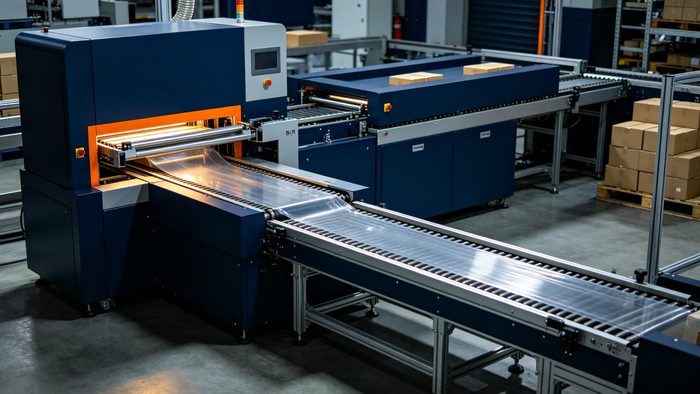
SunAura Machinery supplied and commissioned an automatic L-bar sealer paired with a shrink tunnel for the line, and the useful lesson is that this was not a compromise. It was the correct seal path for a mixed-bundle operation. To understand why, you have to look at how the two machines seal, where the product-length constraint sits, and what a continuous side sealer is genuinely for. Neither is the better machine in the abstract; they are answers to different flow profiles, and the selection is a clean piece of engineering rather than a question of budget prestige.
How the Two Seal Paths Actually Differ
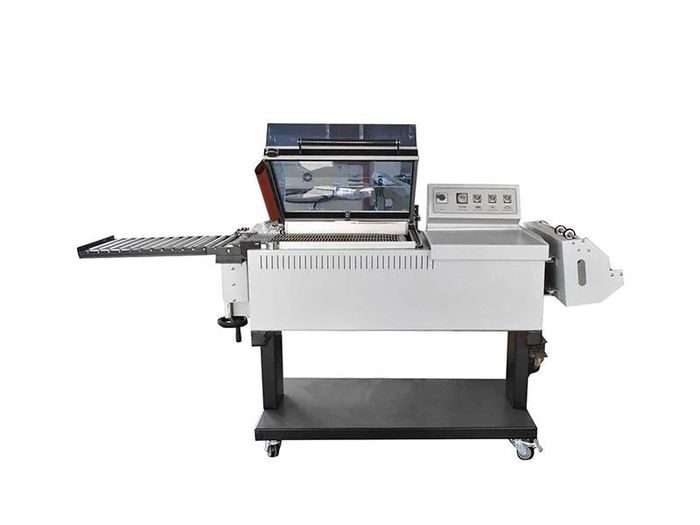
An L-bar sealer takes its name from the L-shaped sealing bar that closes the film along the side and the trailing edge in a single cycle. The product is fed into a folded film web, the bar comes down around it, and one motion makes the side and end seals and cuts the pack free before it enters the tunnel. Because the bar has a fixed physical length, the product has to fit inside that sealing envelope: the bar must close around the longest item in the catalogue. The action is intermittent, meaning the product indexes, the bar seals, and the cycle repeats. This is the classic seal-and-shrink process for boxes, multipacks and bundles of all kinds across the broader shrink wrapping process family, and it is why the L-bar shrink wrappers and the dedicated shrink wrapping machines in a product range are usually the most versatile general-purpose options.
A side sealer works the other way. It makes a continuous longitudinal seal along the film as the product moves, and then uses a separate cross-seal action between products to close the ends. There is no fixed L-bar length acting as the main constraint, because the side seal runs continuously, which is why side sealers handle long products and variable lengths so well. The trade is that product spacing becomes critical: the cross-seal has to land cleanly in the gap between items, so the infeed must control pitch precisely. Continuous-motion side sealers do not stop and start between products, which is how they reach very high throughput, but they demand a disciplined, well-controlled feed and a line that can keep up.
What the Speed Numbers Really Mean
This is where the brochures do most of their damage. A continuous side sealer at the top of the market can process 100 or more products a minute, and manufacturers note that servo motion control can save up to around 20 percent of film compared with non-servo machines, while removing sealing wires, pneumatics and clutches that traditionally wear out. Those are genuine advantages on a high-volume, continuous line. But the number only holds if the rest of the line can absorb it. In this project the shrink tunnel and the downstream packing had a lower sustained capacity, so a sealer running at 100 units a minute would simply have piled product into a tunnel that could not take it, shifting the bottleneck without removing it. A catalog rate has almost no value unless the whole line maintains accepted seals and shrink quality across the intended SKU mix.
An automatic L-bar runs at a more modest, intermittent cycle, often in the rough region of 15 to 35 packs a minute depending on the frame and the product, with manual and semi-automatic versions moving slower still because an operator sets the pace. That sounds unambitious until you measure it against the actual requirement, which was a mixed bundle line running well inside that band with frequent stops for SKU changes. The L-bar was not being asked to run at its limit, and a machine running comfortably at half its rating is a far more reliable asset than a fast machine whose extra speed cannot be used. The discipline is to compare the complete proposed configuration, tunnel and all, rather than transferring a peak number from one model onto another.
Selection Table: L-Bar vs Side Sealer vs Inline Wrapper
| Dimension | L-bar sealer | Continuous side sealer | Automatic inline wrapper |
|---|---|---|---|
| Sealing action | Intermittent; one L-bar cycle | Continuous side seal plus cross seal | Automated infeed on a sealed path |
| Product length | Must fit the fixed bar envelope | Handles long and variable lengths | Set by the chosen seal path |
| Typical speed band | Lower to medium; operator or frame limited | High; 100+ packs a minute at the top | Medium to high; depends on sealer |
| Relative capital cost | Lower; simple proven mechanics | Higher; servo drives and tracking | Higher again; full infeed automation |
| Changeover difficulty | Mechanical and film adjustments | Coordinated tracking and timing settings | More settings to validate |
| Product spacing | Important but forgiving | Critical; cross-seal must hit the gap | Controlled by the infeed |
| Maintenance burden | Sealing wires and heaters; well understood | Fewer wear parts on servo builds | Adds sensors and infeed parts |
| Best fit | Mixed boxes, multipacks, varied SKUs | Long products, continuous high flow | Hands-free integration into a line |
Why the Co-Packer Stayed With the L-Bar
The deciding factors were the three things the L-bar does well and the side sealer could not be paid for. First, the full SKU envelope, including the longest box, fit comfortably inside the L-bar, so the fixed-length constraint that drives buyers to a side sealer simply did not exist. Second, the plant changes products constantly, and an intermittent L-bar with straightforward mechanical and film adjustments is faster and less error-prone to re-set than a side sealer whose tracking, pitch and cross-seal timing all have to be re-coordinated. Third, the tunnel was the proven bottleneck, so paying for sealer speed the tunnel could not consume would have produced no extra accepted output. On every measured point, the L-bar matched the real flow and the side sealer matched a hypothetical faster line that the rest of the factory was not built to run.
There is also a practical argument from the way the machine is actually operated. An L-bar is a forgiving, well-understood technology that a typical packaging team can run, adjust and maintain with the skills already on site, and the wear parts are familiar and inexpensive. The newer servo side sealers are impressive and genuinely reduce maintenance on continuous campaigns, but they reward a plant that runs long, stable, high-volume products with a controlled infeed. For a co-packer whose competitive edge is the ability to switch between many retail bundles, the L-bar’s flexibility is the feature, not a limitation to be engineered away.
When the Side Sealer Would Have Won
The honest reverse of this case is that the same recommendation would flip under different conditions. A side sealer is the right call when the product is long or varies in length in a way that no fixed L-bar can comfortably enclose, because the continuous longitudinal seal removes the bar-length constraint entirely. It also wins on a genuinely continuous, high-volume line where the infeed can control pitch, the tunnel has matching capacity, and the plant runs long campaigns without frequent changeover. In that setting the servo side sealer’s speed, film savings and reduced wear parts all pay back, and an L-bar would become the bottleneck. The machine is not inherently slower by choice; it is specialised for a flow profile this particular co-packer did not have.
An automatic inline wrapper, which adds powered infeed and hands-free operation to either seal path, is justified when the shrink step has to sit inside a synchronised line with no operator at the station rather than as a standalone bundle cell. It is an integration decision as much as a sealing decision, and it should follow the seal-path choice rather than replace it. Specifying full inline automation around a sealer whose path is already wrong for the product only automates a mistake.
When Not to Buy the Faster Machine
The clearest warning is to reject any configuration that fails the flow test rather than the speed test. Before committing, run the shortest, typical and longest products through three events: entry spacing, completion of the cross seal, and clear discharge into the tunnel, recording accepted output and the time to recover after a stop. If the side sealer only raises catalog speed while the tunnel or downstream packing stays limiting, it has not solved the capacity problem and the extra capital is wasted. Equally, do not buy a side sealer for a catalogue that changes every shift if the team cannot reliably re-set pitch and tracking; the changeover will eat the throughput advantage. And avoid specifying a fixed L-bar for a product that is too long for its envelope, which forces a permanent compromise on the one item the machine cannot handle.
Cost, ROI and the Procurement Risks to Allow For
The capital gap between the two paths is real but narrower than it first appears once the whole configuration is priced. An L-bar with a tunnel is a relatively simple, proven build, while a servo side sealer adds motion control, tracking and a more sophisticated infeed, and a fully automatic inline wrapper adds powered conveyors, sensors and guarding on top. The return should be calculated on sustained accepted output rather than the rated peak, and it should credit the side sealer only where its film savings and reduced wear parts can actually be exploited on long campaigns. As a planning estimate, a side sealer that runs at design throughput on a matching tunnel can justify its premium; a fast sealer feeding a slower tunnel cannot, because the additional packs that would repay the difference never leave the line.
Two procurement risks deserve a line in the budget. The first is tunnel capacity, which is the most common hidden mismatch and should be specified and tested together with the sealer rather than assumed. The second is operator skill: a side sealer’s pitch and tracking settings, and an inline wrapper’s integration, call for a more confident team than a basic L-bar, so training and supplier support should be agreed before delivery. Neither is a reason to avoid the faster machine when the flow genuinely needs it, but ignoring them is how a technically correct sealer ends up under-utilised and blamed on the technology rather than the specification.
Frequently Asked Questions
Is a side sealer always faster than an L-bar?
At the top of the market a continuous side sealer reaches a much higher peak rate, but real output is set by the whole line, especially the tunnel. If the tunnel or downstream packing is slower, the sealer’s extra speed cannot be used, and an L-bar running comfortably within its envelope is the more reliable and economical choice.
What makes product spacing so important on a side sealer?
Because the side seal runs continuously, a separate cross-seal must land exactly in the gap between products. If the infeed cannot hold a consistent pitch, the cross-seal clips a product and makes a bad pack. L-bar machines are more forgiving because the single bar seals in one indexed cycle around each item.
Can an L-bar handle long or irregular products?
Only as long as each item fits inside the fixed sealing bar, which is why L-bars suit defined boxes and multipacks. For genuinely long or variable-length products, or chaotic random spacing, the continuous side seal is the better path because it does not depend on a fixed bar length.
Do servo side sealers actually save film?
On continuous high-volume runs, manufacturers report film savings of up to roughly 20 percent from servo motion control, along with fewer traditional wear parts. Those savings are real on the right line but do not justify the machine on a moderate, mixed-SKU operation where the tunnel is the constraint.
Conclusion: Pick the Seal Path the Flow Rewards
An L-bar is the rational, flexible choice when the products fit its envelope, the SKU mix changes often and the tunnel sets the true pace; a side sealer wins for long or variable products and continuous, high-volume, well-controlled flow; and full inline automation belongs on either path only when the station must run hands-free inside a synchronised line. The recurring error is buying the bigger peak number and discovering the bottleneck simply moved one stage downstream. The same logic of dividing work rather than forcing one path harder appears in the choice between single and twin-lane packaging machines, and once the bundles are made, the question of holding the finished pallets comes down to steel versus polyester strapping.
If you are specifying a shrink line and want the seal path, tunnel capacity and infeed arrangement checked against your actual product envelope, send the SKU dimensions and target throughput on the SunAura Machinery contact page and our engineers will run the flow test with you so the chosen machine earns its speed on the floor, not just in the brochure.
Selected Sources
- Kallfass, continuous-motion side sealer specifications: throughput, servo film savings and wear-part design.
- Plexpack (Damark), L-bar sealer types and operation: manual, semi-automatic and automatic configurations.
- SelectPack, L-bar sealer vs side sealer selection: seal paths, product envelope and the flow-test method.