
QINGDAO, China — October 10, 2026 — SunAura Machinery has expanded its bag sealing range with a new continuous band sealer series built around servo-controlled sealing temperature and pressure. The series is aimed at coffee, spice, snack, and dry-food producers who need consistent seal quality on laminated and foil bags at throughputs between 10 and 25 bags per minute, and it closes the gap between manual heat sealers and high-speed form-fill-seal lines.
The series answers a specific production complaint: band sealers that drift. Temperature drift and pressure drift between rolls produce seals that look identical and fail differently — a seal that holds on Monday and leaks on Thursday. For coffee and spice producers, a failed seal means stale product and a customer complaint; for snack producers, it means a bag that opens in transit. The new series addresses the root cause of drift with closed-loop temperature control and servo-regulated seal pressure.
What the New Band Sealer Series Delivers
The continuous band sealer carries the bag between two heated bands, sealing it as it passes, with an integrated cooling section that sets the seal before the bag is released. The new series adds three specifications over the previous generation:
| Specification | Value / Feature |
|---|---|
| Sealing speed | 10–25 bags/min (0–12 m/min band speed) |
| Bag width range | Up to 400mm bag width |
| Sealing temperature | 0–250°C, PID closed-loop control (±2°C) |
| Seal pressure | Servo-regulated, adjustable per film type |
| Cooling | Integrated cooling section sets the seal before release |
| Film compatibility | Laminated, foil, PE/PP, paper-poly combinations |
| Options | Vertical model with ink coder, embossing coder, conveyor infeed |
Temperature control is the specification that matters most. The PID loop reads the band surface temperature continuously and corrects it between bags, so the seal temperature does not sag during a long run or after a bag gap. That is the difference between a seal that holds at 8,000 bags and one that fails at 8,000 bags.
Manual Heat Sealer vs Continuous Band Sealer: When to Move Up
The most common question about band sealers is whether they replace manual heat sealers. The answer depends on volume, and the crossover point is lower than most producers expect:
| Factor | Manual Heat Sealer | Continuous Band Sealer |
|---|---|---|
| Throughput | 5–8 bags/min (operator-dependent) | 10–25 bags/min (consistent) |
| Seal consistency | Depends on operator dwell time | Automatic, ±2°C, fixed pressure |
| Labor | 1 operator per sealer | 0.5 operator (load/unload) per sealer |
| Price range | $300–$1,500 | $3,000–$12,000 |
| Best for | Under 2,000 bags/day, multiple formats | 2,000–10,000 bags/day, single-line sealing |
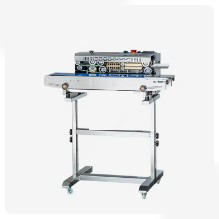
Above roughly 2,000 bags per day, the manual sealer stops being cheaper — the labor cost per bag overtakes the machine amortization, and seal consistency starts costing product. The crossover is also driven by repeat orders: a distributor or retailer that rejects one lot over seal failure costs more than the sealer upgrade. The vertical model with an ink coder, which dates and codes the bag in the same pass, is the version most coffee and spice producers choose — it removes a separate coding operation. The vertical ink coding band sealer configuration is part of the current range, shown alongside the full band sealer product family.
Seal Quality: What Actually Makes a Seal Hold
Three variables decide whether a bag seal holds: temperature, pressure, and dwell time. The band sealer controls all three automatically, but only if the operator sets them for the film. The failure mode on most band sealer lines is not the machine — it is running a film at settings tuned for a different film.
Temperature: each film has a sealing window, typically 10–20°C wide. Below the window, the seal does not bond; above it, the film scorches or the seal becomes brittle. Laminated films used for coffee and spices have narrower windows than plain PE, which is why closed-loop temperature control matters more on these products than on simple poly bags.
Pressure: the bands must press the film layers together while the heat bonds them. Too little pressure leaves a weak bond; too much pressure thins the film at the seal line. The servo pressure control lets the operator set pressure per film and repeat it exactly — a setting that manual adjustment cannot hold across a shift.
Dwell time: set by band speed. Slower speed equals longer heating — and a longer cooling phase, because the integrated cooling section needs time to set the seal. The practical setting is the fastest speed that still delivers a full-strength seal, verified by a seal-strength test on the actual film at commissioning.
For producers moving from manual sealing, the single most useful habit is to document the temperature-pressure-speed settings per film type and store them with the machine. SunAura delivers the series with a per-film setting chart and includes seal-strength verification in the commissioning training — the same verification method covered in the band sealer buying guide.
Choosing the Right Band Sealer Configuration
The series splits into three configurations, and choosing wrong costs throughput:
- Horizontal band sealer with manual feed: the operator places the bag on the infeed table and the machine pulls it through. Right for 2,000–6,000 bags/day with varied bag sizes.
- Horizontal band sealer with conveyor infeed: adds a powered infeed conveyor so bags feed continuously. Right for 6,000–10,000 bags/day with a stable bag supply.
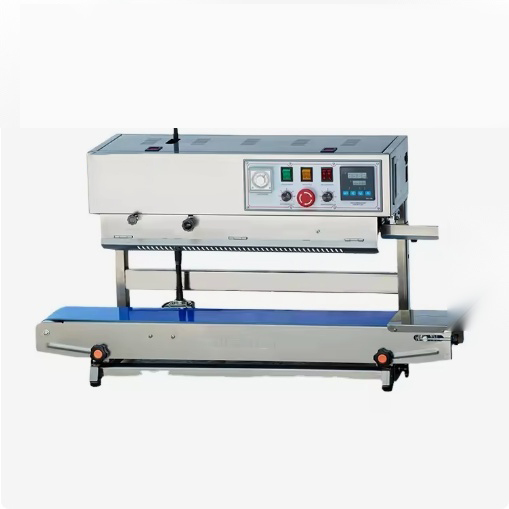
- Vertical band sealer with ink coder: seals and codes in one pass. Right for coffee, spice, and dry-food producers who need batch coding and run bags that sit upright after filling.
The decision is driven by two numbers: bags per day and whether batch coding is required. Producers who need coding should buy the vertical coder version from the start — retrofitting a coder onto a horizontal sealer is possible but adds a handling step that slows the line.
Budget and Payback
The series price range of $3,000–$12,000 compares with the labor it replaces. A manual sealing station costs roughly $15,000–$25,000 per year in wages plus benefits in most export markets — one shift, one operator. The payback on a band sealer at that comparison is under six months for a facility running 3,000+ bags per day. Adding the ink coder removes a second operation and typically pays back within the same window.
The budget comparison also includes the seal failure cost: a rejected lot over seal quality costs product, freight, and the reshipment — often more than the sealer itself. Producers who have experienced one distributor rejection rarely question the upgrade again.
Common Seal Defects and What They Mean
Band sealer quality problems follow a short list of causes, and plant operators who can read the defect fix the line in minutes instead of chasing ghosts:
Intermittent weak seals — same bag, same settings: this is the classic drift symptom. The temperature or pressure is not holding at the set point between bags. Check the PID controller readout against the set point during a run; if it drifts, the heater element or the temperature sensor is failing. On the new series, this is visible on the HMI — the fix is typically a heater element replacement.
Seals that look sealed and fail in the hand: the film bonded at the surface but the layers did not fuse — the classic under-temperature seal. The temperature setting is at the bottom of the film’s sealing window, or the dwell time is too short for the film thickness. Raise the temperature 5–10°C or slow the band 10% and re-test with a seal-strength check.
Scorched or embrittled seal edge: the temperature is above the film’s window, or the cooling section is not doing its job. Lower the temperature or check the cooling fan and cooling band condition. Scorched seals fail in transit — the brittleness travels.
Wavy or shifted seal line: the bag is feeding crooked into the bands, usually from a misaligned guide rail or a bag that is overfilled and uneven. Straighten the guides and check the infeed table level. A wavy seal line is a feeding problem, not a sealing problem — fixing the guides fixes the seal.
Every one of these defects is covered in the commissioning training, with the setting charts per film type posted at the machine. Producers who document their settings and keep the defect guide at the line report dramatically fewer quality holds — the difference between a machine that runs and a machine that runs well.
Frequently Asked Questions
Can a band sealer seal all bag types?
No. Band sealers are built for flexible bags — laminated, foil, PE/PP, and paper-poly combinations. They do not seal rigid containers, vacuum-packed bags (which need a vacuum chamber first), or bags with thick, rigid closures. For vacuum sealing, the vacuum packing machine range is the right equipment; for rigid containers, a capper or induction sealer applies. Each product category has its own sealing machine, and mixing them is the most common mis-specification in bag packing lines.
What causes seal failures that appear days after sealing?
Late seal failures — seals that fail after storage or transit — trace to two causes: insufficient cooling at the sealing station (the seal is disturbed before it sets) and film moisture. The new series addresses the first with the integrated cooling section. Film moisture is a material issue: if the film was stored humid, the seal line can delaminate days later. Store film in dry conditions and check the film’s moisture barrier spec with the supplier.
How long does changeover between bag sizes take?
For the horizontal model, changeover between bag widths takes 5–10 minutes: adjust the band height and guide rails. No change parts are needed for the sealing mechanism itself. The vertical model changes over in a similar window. Producers running many small lots can change formats between runs without losing a production window.
Does the sealer need compressed air?
The standard models run on electric drive only — no compressed air required. This is a practical advantage for small and mid-size facilities without a compressor network, and it keeps the machine footprint small. Air-operated sealers exist in the market, but the electric servo version has fewer failure points and lower running cost.
What maintenance does the band sealer need?
The consumables are the sealing bands and the PTFE tape that protects them. Daily: clean the bands with the recommended cleaner to remove film residue. Weekly: check band tension and the cooling fan. Monthly: inspect the PTFE tape and replace when worn — worn tape is the first cause of inconsistent seals. The spares — bands, PTFE tape, heater elements, coder rollers — are stocked under SunAura’s 48-hour spare parts dispatch program, and the full stocking approach for machine spares is covered in the packaging machine spare parts strategy guide.
Integrating the Sealer Into a Complete Bag Packing Line
The band sealer is one station in a bag packing line, and the integration decision is the same one that applies across every packaging machine: buy the stations as a line, or bolt them together from different suppliers. The sealer’s infeed needs to match the bag supply speed from the filler or weigher, and its outfeed needs to match the conveyor to the case packer. When the sealer, the filler, the weigher, and the conveyor come from one supplier with one PLC program, the transfer points are engineered once. When they come from four suppliers, the transfer points become four interface arguments. SunAura supplies the sealer with the filling, weighing, and conveying stations as a complete line, with the packaging line integration covered by a single warranty and service contact. The conveyor selection method that keeps the sealer’s infeed and outfeed flowing is covered in the conveyor selection guide, and the filling station feeding the bags is shown in the automatic linear filling machine delivery.
Availability and Support
The new continuous band sealer series is available for order with 2–3 week lead time. SunAura Machinery delivers the series with seal-strength verification at commissioning, operator training, and an 18-month warranty on servo and heating components. For producers planning a complete bag packing line, the sealer integrates with weighing, filling, and conveying equipment. To discuss your bag formats, film types, and daily output with the applications engineering team, contact SunAura Machinery.
About SunAura Machinery
SunAura Machinery is a packaging equipment manufacturer based in Qingdao, China, exporting to more than 100 countries. The company’s sealing range covers continuous band sealers, vacuum packing machines, induction sealing machines, and the filling and conveying equipment that completes bag and bottle lines, all CE certified.
Editorial note: Specifications and price ranges are subject to change without notice. Contact SunAura Machinery for current configuration options.