What a case erector purchase actually covers
An automatic case erector takes a flat corrugated blank from a magazine, opens it into a rectangular tube, folds the bottom flaps and seals the bottom so the case can move straight onto a filler, packer or carton sealer. On a packaging line it sits upstream of the product loading station, and its speed and uptime set the ceiling for everything behind it. When buyers ask “how much does a case erector cost”, the number that comes back first is usually the machine list price, and that number answers only one question: what leaves the factory on the truck. The three-year cost of ownership also includes installation and commissioning, operator training, consumables, compressed air and electricity, planned maintenance, spare parts, changeover labor, unplanned downtime and the floor space the machine occupies. A machine with a lower ticket price can cost more over its life if it jams often, burns through tape, or needs a second operator to keep it fed.
This guide breaks the purchase decision into the price bands buyers actually see on quotations, separates one-time capital cost from recurring operating cost, and works two full total-cost-of-ownership examples with stated assumptions so the payback math can be checked against your own volumes. The figures are planning ranges for budget and comparison, not fixed quotes; a supplier should confirm them against your blank sizes, board grade, shift pattern and destination line during a factory acceptance test.
What moves the purchase price
Before looking at bands, it helps to know which specifications drive the number. Two machines that both say “automatic case erector” can differ by a factor of three because of the following choices.
- Speed band. A low-speed machine rated 10–15 cases per minute uses simpler pneumatics and a lighter frame. A medium-speed unit at 15–25 cases per minute adds better belt control and tighter forming. A high-speed or servo-driven machine above 25–30 cases per minute uses servo axes, closed-loop positioning and more sensing, which shows up directly in the price.
- Case size range. A fixed-size or narrow-range machine running one or two blank dimensions stays simple. A wide-range machine covering small cases from roughly 200×150×100 mm to large cases around 500×400×400 mm needs adjustable guides, longer forming frames and more change parts.
- Bottom sealing method. Pressure-sensitive tape, self-locking (bottom-lock) folding, hot-melt glue and nail-type closure each carry different hardware costs. A hot-melt build adds a melter, heated hoses, nozzles and a glue control panel; a tape build adds tape heads, crash plates and tape tension controls.
- Format flexibility. A random-size erector that forms mixed case sizes in one sequence needs case-size recognition, servo adjustment and more software, and costs more than a dedicated fixed-size unit.
- Controls and data. A basic relay or PLC panel with pushbuttons sits at the low end. An HMI with recipe storage, cycle counters, fault logging and connectivity to line supervision adds cost, as does remote diagnostics.
- Guarding and destination-market compliance. Interlocked guards, light curtains, e-stop layout and the documentation package required for CE or other market conformity add engineering and hardware that a bare-bones machine omits.
- Integration scope. A standalone machine bolted to the floor is one purchase. An integrated section that matches conveyor height, signals to the line PLC, feeds a case sealer or palletizer and shares safety circuits is a larger project.
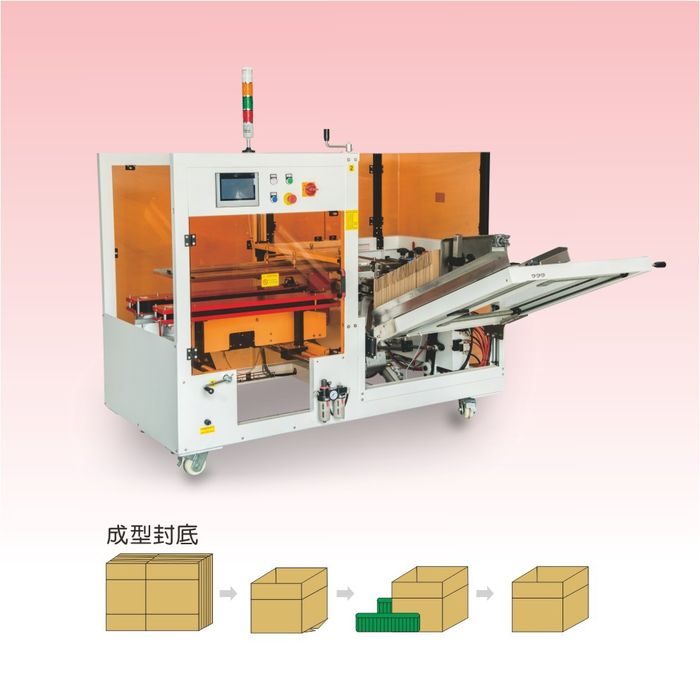
Machine price bands in USD
The bands below reflect standalone machines sold into general industrial packaging, excluding imported used equipment and custom engineered lines. Prices move with exchange rates, steel, controls and the sealing method, and they do not include freight, import duty, installation or commissioning unless stated.
| Configuration | Typical speed | Indicative machine price (USD) | What is included / where the cost sits |
|---|---|---|---|
| Entry-level automatic tape erector | 10–15 cases/min | $9,000–$16,000 | Basic PLC or relay control, pneumatic pick and form, tape bottom seal, fixed or narrow size range; guarding kept to the minimum required for the destination market. |
| Medium-speed automatic tape or bottom-lock erector | 15–25 cases/min | $16,000–$28,000 | HMI with recipe storage, adjustable guides, better belt and flap control, vacuum monitoring; suited to multi-SKU lines with regular changeovers. |
| Hot-melt glue case erector | 15–30 cases/min | $22,000–$38,000 | Melter unit, heated hoses, glue nozzles and bead control, plus the forming frame; premium over a tape build comes from the glue system and its maintenance requirements. |
| High-speed or servo random-size erector | 25–40+ cases/min | $30,000–$55,000+ | Servo-driven axes, size recognition, automatic or semi-automatic adjustment, fault logging and tighter squareness control; built for high-volume mixed-size lines. |
| Nail-type carton forming and bottom sealing unit | 10–20 cases/min | $18,000–$32,000 | Wire-nail closure for heavy or wet-board cases; includes nail feed, clinch station and dedicated change parts for the case size. |
| Integrated packaging section | Matched to line | $60,000–$150,000+ | Erector matched to conveyors, case sealer, strapping and palletizer on one shared control and safety architecture; cost depends on station count and automation level. |
Within any band, expect a spread of roughly 20–30% between a basic spec and a loaded one. Adding stainless washdown construction, a wider case range, extra guarding, remote diagnostics or a spare-parts kit each moves the number upward. The case erector family page lists the standard and medium-speed builds available, and individual models such as the case erector 1, the case erector 2 and the medium-speed case erector show the mechanical layout behind each price point.
Costs that do not appear on the machine invoice
The invoice price buys the machine. The items below decide whether the machine stays productive after delivery, and they are where a low-priced purchase often turns into an expensive one.
Installation, commissioning and training
A standalone erector needs level floor space, a compressed-air supply at roughly 0.5–0.7 MPa, an electrical connection, and alignment to the incoming and outgoing conveyor. Commissioning covers setting pick-up timing, flap fold timing, seal pressure and squareness, and running trial cases across the size range. Budget one to three days of supplier or integrator time for a standard machine, longer for an integrated section. Operator training covers blank loading, recipe selection, basic fault response and routine checks; a line that skips training usually develops avoidable jams in the first month.
Consumables
Every sealed case consumes something: tape, adhesive, wire nails or the corrugated blank itself. The blank is usually bought by the packaging buyer regardless of the machine, but tape and glue are recurring costs tied to the sealing method. Tape for a bottom seal typically runs 48–60 mm wide, and a case uses roughly 0.5–0.7 m of tape across the bottom flaps plus overlap. Hot-melt adhesive uses about 3–8 g per case depending on case size and bead pattern, laid in beads around 2–4 mm wide. These per-case consumables look small, but at high volume they accumulate faster than most buyers expect.
Labor and attendance
Even a fully automatic erector needs someone to load the blank magazine, replenish tape or adhesive, clear occasional jams and carry out changeovers. Magazine capacity commonly sits between 100 and 250 blanks, which sets how often an operator returns to the station. Labor cost depends on how much attendance the machine actually needs: a stable machine on uniform blanks may share one operator across several stations, while a finicky machine on damp or mixed board demands near-continuous attention. Changeover labor matters on multi-SKU lines, where a 20-minute setup repeated several times a shift adds up.
Utilities
Pneumatics drive the pick, fold and compression cylinders; air consumption typically runs 300–600 L/min during a cycle, and leaks or undersized compressors raise the electricity bill. A hot-melt melter adds continuous heat to keep adhesive at 160–180 °C, which raises both power draw and standby energy. Both are modest per case, but they belong in the annual operating estimate rather than being ignored.
Maintenance, spare parts and downtime
Suction cups, vacuum filters, belt sections, air cylinder seals, springs and sensors wear out and need replacement. Glue systems add nozzles, filters and hose assemblies to the spares list, and tape systems add tape heads and crash plates. Planned maintenance keeps the machine running; unplanned downtime from a jam, a failed cup or a clogged nozzle costs lost production across the whole line, not just the erector station. Downtime cost should be estimated against line throughput and the value of the product waiting to be packed.
Floor space, financing and warranty terms
An erector and its blank magazine occupy roughly 2–3 m of line length plus depth for access. If the line already has limited space, relocating conveyors or adding a feeder carries a cost that never shows on the machine quote. Financing spread over several years changes the monthly cash requirement, and warranty terms differ: some suppliers cover parts for 12 months, others shorter, and the cost of extended cover or a spares kit should be compared before signing.
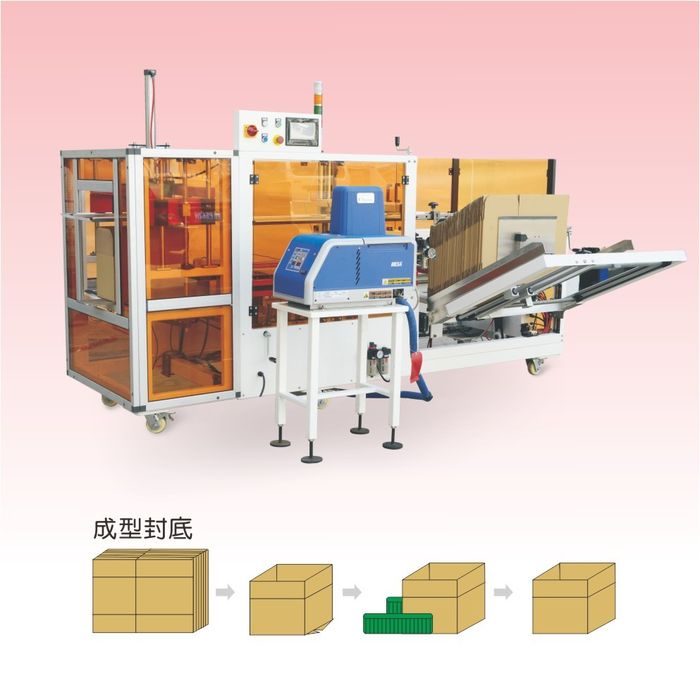
Tape versus glue: the consumable comparison
Sealing method is the single biggest recurring-cost choice after the machine itself. Tape and glue differ in per-case material cost, sensitivity to board and environment, speed fit and line cleanliness. The self-locking bottom versus tape versus hot-melt glue comparison walks through the mechanical differences in depth; here the focus is what each method costs to run.
| Factor | Pressure-sensitive tape | Hot-melt adhesive | Self-locking bottom fold |
|---|---|---|---|
| Hardware on the erector | Tape heads, tension control, crash plate | Melter, hoses, nozzles, bead control | Folding plows and compression; no seal consumable at the bottom |
| Per-case consumable | ~0.5–0.7 m of 48–60 mm tape | ~3–8 g adhesive, beads 2–4 mm wide | None beyond the blank itself |
| Material cost sensitivity | Tape price per roll; tails and waste on misalignment | Adhesive price per kg; melter energy and nozzle wear | Board cost drives the blank; fold geometry must match the box design |
| Weak points | Tape can peel on heavy, dusty or cold cases; tails and stringy ends | Stringing, clogging and temperature drift; burn hazard at the melter | Requires a compatible blank die-cut; less forgiving on thin board |
| Speed fit | Good for low to medium speeds | Common on medium to high-speed lines and heavy loads | Good where the box design supports the lock; setup is mechanical |
As a planning estimate, tape works out to roughly $0.015–$0.025 per sealed bottom, and hot-melt adhesive to roughly $0.015–$0.022 per case at normal bead weights, before counting glue-system maintenance and energy. The gap between methods is narrower than buyers often assume, and the deciding factors are usually line speed, case weight, board condition, dust or temperature in the plant, and the tolerance for tape tails rather than material price alone.
Worked three-year TCO examples
The following examples use stated assumptions so the arithmetic can be re-run against your own volumes. Both assume a line producing 120,000 cases per year over a three-year ownership period, loaded labor of $18 per hour, and a standard machine that keeps attendance to about a quarter of one operator. Figures are planning estimates, not supplier quotations.
Assumptions held for both scenarios
- Volume: 120,000 cases/year; 360,000 cases over three years.
- Operator attendance: 0.25 FTE-equivalent at $18/hour loaded, about $9,000 per year in labor.
- Changeover and minor jam handling are included in the attendance figure; major unplanned downtime is listed separately.
- Spare-parts pricing excludes emergency expediting; maintenance excludes major component overhaul.
Scenario A: automatic tape erector
| Cost element | Annual basis | Three-year total (USD) |
|---|---|---|
| Machine purchase | One-time | $14,500 |
| Tape consumables | ~$0.020/case | $7,200 |
| Operator attendance | $9,000/year | $27,000 |
| Planned maintenance and spares | $1,200/year | $3,600 |
| Compressed air and electricity | $600/year | $1,800 |
| Downtime and changeover loss | $1,500/year | $4,500 |
| Three-year TCO | $58,600 | |
| Cost per case | ~$0.163 |
Scenario B: hot-melt glue erector
| Cost element | Annual basis | Three-year total (USD) |
|---|---|---|
| Machine purchase | One-time | $26,000 |
| Adhesive consumables | ~$0.018/case | $6,480 |
| Operator attendance | $9,000/year | $27,000 |
| Planned maintenance and spares (melter, nozzles, filters) | $1,800/year | $5,400 |
| Compressed air, electricity and melter heat | $900/year | $2,700 |
| Downtime and changeover loss | $1,800/year | $5,400 |
| Three-year TCO | $72,980 | |
| Cost per case | ~$0.203 |
On these numbers, the glue machine carries a purchase premium of about $11,500 and a higher maintenance and utility load, so the tape build wins the three-year TCO comparison at 120,000 cases per year. That result flips when the glue machine removes a recurring pain point the model does not price: tape peeling on heavy loads, tape tails on dusty lines, or jam losses from misaligned tape heads. The payback rule is straightforward: divide the purchase premium by the monthly saving the alternative delivers, and the result is the payback in months. For example, if a glue build cut tape-related jams enough to save $960 per month in lost production, the $11,500 premium would pay back in roughly 12 months; if the saving were only $400 per month, payback would stretch past 24 months.
At higher volume the balance changes again. A line running 500,000 cases per year spreads the fixed labor, maintenance and machine cost over far more cases, and the per-case seal method matters more. In that regime a glue build that protects seal integrity on heavy or dusty cases can justify its premium even when material prices are close. Run the same tables at your own annual volume, local labor rate and current seal-failure complaints before choosing a sealing method on price alone.
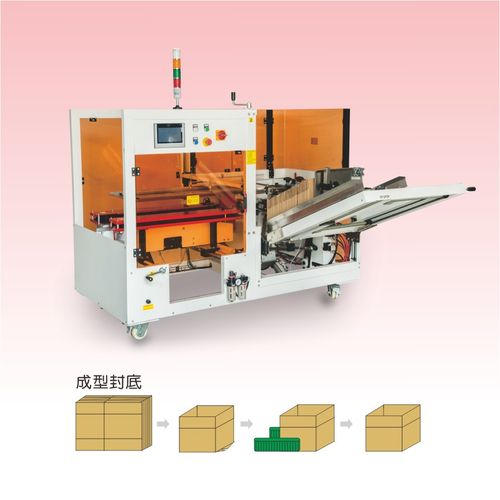
Freight, delivery and the hidden project costs
Machine price rarely travels alone. International freight, ocean or air transport, customs clearance and import duty all land on the buyer’s side of the purchase, and they are easy to forget when comparing a local vendor with an overseas supplier. Delivery terms decide who books and pays transport: an FOB or EXW quote leaves freight and insurance to the buyer, while a delivered price wraps them into the invoice but may spread the same cost across a higher machine figure. Ask which Incoterm applies, and get the freight and duty estimate written into the comparison so two quotations sit on the same landed basis.
Project costs also include anything the line needs around the machine: a level concrete pad or frame mount, air line run to the station, electrical supply and disconnect, guarding between the erector and adjacent conveyors, and any guarding modification where the blank magazine opens toward an aisle. If the existing line is older, mechanical interfaces between frames and belting may need adapters or new transition sections. These are one-time engineering and fit-out costs, and they should be estimated before the budget is locked rather than discovered during installation.
Depreciation and tax treatment matter for the capital side of the decision. Packaging machinery is commonly depreciated over five to ten years depending on local rules, and a capital purchase spreads that cost over the asset life even though cash leaves at delivery. Leasing or renting changes the monthly cash profile and may include service cover, but the total paid over the lease term can exceed an outright purchase. Whichever route is used, keep the machine’s expected service life in mind: a well-built erector can run eight to twelve years with planned maintenance, so the capital comparison should not assume a three-year replacement cycle.
Reading a quotation line by line
When several proposals arrive, the fastest way to compare them is to split each into the same line categories and fill in the gaps where a supplier left an item out of scope. A missing line is not the same as a free item; it usually means the cost will appear later as an add-on. The checklist below mirrors what a procurement file should hold for each bidder.
| Quotation line | What to confirm | Common gap |
|---|---|---|
| Machine frame and forming section | Case size range, speed rating, blank magazine capacity | Rated speed given as peak rather than sustained; size range narrower than the SKU list |
| Sealing system | Tape, glue, lock or nails; consumable grade and capacity | Tape heads or glue melter listed as optional rather than included |
| Guarding and safety package | Fixed and interlocked guards, e-stops, light curtains, isolation switch | Guarding limited to home-market minimum; destination-market conformity not documented |
| Controls and data | HMI, recipe storage, fault log, connectivity, remote access | Basic panel supplied while recipe recall and diagnostics are add-ons |
| Spare parts and wear kit | Cups, seals, filters, belts, sensors, nozzles or tape heads | No starter kit; first replacement parts ordered at emergency lead time |
| Freight, duty and delivery | Incoterm, transport mode, insurance, clearance, lead time | Ex-works quote with transport and duty left to the buyer |
| Installation and commissioning | Site prep, connection, trial run, acceptance criteria | Commissioning charged per day after arrival; no written FAT or SAT protocol |
| Training and manuals | Operator training, maintenance manual, diagrams, spare-parts list | Manual in machine language only; no operating or safety instructions for staff |
| Warranty and service | Warranty period, covered parts, response time, local service access | Short warranty with no named service contact; wear parts excluded by default |
One practical check: total the one-time costs (machine, options, freight, installation, commissioning, spares kit) separately from the recurring annual costs (consumables, labor, maintenance, utilities, expected downtime). The capital number answers what the company spends to get the line running; the operating number answers what it costs to keep running, and that second figure is what usually separates a good buy from a poor one.
How configuration choices affect the budget
Some options add capital cost but reduce operating cost, and buyers should weigh them against their own SKU mix rather than buying the bare machine.
- Recipe storage and quick-change parts. On a line that changes case sizes several times a shift, recipe recall and tool-less adjustment pay back through saved changeover minutes. On a line that runs one size all year, the option rarely earns its cost.
- Wider case range. Buying extra size coverage that never gets used is dead capital. Specify the range around the SKUs you actually run, plus a modest margin for future sizes.
- Stainless or washdown construction. Needed where the plant is washed down or handles wet, greasy products; unnecessary dry warehouse lines where it adds cost without benefit.
- Spare-parts kit. A starter kit of cups, seals, filters and sensors avoids emergency expediting after the first wear-out period; compare the kit price against local parts lead time.
- Conveyor and integration package. Matching the erector to existing conveyors and the line control system reduces commissioning risk, but duplicated conveyor length should not be bought twice. Review the conveyor range and how sections connect before sizing the line.
What to ask for in the quotation
A cost comparison is only fair if every supplier quotes the same scope. When requesting prices, pin down the following so the TCO numbers sit on the same basis.
- Case L/W/H range to be formed, with every SKU listed, blank board grade and flute, and whether blanks are flat or pre-scored.
- Sustained required cases per minute, not the headline peak speed; number of shifts and annual run hours.
- Sealing method preference and any restriction on tape, adhesive or nails for the product or market.
- Guarding and compliance package required for the destination market; ask for the conformity documentation listed in the certifications and patents overview.
- Electrical supply and compressed-air requirement, including air consumption in L/min and installed power in kW.
- What is included: freight, duty, installation, commissioning, training, operator manual, electrical and pneumatic diagrams, warranty period.
- Recommended spare parts and their lead time, plus the availability of wear parts after the warranty period.
- FAT protocol: whether the supplier will run your blanks at the sustained target and record seal quality, squareness and jam rate before shipment.
- Payment terms, delivery lead time, and whether remote diagnostics or service visits are available in your region.
Common buying mistakes
Choosing on the sticker price alone. The cheapest machine in the comparison often sits in the lowest speed or narrowest size band, and it may omit guarding, documentation or spares that the line actually needs. Compare TCO and scope, not the first number on the page.
Specifying peak speed as operating speed. A machine rated to 30 cases per minute on a short demonstration will not hold that rate through an eight-hour shift with blank changes and seal interruptions. Size at 70–80% of the rated figure against the sustained target so the line keeps headroom.
Ignoring the blank feed condition. Damp, curled or dusty blanks cause pick failures and jams on any machine. If incoming board varies, ask whether the magazine feed has separation aids and vacuum monitoring, and budget for board conditioning before blaming the erector.
Underestimating changeover on multi-SKU lines. A dedicated machine that runs fast on one size can spend most of its life being adjusted if every order is a different case. For high-mix work, weight quick-change tooling and recipe recall more heavily than raw speed.
Skipping the factory acceptance test. Brochure tables describe capability; the FAT proves it on your blanks. Require recorded seal quality, squareness and jam results at the target rate before the machine ships, rather than finding problems after installation.
Where this machine sits in the line
The erector feeds formed cases to the loading station, after which a case sealer or carton sealing machine closes the top, and downstream sections may add strapping and palletizing. On a fully integrated packaging line, the erector’s speed and uptime constrain every station behind it, which is why its TCO should be judged against line output rather than as a standalone purchase. The hot-melt glue case erector product page shows the glue build in more detail, and the nail-type carton forming and bottom sealing unit covers the wire-nail closure option for heavy cases.
For the mechanics behind these cost choices, see how the automatic case erector works through pick-off, plunger forming, flap folding and bottom sealing, and compare sealing methods in the bottom-lock versus tape versus glue breakdown. The brand-side launch view is covered in the SunAura hot-melt glue case erector introduction, while compliance expectations are detailed in the case erector safety and CE guarding guide and day-to-day upkeep in the troubleshooting and changeover reference. Send your case sizes, annual volume and sealing-method preference through the contact desk for a configuration-level quotation.