Three bottom seals, one forming machine: what the choice actually changes
An automatic case erector pulls a flat corrugated blank from a magazine, opens it into a square, folds the bottom flaps and seals the bottom so the case can be filled on the next station. The forming cycle itself is broadly the same across makes; the decision that separates quotations and drives five years of operating cost is how that bottom stays closed. Three sealing methods appear on real production lines: a self-locking blank whose slots and tabs interlock without any consumable, a pressure-sensitive tape strip laid across the bottom center seam, and a hot-melt adhesive bead applied to the flaps before compression. Each method changes the blank you can buy, the consumable you reorder every week, the warm-up and cleaning routine, the seal strength on a heavy or export case, and the price band of the machine itself.
This comparison works from the corrugated blank outward: board grade and case size first, target speed second, consumable cost over a shift third, and the line environment last. It does not rank one method as universally better. A self-locking blank that fits a light e-commerce carton can fail on a double-wall appliance crate; a hot-melt station that seals 25 cases a minute in a food plant can be wasted capital on a line that forms 120 cases a day. The aim is to match the seal to the board, the volume and the audit requirement, then write that choice into the purchase specification rather than leaving it to the machine builder.
The figures used here are the standard bands seen on the SunAura case-erector range: output 8–25 cases/min, blank size roughly 200×150×100 mm to 600×400×400 mm depending on frame, magazine capacity 50–100 blanks, four to eight suction cups per head, air at 0.6 MPa, and bottom squareness held within about ±2 mm on a servo or guided pneumatic frame. Any number quoted on a brochure should be checked against your own blank and your own sustained rate during the factory acceptance test.
How each bottom seal closes the case
Self-locking bottom (slotted or tab-lock blank). The blank is die-cut with matching slots and locking tabs along the bottom flaps. When the erector opens the case and folds the flaps, the tabs pass through the slots and snap into a mechanical interlock. No adhesive, no tape, no heated station touches the board. The seal lives in the blank geometry, so the die-cut must be accurate and the board must be stiff enough to hold the tab under load. This method is common on lighter retail cartons, e-commerce blanks and cases that must be opened and refilled without destroying the box.
Pressure-sensitive tape. A tape head pulls a roll of packing tape across the center seam where the two major bottom flaps meet, a pressure roller beds the tape onto the board, and a cutter severs the strip after the case passes. Tape widths run 48–72 mm, with 50 mm the standard on medium cases; wider tape is specified for heavy or rough board. Tape is the flexible default: the station is simple, there is no warm-up, and changing between tape widths is a head adjustment rather than a service task. The seal depends on the tape adhesive wetting the board, which matters on coated, dusty or cold corrugated.
Hot-melt glue. A heated melter keeps adhesive at 150–180 °C, hoses carry it to one or two nozzles over the flap station, and beads are laid on the inner faces of the bottom flaps. The case is held under compression while the adhesive wets the board and sets, typically within a second or two at operating temperature. Glue forms a bond across the flap overlap rather than a strip across one seam, which gives a firm bottom on double-wall and loaded cases. The trade-off is a warm-up period at start of shift, nozzle and hose care, and adhesive that must be matched to the board and the room temperature.
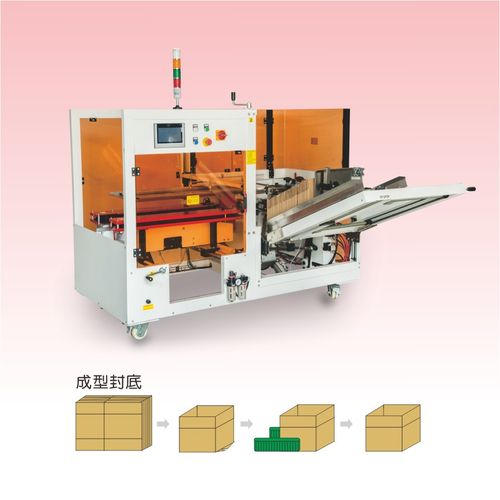
The blank and board spec set the hard constraints
Before comparing consumables, list every blank the line will run: smallest and largest case, single-wall or double-wall, board grade, whether the outside is coated or pre-printed, and how the blanks are stored. The forming frame covers a stated blank range, usually under a 2:1 spread in blank length; a case at the edge of the range runs slowly, wears the guides and is the first to reject. Warped or damp blanks cause vacuum misfeeds on any method, so storing blanks flat and dry is a precondition for consistent forming rather than a separate machine problem.
Board stiffness decides whether a self-locking tab can hold. Light single-wall B or C flute works with tab-lock geometry; stiff double-wall board springs the tabs out of their slots, and the die-cut slots themselves can tear under the tab’s locking load. Coated or heavily printed board changes the tape side: pressure-sensitive adhesive needs a clean, porous surface to wet, and a glossy or dusty liner can leave a tape strip that peels at the edge. Hot-melt bonds well to most corrugated faces but needs the adhesive grade matched to coated stock and to cold-room conditions, where a wrong grade sets brittle.
Case weight and transport cycle matter as much as board type. A case holding a few retail packs sits on a short pallet run; a crate of appliances, tiles or bottled goods moves through stacking, container loading and rough handling. The bottom seal on the loaded case must hold the contents through that cycle, and the method that looks cheapest on an empty blank may be the one that opens on the pallet. If the line ships export containers or stacks cases high, specify the seal against the loaded weight and the drop or compression test the retailer or freight forwarder requires.
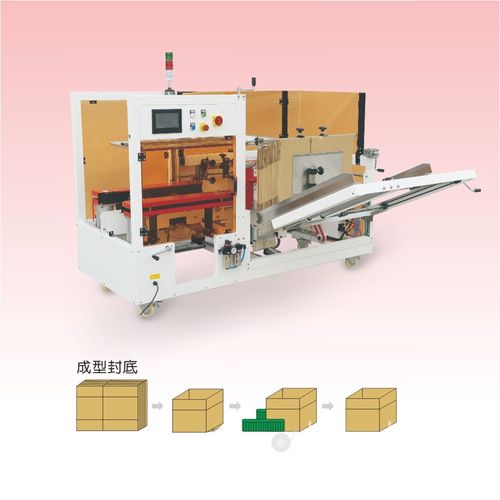
Seal behavior under load: what the freight cycle exposes
A bottom seal that passes an empty-case inspection can still fail after the case is filled. The relevant load is not the flap’s own weight but the column of product pressing down on the bottom, plus vibration in transit and the compression of stacking. Tape holds by a strip across the center seam; if the liner separates under vibration, the strip lifts from one edge and the seal opens even though the adhesive itself never let go. Glue bonds across the overlap between flaps, so the load spreads over a wider joint and the bond fails only if the adhesive itself cracks or the board tears. Tab-lock holds mechanically, but the tab and slot are small features, and on a heavy crate the load concentrates at the slot edge where the board scores easiest.
Drop and stacking tests are the honest way to compare methods for a real load. Ask the supplier to form your blank, fill it to the target weight, and record how each seal performs under a defined stack height and a short vibration or drop cycle. A dry demonstration on an empty box shows only that the machine moves; it does not show whether the bottom survives the route. If the retailer or freight forwarder publishes a test protocol, hand that protocol to the supplier before the FAT so the acceptance criteria are written in numbers rather than a visual check.
Re-open behavior is the other side of the load question. A glued bottom is a permanent bond: opening the case means cutting through the joint or tearing a flap, which matters if the carton returns to the warehouse for repacking. Tape peels and can be renewed with a fresh strip, and a self-locking tab releases without destroying the box. Where the same carton cycles between warehouse and customer, the ability to reopen cleanly can outweigh a small seal-strength advantage, and the sealing method should be chosen to match that loop rather than to the heaviest single shipment.
Comparison table: self-locking, tape and hot-melt side by side
| Criterion | Self-locking bottom | Pressure-sensitive tape | Hot-melt glue |
|---|---|---|---|
| How the bottom closes | Die-cut tabs pass through slots and interlock mechanically | Tape strip bridges the center seam and is rolled onto the board | Adhesive beads on flaps, held under compression while setting |
| Consumable per case | None at the machine; the lock is part of the blank | Tape roll, 48–72 mm wide (50 mm standard) | Hot-melt adhesive, roughly 8–20 g per case depending on bead pattern |
| Consumable cost position | No reorder at the machine; die-cut adds blank cost per box | Moderate per case; cost tracks tape price and meters used | Lowest per case at high volume; adhesive priced by weight |
| Typical erector output | 8–18 cases/min on light blanks; limited by blank stiffness | 8–20 cases/min across standard frames | 15–25 cases/min on high-volume lines |
| Seal strength on loaded cases | Moderate; tabs can pull out on stiff or heavy board | Good for normal loads; edge peel risk on coated or cold board | High across the flap overlap; suited to double-wall and export crates |
| Re-open and reseal | Opens without destroying the box; can be relocked | Peels off; reseals with fresh tape | Must be cut or pried; bond is harder to reopen cleanly |
| Blank requirement | Special die-cut blank; slot and tab accuracy critical | Standard RSC blank; tape-compatible face | Standard RSC blank; adhesive matched to board grade |
| Warm-up at start of shift | None | None | Melter warm-up, typically 10–25 minutes depending on tank size |
| Environment sensitivity | Board warping affects tab fit | Cold, dusty or coated board weakens adhesion | Room temperature and board moisture affect set time; nozzle can clog |
| Cleanup and spill risk | No residue | Adhesive residue on rollers and cutter | Melted adhesive drips; drip tray and nozzle cleaning required |
| Changeover between formats | Guide adjustment; blank die-cut changes with size | Guide and tape-width adjustment, often 10–20 min | Guide adjustment plus bead-pattern setting; 15–25 min on many frames |
| Machine price position | Standard forming frame; no sealing station premium | Standard frame plus tape head; mid entry band | Frame plus melter, hoses and nozzles; upper price band |
| Main limitation | Not suited to heavy, stiff or oversized cases | Seal quality depends on board face and temperature | Warm-up, adhesive inventory and nozzle maintenance |
| Best fit | Light retail and e-commerce blanks that reopen easily | General-purpose lines, mixed board conditions, simple operation | High-volume, loaded or export cases where seal strength matters |
Speed and how the sealing station affects cycle time
Case erectors in this range run 8–25 cases per minute, which translates to a cycle of roughly 2.4 to 7.5 seconds per case. The forming, folding and discharge motions share that cycle; the sealing station adds its own step inside it. Tape sealing adds a short roll-and-cut motion with no dwell, so a tape-format frame keeps pace across the standard range. Glue sealing adds a short compression dwell while the bead sets, which is why glue frames are usually specified at the upper end of the output band where the line volume justifies the station. Self-locking forming has no consumable step, but the blank itself must feed and open cleanly, and light blanks that buckle under the suction cups slow the cycle more than any sealing head.
The headline speed on a brochure is measured on the most favorable case in the range. A larger double-wall blank takes longer to open and fold; a smaller blank can trip the sensors if the frame is sized up. Size the machine at your own dimensions and at 70–80% of the quoted rate across a shift, leaving headroom for feeding interruptions and changeovers. The upstream and downstream stations must accept the same rate: an erector that outruns the packer or case sealer creates a queue, then idle time, and the line loses more to imbalance than the machine gains in peak speed.
Consumable cost: what each method costs over a shift and a year
The machine purchase is the visible cost; over five years the consumables, the changeover labor and the stops from worn parts usually exceed it. Work the consumable comparison on a per-case basis before looking at the frame price. For tape, record the roll width, the meters used per case, the roll length and the delivered price, then divide: a 50 mm tape strip across a 400 mm flap overlap uses about 0.4–0.5 m of tape per bottom. For glue, weigh adhesive consumption on a sample run and convert grams per case to weight per thousand cases, then price the adhesive by kilogram. For self-locking, there is no machine consumable, but the die-cut blank costs more than a standard RSC blank, and that per-box premium repeats on every carton.
The break-even pattern is consistent across plants. At low daily volume, tape or manual forming keeps the cash outlay small, and adhesive inventory and a heated station do not pay back. At high volume on a stable blank, glue per case drops below tape per case because adhesive weighs little and bridges the overlap in a small bead. Self-locking avoids both consumables but shifts the cost into the blank supplier’s die-cut, which only makes sense when the carton spec already calls for a special blank. Compare the five-year total: machine, freight, installation, consumables, power and air, spare parts and the labor the station removes. A machine that saves a dollar on purchase but uses more consumable per case over two shifts a day will reverse that saving inside the warranty period.
Power and air are smaller lines but they are real. A tape-format frame draws roughly 2–4 kW; a glue frame adds melter heater load and typically draws 3–6 kW. Compressed air runs the folder arms and valves at 0.6 MPa, with a free air capacity around 0.3–0.4 m³/min on a standard frame; dry air matters, because moisture in the supply sticks valves and wears cylinders. Glue lines also carry a small standby heat load outside production hours, so confirm how the melter idles or shuts down between shifts.
Consumable availability belongs in the comparison, not as an afterthought. Tape rolls and adhesive pellets or sticks are reordered for the life of the machine, and a grade that cannot be sourced locally turns a short supply gap into a line stop. Check the local distributor for the tape width and adhesive grade your board needs, and confirm the supplier will match the grade written in the specification rather than substituting a general-purpose item on price. For self-locking blanks, the dependency moves to the carton supplier: die-cut slots and tabs must hold tolerance across repeated runs, so the blank source and its tooling matter as much as the machine.
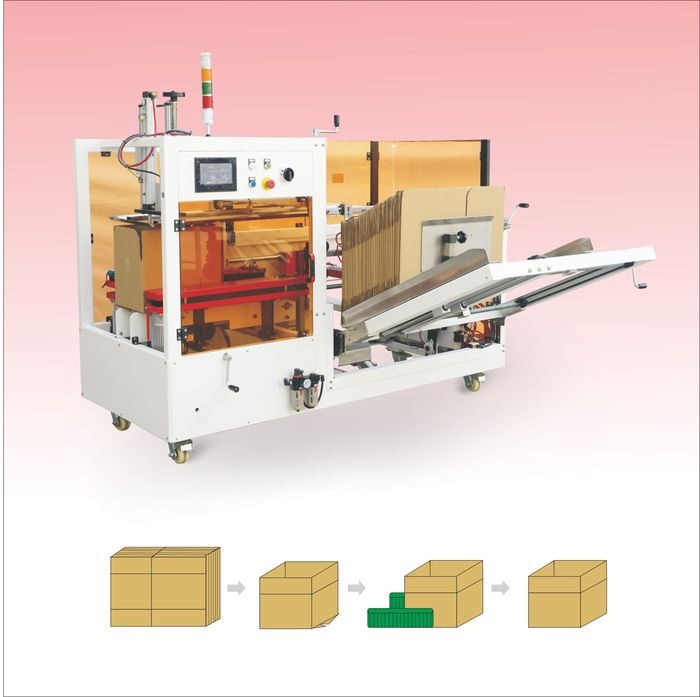
Decision framework: choose the seal in this order
- List every blank: dimensions, flute, board grade, single or double wall, coated or printed, and storage condition. The frame range and the seal method both have to cover the extremes, not the average.
- Record loaded case weight and transport cycle: short internal runs, pallet stacking, export container loading or rough handling. Heavier and harsher transport pushes the choice toward glue and away from tab-lock.
- State the sustained rate and shift pattern. Under about 400 cases a day, hand forming or a simple tape station stays rational; above that, an erector removes a full-time person and the sealing method can be sized to volume.
- Check the board face against the seal. Coated, glossy, dusty or cold board weakens tape; confirm the adhesive grade for glue; confirm die-cut accuracy for self-locking.
- Decide whether the case must be reopened. Retail returns, refillable packs and kit boxes favor a seal that opens without destruction; shipping crates that stay closed favor a permanent bond.
- Match the station to downstream equipment. The top closure is usually a separate case sealer; confirm conveyor height, pitch and the signals the line uses before locking the erector configuration.
- Ask the adhesive or tape supplier to confirm compatibility with your board and room temperature in writing, rather than relying on a general-purpose grade.
Scenario profiles: which seal fits which plant
Light retail and e-commerce fulfillment. Light single-wall blanks, many formats, cases opened for picking or returns. A self-locking blank or a tape-format erector is the usual fit. The priority is fast changeover between sizes and a seal that does not destroy the carton; glue’s dwell and nozzle care add cost a mixed-SKU center does not recover. Where random sizes meet a fixed magazine, that format choice is a separate planning question covered in the existing random-size versus fixed-size comparison.
Food and beverage high-volume lines. Regular blanks run two or three shifts, cases hold liquid or packaged food, and cleanliness is audited. Glue is common here when volume justifies it, because the bead seals the overlap and the station runs at 15–25 cases/min; tape remains the choice where the line changes board condition often or where adhesive residue in a washdown room is a concern. Food-contact declarations and washdown finish are specified alongside the seal method.
Heavy industrial and export crates. Double-wall board, loaded cases, container stacking and rough freight. Tab-lock is the weak link on stiff board; tape can peel at the seam edge under vibration; hot-melt across the flap overlap is the default for this profile. The heavy-duty frame uses larger cups and folder arms, and the adhesive grade is selected for the load and the climate.
Cold, wet or dusty rooms. Tape adhesive loses grip on cold or damp board; glue grade must stay flexible in low temperature; either method needs guards and electrics matched to the washdown or dust level. A self-locking blank avoids both adhesives but depends on board that stays flat and dry, which is hard to guarantee in a wet room.
High-mix, low-volume catalogue. Many case sizes, short runs, frequent changeovers. A dedicated glue melter earns its keep only when one blank runs long enough to absorb warm-up and cleaning. For high mix, a flexible tape-format frame with recipe recall and quick-change guides usually gives the lower five-year cost, even if the per-case consumable looks higher on paper.
Common selection mistakes and how to avoid them
Choosing the seal on machine price alone. The tape head is cheaper than a glue melter at purchase, but a high-volume line can spend the difference in adhesive versus tape within a year. Work the per-case consumable before comparing frame prices, and include the melter’s power and warm-up time in the glue column.
Specifying tab-lock for a loaded double-wall case. The slots and tabs work on light, stiff-enough board; on heavy crate stock the tabs spring out and the slots tear. If the blank is double-wall or the case carries a heavy load, evaluate tape or glue and keep self-locking for the lighter range.
Ignoring board coating and room temperature. A tape that bonds to plain liner fails on glossy coated stock; an adhesive that sets brittle in a cold room splits when the case flexes. Get the consumable supplier’s written compatibility for your board and your lowest working temperature before the order.
Buying the highest-speed frame for a short run. A 25-case/min glue machine held at 8 cases/min on a low-volume line carries the melter standby load, the nozzle maintenance and the larger footprint without recovering the cost. Size output to the sustained target, and reserve the upper band for lines that actually run there.
Leaving the blank specification to the machine builder. The die-cut for self-locking blanks and the board grade for tape or glue are decided upstream. Send drawings and a sample blank with the inquiry so the seal can be validated on real board during the FAT, rather than discovered as a feed or peel problem after installation.
What to bring to the quotation
A precise comparison needs the same inputs for every supplier: smallest and largest blank with flute and grade, loaded case weight, sustained cases per minute and shift pattern, number of formats and changeover frequency, board face condition and storage, working environment (dry, wet, cold, dusty), whether cases must reopen, and the downstream case sealer and conveyor specs. With those in hand, the quotation can match frame range, sealing station and consumable grade to the real application. The current case erector range shows the frames available: the standard case erector for regular single-wall blanks, the heavy-duty case erector for large and double-wall cases, the medium-speed erector at 15–20 boxes/min, the hot-melt glue case erector for tape-free bottoms, and the nail-type carton forming and bottom sealing machine where a mechanical bottom closure is specified.
For the mechanics behind the forming cycle, see the technical walkthrough of how an automatic case erector works, from blank pick-off to bottom sealing. The new glue-format line is described in the SunAura hot-melt case erector launch note. Purchasing teams working out the five-year outlay should read the case erector cost and TCO breakdown, and anyone planning guarding or compliance should check the case erector safety and CE guarding guide. For day-to-day faults, suction-cup wear and format changes, the troubleshooting and changeover guide covers the maintenance side.
Related equipment sits beside the erector in the line: the case sealers close the top after filling, carton sealing machines handle smaller cartons, strapping machines secure pallet loads, conveyors transfer cases between stations, palletizers stack the filled cases, and a complete packaging line ties the stations together. Send blank samples, target rate and loaded weight through the contact desk for an application-matched configuration; the certifications and patents section lists the compliance documentation available with the machine.