What an automatic case erector does, in one cycle
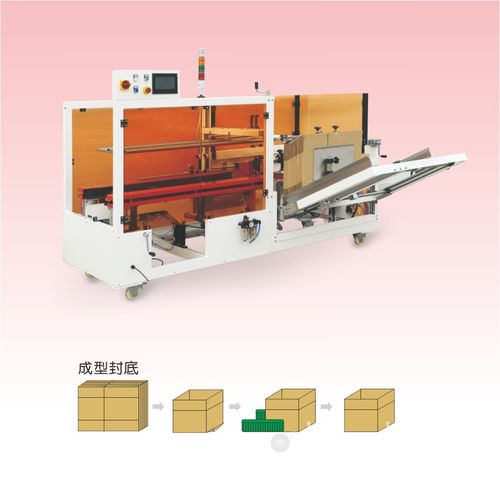
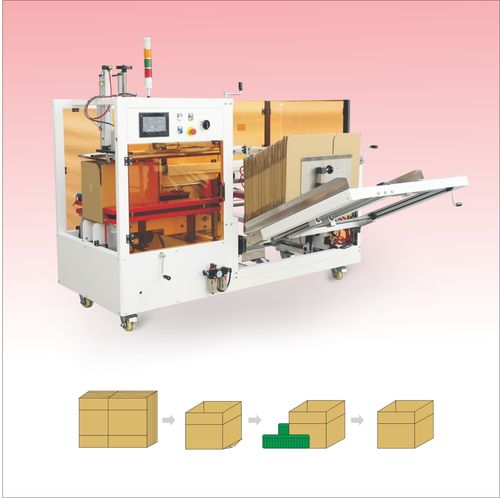
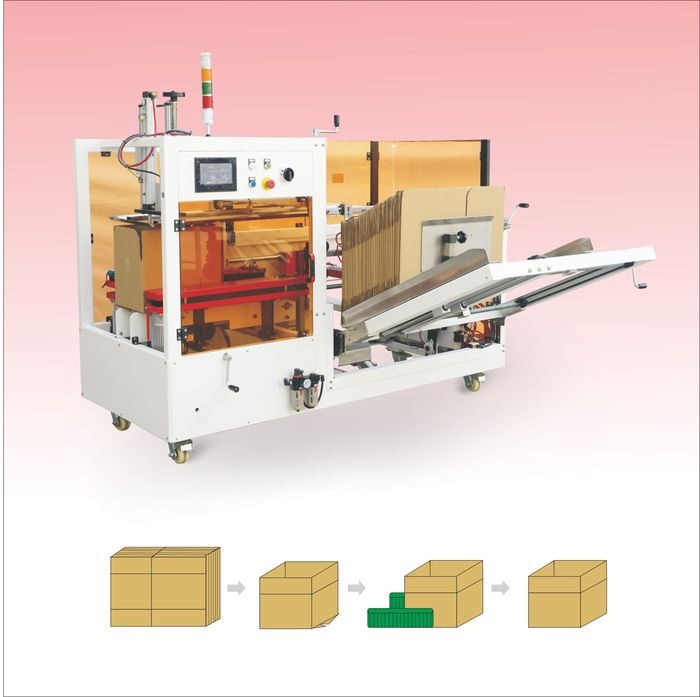
An automatic case erector takes a flat, folded corrugated blank from a stack, opens it into a square tube, folds the bottom flaps and seals the bottom so the case can move to filling. It sits at the start of the end-of-line: before the packer or loader, before the top case sealer, and upstream of strapping and palletizing. A manual or semi-automatic station forms one case at a time by hand; the automatic version repeats the same motions on every blank at a fixed rhythm, and its output is set by the feed, the forming sequence and the condition of the wear parts rather than by operator technique.
This walkthrough follows one blank through the machine and names the assemblies, the motions and the numbers behind them. It covers the standard frames sold in the SunAura range: output 8–25 cases/min, blank size roughly 200×150×100 mm to 600×400×400 mm depending on frame, magazine capacity 50–100 blanks, four to eight suction cups per head, compressed air at 0.6 MPa, and bottom squareness held within about ±2 mm on a guided pneumatic or servo frame. Figures vary with case dimensions, board grade and configuration; the factory acceptance test on your own blank is the number that counts.
Understanding the cycle matters for three reasons. It lets a buyer ask the right questions in a quotation, it tells maintenance where a jam or mis-open originates, and it shows how the erector’s speed and air demand fit the rest of the line. The machine is not a single black box: each station has its own timing, its own wear parts and its own failure mode, and most problems trace to one of those stations rather than to the controls.
The major assemblies
A standard inline erector divides into seven working sections. The blank magazine holds the stack of flat blanks and lifts the top blank into pick position. The vacuum pick-off head carries suction cups that pull one blank away from the stack. The forming frame, sometimes called the plunger or opening section, pulls and guides the blank into a square tube. The flap folder closes the minor flaps first and the major flaps second. The sealing station applies tape or hot-melt glue to the bottom. The discharge conveyor pushes the sealed case toward the next station. The control panel, sensors and guarding tie the sections together and stop the cycle when a blank misfeeds or a guard opens.
Frames share the same base layout even when the sealing method differs. A tape-format erector and a glue-format erector use the same magazine, pick-off and forming sequence; the difference is the station behind the folder: a tape head with roll, roller and cutter on one, a melter, hoses and nozzles on the other. Heavy-duty and large-case frames use larger cups, stronger folder arms and a wider guide spacing, but the cycle order stays the same.
Step 1: blank presentation and magazine lift
The operator loads a stack of flat RSC or die-cut blanks into the magazine, usually through an angled hopper at the side or rear of the frame. A lift mechanism raises the stack so the top blank sits at the pick-off position; as blanks are removed, the lift follows to keep the next blank in range. Magazine capacity on standard frames runs 50–100 blanks, with larger hoppers optional for long runs. Refill causes a brief stop, so on a high-volume line the hopper size is a planning decision: a smaller magazine means more refill interruptions, a larger one means more floor space and a heavier stack to load.
Blank condition sets up everything downstream. Warped, curled or damp board does not sit flat in the hopper, and a blank that shifts in the stack can be picked two at a time or missed entirely. Blanks should be stored flat and dry, and the feed side should be free of paper dust and liner fragments. The magazine guides are set to the blank width at changeover; a guide too tight crushes the stack, too loose lets blanks skew before pick-off.
Step 2: vacuum pick-off
When the cycle calls for a blank, the pick-off head moves to the magazine and four to eight suction cups press against the face of the top blank. Vacuum draws the cups onto the liner, and the head pulls the blank away from the stack. The number and size of cups scale with blank area: small cartons use fewer cups, large double-wall blanks need more and larger cups to hold the stiff board without tearing the liner.
The vacuum source is a small vacuum pump or a regenerative blower mounted on or beside the frame, with a vacuum reservoir and check valves to hold suction through the motion. Cup condition is the first thing to check on a mis-open: porous or cracked cups lose vacuum, hard cups do not seal on the liner, and a worn cup shows as a blank that lifts halfway and drops. Suction cups are a listed wear part, typically replaced on a 6–12 month interval depending on board dust and shift pattern.
A blank that feeds two at a time, or one that skews as it leaves the stack, points back to the magazine guides, the stack condition or the cup pattern rather than the forming section. Sensors at the pick-off confirm a blank is present before the head advances; if no blank is detected, the cycle waits rather than pulling an empty frame through the motions.
Step 3: opening and squaring the case
Once the blank is pulled clear, the forming section opens it from a flat sheet into a rectangular tube. Arms, plunger plates or vacuum-assisted guides catch the sides of the blank and pull them apart while the creases along the score lines fold. The blank’s pre-scored folds do the work; the frame holds the sides square so the corners form at right angles rather than collapsing into a skewed tube. On servo-guided frames the opening motion is position-controlled; on pneumatic frames it is set by cylinder stroke and adjustable stops.
Squareness is the quality number buyers should ask for. A case that leaves the erector out of square jams the top sealer, sits crooked on the pallet and cannot be filled cleanly. Standard frames hold the bottom within roughly ±2 mm on a matched blank; large or stiff double-wall blanks need the wider cup and arm setup described for heavy-duty frames. If the forming arms bend or the guide rails wear, squareness drifts before any other fault shows, so alignment checks belong in the preventive schedule.
Step 4: flap folding
With the case square, the folder closes the bottom flaps in a fixed order. The two minor flaps, the shorter flaps on the sides, fold inward first; the two major flaps, the longer flaps that meet along the center seam, fold second. Folding order matters: a major flap closed before the minor flaps traps board against the seam and produces a crooked bottom. Folder arms are pneumatic, with cam or timed valve actuation matched to the conveyor pitch, and soft contact pads so they do not mark the liner.
Flap fold faults show as a case leaning to one side, a flap standing open at discharge, or a sealed bottom with a visible gap along the seam. The usual causes are worn folder arm bearings, a mistimed valve, or guides set for a different blank size. Folder arm bearings are another listed wear part, commonly inspected at 12–24 month intervals, and the fold timing is checked whenever a new format is run.
Step 5: bottom sealing
The folded case reaches the sealing station, which is configured at purchase for tape or hot-melt glue. On a tape-format machine, a tape head feeds a 48–72 mm packing tape strip across the center seam, a pressure roller beds the tape onto both flaps, and a cutter severs the strip as the case passes. Tape heads are mechanically simple: roll holder, brake, guide, roller and cutter, with width set to the case and board. On a glue-format machine, a heated melter holds adhesive at 150–180 °C, hoses carry it to one or two nozzles, and beads are laid on the inner flap faces; the case is held under compression for a short dwell while the adhesive wets the board and sets.
The sealing station is where the two configurations diverge in operation. Tape needs no warm-up; the first case can run once the roll is loaded. Glue needs melter warm-up, typically 10–25 minutes depending on tank size, and the nozzle and hoses need purge or cleaning at shutdown so adhesive does not set in the lines. Glue consumption runs roughly 8–20 g per case depending on bead pattern and flap overlap; tape use tracks strip length and width. The choice between the two is covered in the self-locking versus tape versus hot-melt comparison; this walkthrough treats the station as one step in the cycle.
Step 6: discharge and the next cycle
After sealing, the discharge conveyor pushes the sealed case forward to the line’s next station. Discharge height and pitch must match the adjacent conveyor or packer; a mismatch creates a transfer plate, a step or a pitch change that catches cases. A sensor confirms the case has left the sealing zone before the next blank is picked, so two cases do not stack in the frame. The empty cycle repeats: magazine lift, pick-off, open, fold, seal, discharge.
On an inline machine the cycle is partly continuous: while one case folds and seals, the next blank is being picked. The stations overlap on a shared conveyor pitch, which is why the rated output depends on the slowest station rather than the fastest. A glue dwell that runs long, or a tape cutter that hesitates, sets the ceiling for the whole machine even if the pick-off and folder are faster.
Spec numbers that belong in a purchase inquiry
| Parameter | Standard band on the range | Why it matters |
|---|---|---|
| Output | 8–25 cases/min, case-size dependent | Large and double-wall blanks run slower; size to sustained rate |
| Blank size | About 200×150×100 mm to 600×400×400 mm per frame | Each frame covers a spread usually under 2:1 in blank length |
| Magazine capacity | 50–100 blanks; larger hopper optional | Determines refill interruptions on long runs |
| Suction cups | 4–8 cups per head, sized to blank area | Worn cups are the commonest cause of mis-open |
| Compressed air | 0.6 MPa, about 0.3–0.4 m³/min free capacity | Dry air required; moisture sticks valves and wears cylinders |
| Power | 2–6 kW, 380 V three-phase; glue frames draw more | Melter heater adds load on glue configurations |
| Tape width | 48–72 mm, 50 mm standard | Wider tape for heavy or rough board |
| Glue temperature | 150–180 °C, hot-melt only | Warm-up at start of shift; nozzle and hose care required |
| Squareness | About ±2 mm on a matched blank | Out-of-square cases jam the downstream sealer |
| Noise | Under 75 dB(A) at 1 m on standard frames | Most noise comes from the vacuum pump or blower |
| Floor area | About 2.4×1.3 m plus 1.2 m service access each side | Service clearance is for the mechanic, not the operator |
Drive systems: vacuum, pneumatics, sensors and controls
Most motions on a standard erector are pneumatic: folder arms, push plates and guide adjustments run off cylinders and directional valves fed by the plant air supply at 0.6 MPa. Vacuum is a separate circuit with its own pump or blower, reservoir and cups. Where position control matters for squareness or format recall, a servo drive replaces a cylinder on the opening or push station; servo frames give repeatable positioning and recipe recall, pneumatic frames keep the purchase price lower and the parts list simpler.
Sensors sit at the decision points: blank present at pick-off, case open at the forming frame, flaps folded before seal, case discharged before the next pick. Proximity or photoelectric sensors confirm each state, and the PLC sequences the stations against the conveyor pitch. Fault states — missing blank, mis-open, flap fault, guard open — stop the cycle and show a code on the HMI. The control panel stores format recipes: blank dimensions, guide positions, fold timing and seal settings, so a changeover can recall a setup rather than rebuild it by hand.
Component brands matter for uptime. Valves, drives, PLC and sensors are bought-in parts whose local availability decides whether a breakdown is a two-day wait or a two-month one. Ask for the component list in the proposal and check local distribution for those brands before the order; this is part of supplier evaluation rather than a specification detail.
Cycle time, rated speed and what the line actually holds
A frame rated at 25 cases/min completes a 2.4-second cycle; a 10-case/min frame runs a 6-second cycle. The rated figure is measured on the most favorable blank in the range, at steady state, without refill or changeover. Across an eight-hour shift, plan on 70–80% of the rated rate once feeding interruptions, brief stops and operator refill are counted. Sizing the machine to the middle of its range leaves mechanical headroom; running a frame at its peak for a full shift wears cups, bearings and valves faster and leaves no margin for a slow batch.
The line balance sets real output more than the erector alone. If the packer downstream runs 12 cases/min and the erector is sized for 25, cases queue between stations and the queue then backs up; if the filler runs faster than the erector, the filler waits. Match the sustained rate of every station in the line, and use the erector’s upstream/downstream signals — case present, consumable low, fault — so the line stops cleanly instead of piling product into a stopped station.
Utility planning: air, power and layout
Site planning fails more often on utilities than on floor area. Confirm the free compressed-air capacity at shift start, when every other machine on the ring main is also drawing air; a marginal air supply shows as slow folder motion and weak vacuum rather than a clear alarm. Air must be dry: moisture in the supply sticks spool valves, corrodes cylinders and shortens seal life. A filter-regulator-lubricator unit at the machine inlet is standard, and the drain or drip tray position should be checked against washdown needs.
Power on a standard tape frame runs roughly 2–4 kW; a glue frame adds melter heater load and typically draws 3–6 kW on a 380 V three-phase, 50 or 60 Hz supply on a dedicated circuit with earth. Ceiling height above the frame needs room for any nozzle lift and the tallest blank; service access of about 1.2 m on the mechanic side must stay clear, because a frame installed against a wall turns a fifteen-minute adjustment into a two-hour dismantling job.
Configurations built on the same base frame
| Configuration | Typical output | Blank fit | Profile and trade-off |
|---|---|---|---|
| Manual box forming | 2–5 cases/min | All sizes by hand | Very low volume; labor intensive, no machine automation |
| Entry tape erector | 8–12 cases/min | Single-wall blanks | Small inline station; limited blank range |
| Medium-speed erector | 12–20 cases/min | 2–3 case sizes | Regular packing runs; magazine refill planned |
| Heavy-duty erector | 10–18 cases/min | Double-wall, large cases | Appliances and heavy crates; heavier footprint |
| Hot-melt glue erector | 15–25 cases/min | High-volume blanks | Fast consumer lines; glue warm-up and nozzle care |
Changeover between formats
When the line switches to a different case size, the magazine guides, pick-off cup spacing, forming rails and folder settings move to the new format. On frames with recipe recall, the operator calls the stored setup and adjusts the guide parts by hand; on simpler frames every setting is manual. Changeover runs 10–20 minutes on a standard tape frame and 15–25 minutes on a glue frame, with extra time if bead patterns or tape width change. How often the line changes formats decides whether quick-change tooling and recipe memory pay back: a line running one blank all shift does not need them, while a high-mix line loses more time to setup than to running.
Record the as-built settings for each format in the manual after commissioning, rather than on a note taped to the frame. A second operator and one mechanic should both know the changeover procedure; a station that depends on one person cannot run weekends or cover leave. The maintenance side of jams, cup wear and changeover is detailed in the troubleshooting and changeover guide.
Installation, commissioning and the first production run
A standard station installs in two to three days; glue variants take longer because the heater, hoses and nozzles are tested separately. The site and utility checklist is agreed one to two weeks before shipment: floor level, ceiling height, power, free air capacity and service clearance. Mechanical installation anchors and aligns the frame to the conveyor height and pitch, then power and air are connected and checked for pressure, dryness and earth continuity. A dry run moves empty blanks through every station by hand before the sealing circuit is enabled, and the calibration and format settings are recorded in the manual rather than on a loose note.
The production trial runs the buyer’s own blank at the target sustained rate, and the acceptance criteria are written in numbers before the order: rate over a set period, squareness, seal appearance, reject count. The FAT at the factory and the site trial after install both use the same criteria. The document pack should include mechanical and electrical drawings, the spare-parts list, the calibration record, the compliance declaration and an English operation and maintenance manual. Training covers operators on start-up, changeover, cleaning and first-level fault finding, and a mechanic on adjustment and wear-part replacement, ending with a written SOP the plant keeps.
How the cycle changes on multi-format and random-size lines
A fixed-size erector holds one blank range for a run; changeover moves the guides and recalls the recipe between formats. A random-size line, typical of e-commerce fulfillment, meets a different case size on almost every pick, so the machine must open, form and seal a new dimension on each cycle without a manual setup. That calls for automatically adjusting guides, sensors that read or signal the incoming size, and a frame wide enough to cover the spread of blanks. Random-size systems are a separate architecture from the standard fixed frames described here; the planning trade-offs between them are documented in the existing random-size versus fixed-size case erector comparison, and they should not be mixed up when sizing a catalog packing line.
For a line that runs two or three common sizes in batches, the standard medium-speed or heavy-duty frame with recipe recall covers the work: batches run one size, the recipe is called at the break, and the spare guides for the other formats stay on the rack. The deciding question is how long a blank runs before the next size appears. Long batches favor a dedicated standard frame; one-off sizes every few minutes favor the random-size architecture; anything in between should be evaluated against the recorded changeover time rather than a brochure speed.
Wear parts and what the schedule should watch
The listed wear items set real uptime more than the main motor does, and they are cheap to hold locally but expensive to wait for after a stop. Suction cups last 6–12 months on dusty board; a worn cup mis-opens or drops blanks. The tape head roller and cutter last 12–24 months before the tape stops cutting or bedding cleanly. Folder arm bearings run 12–24 months; worn bearings show as crooked cases. Glue nozzles need 6–12 month inspection and cleaning, and a blocked nozzle changes the bead pattern before it stops sealing. Keep the first spare kit on site from commissioning and set intervals from observed wear in the first months rather than applying generic figures.
Where the erector sits in the complete line
The sealed bottom case moves to filling, then the top closure is made by a separate case sealer; smaller cartons may go through a carton sealing machine. Filled and sealed cases move on conveyors to palletizers, and loaded pallets may be secured with strapping machines. A turnkey packaging line sequences these stations to a shared pitch and rate. The erector’s own range, including the standard erector, heavy-duty erector, medium-speed model, hot-melt glue erector and nail-type bottom sealing machine, is listed on the case erectors family page.
Compliance and guarding are specified alongside the cycle: interlocked guards, hot-melt burn protection on glue frames and the CE-related requirements covered in the case erector safety and CE guarding guide. For the purchase side, machine price bands, consumable comparisons and payback are worked through in the automatic case erector cost and TCO breakdown. The new glue-format machine from SunAura is described in the hot-melt case erector launch note.
To specify a frame to your own blanks, send smallest and largest case dimensions, board grade, sustained rate and shift pattern, the number of formats, and the working environment through the contact desk. Documentation and compliance declarations for installed machines are listed in the certifications and patents section, and background on the manufacturer is on the about us page.