Semi-Automatic vs Fully Automatic Pallet Wrapper: Choosing Stretch-Wrap Automation by Load Volume, Labor and Dock Flow
Most buyers do not start out wanting a pallet wrapper. They start out tired of watching two people spend ten minutes on every load, fighting film that tears and corners that crush, and wondering whether the answer is a basic turntable or a fully wired line that runs without an operator. The honest problem is that the two machines look almost identical from ten metres away — a round table, a vertical mast, a roll of stretch film — but they ask very different things of a factory. Specify the cheaper semi-automatic on a high-volume dock and it becomes a bottleneck with a queue of forklifts waiting. Specify a fully automatic in a small warehouse that wraps a dozen loads a shift and you have paid for conveyors and sensors that will never earn their money.
At SunAura Machinery we build both configurations, and the useful starting point is that neither is the better machine. They are answers to different questions. A semi-automatic wrapper keeps a human in the loop: an operator attaches the film, starts the cycle and cuts the tail. A fully automatic wrapper, often called an online or in-line machine, takes the load from a conveyor, wraps it and discharges it with nobody touching the film. The right choice is set by how many pallets you move, what labor costs, and whether the wrapper sits inside a synchronized line or stands alone at the end of the floor.
What a Semi-Automatic Pallet Wrapper Actually Does
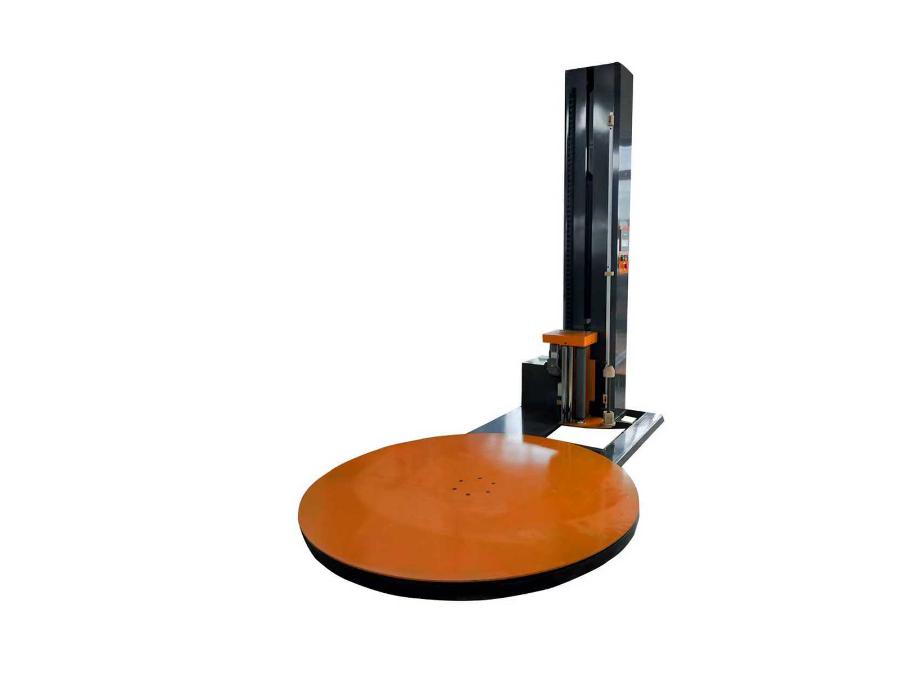
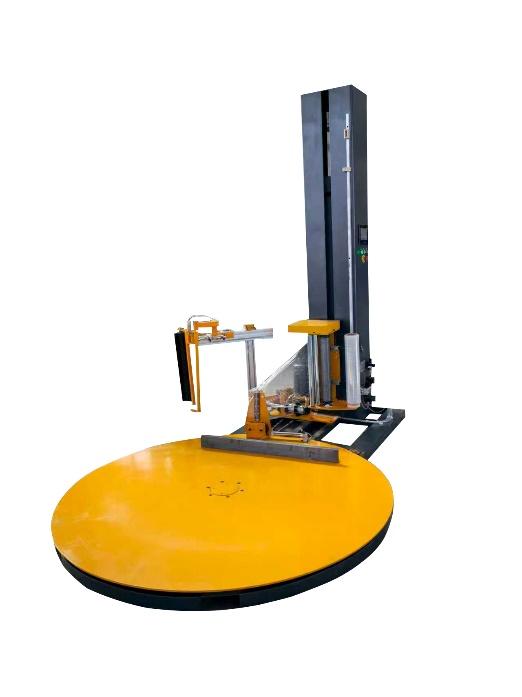
The semi-automatic turntable wrapper is the simplest powered option. The operator places the load on the rotating table with a forklift or hand pallet jack, pulls the film tail out and clamps it to the load, then starts the cycle from a control panel or a foot switch. The turntable rotates while the film carriage climbs the mast, wrapping the load from the bottom to the top according to a set number of top and bottom revolutions. At the end the machine stops, the operator cuts the film and presses the tail down, and the load is taken away. The operator does not push the load or walk around it, but they are involved at the start and end of every single cycle.
That involvement is precisely what keeps the price down. There is no powered conveyor in or out, no automatic film clamp and cut, and no need to tie the machine into the line’s controls. A semi-automatic machine is delivered, anchored, plugged in and running, and it can be moved later if the layout changes. It suits a facility that wraps loads in batches, where a single operator can run the wrapper between other tasks and the pace is set by the forklift rather than a fixed production rate.
What a Fully Automatic Online Wrapper Does Differently
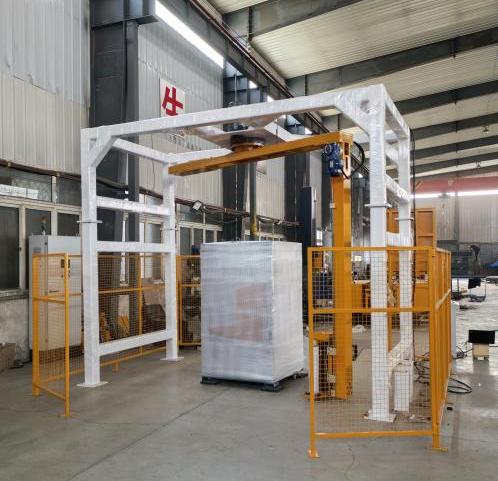
The fully automatic online wrapper is built to run inside a conveyor line. The load arrives on a powered conveyor, is indexed onto the wrapping station, and the machine clamps the film, wraps the load, cuts the tail and discharges it onto an out-feed conveyor — all on its own, triggered by a photo-eye or a signal from the line PLC. There is no operator at the machine. The film is applied at a repeatable tension and a fixed wrap pattern, and the throughput is governed by the conveyor speed and the number of revolutions rather than by how fast someone can walk between loads.
This is where the extra money goes. An automatic machine needs in-feed and out-feed conveyors, an automatic film clamp and cut mechanism, sensors and safety guarding, and integration with whatever feeds it. In return it removes the operator entirely, holds a steady cycle time across a whole shift, and can be paired with a palletizer and stretch wrapper in one continuous end-of-line flow. It is the correct answer when the wrapper is not a standalone station but one link in a line that cannot stop and wait for a person.
Where the Semi-Automatic Earns Its Keep
The semi-automatic is the rational choice for low-to-moderate volume. As a rough guide, suppliers rate these machines at roughly 20 to 30 loads per hour as a maximum, but real-world throughput is lower because the operator needs time to place the load, attach the film and remove it. If you wrap somewhere in the range of a few dozen to a hundred pallets a day, often in bursts rather than a continuous stream, the semi-automatic handles the work without forcing you to redesign the floor. It is also the forgiving choice for mixed loads and irregular sizes, because the operator can adjust the film and watch each load rather than relying on a fixed automatic cycle.
The limits are tied directly to the person. Throughput cannot exceed the operator’s pace, and the machine is idle while they walk or drive to fetch the next load. Labor cost is recurring for every shift, and quality depends on the operator — a rushed worker who skips top wraps or leaves a loose tail produces a load that fails in the container. The semi-automatic also cannot be fed directly by an automatic palletizer without someone bridging the gap, so it is a poor fit for a genuinely continuous line. Treat it as a machine that removes the hard physical work of hand wrapping but keeps the human decision in the cycle.
Where the Fully Automatic Earns Its Keep
The fully automatic wrapper pays back when volume is high and steady. Suppliers commonly rate online turntable machines from around 30 to 60 or more loads per hour, and because there is no operator between cycles, the machine can sustain that rate across the shift. If you are wrapping well over a hundred pallets a day, running multiple shifts, or feeding the wrapper straight from an automatic palletizer, the labor saved and the steady cycle justify the higher capital. Wrap quality becomes repeatable rather than dependent on which worker is on the station, and the machine can be integrated into a single end-of-line control system with the palletizer and conveyors.
The trade-off is cost and rigidity. An automatic wrapper needs conveyors and controls, so the installed price is substantially higher, and it requires a floor layout that can feed and discharge loads in a fixed direction. It is harder to relocate, and a fault in the conveyor or a sensor can stop the whole line rather than one machine. It is also easy to over-specify: a fully automatic line that runs at a fraction of its capacity is a lot of capital sitting idle, and very small or very irregular loads may still need manual handling. The discipline is to automate only when the upstream line genuinely delivers a continuous flow.
The Third Option: When Neither Turntable Is Right
Some loads should not be spun at all. A turntable rotates the product, which is a problem for very light, unstable or tall loads that can topple under film tension, and for loads that are too heavy or fragile to turn. In those cases the correct machine is a rotary-arm wrapper, which keeps the load stationary while an arm carrying the film rotates around it. A rotary-arm can reach high throughputs, often 60 to 120 loads per hour, and is commonly used in high-speed and heavy-load plants. If your reason for hesitating is that the load itself is the problem rather than the volume, the decision is not semi-automatic versus automatic — it is turntable versus rotary arm.
Selection Table: Semi-Automatic and Fully Automatic Side by Side
| Dimension | Semi-automatic wrapper | Fully automatic online wrapper |
|---|---|---|
| Operator role | Attaches and cuts film every load | None at the machine; fully automatic |
| Indicative throughput | Roughly 20–30 loads/h, pace-limited | Roughly 30–60+ loads/h, steady |
| Relative capital cost | Lower; no conveyors or integration | Higher; conveyors, sensors and controls |
| Installation | Plug in and run; easy to relocate | Fixed conveyor integration and guarding |
| Labor requirement | One operator per shift | Supervision only; no dedicated operator |
| Wrap consistency | Depends on the operator | Repeatable cycle on every load |
| Maintenance burden | Low; drive and controls only | Conveyors, sensors, clamp and cut |
| Best fit | Batch work, mixed loads, standalone station | Continuous high-volume end-of-line flow |