
QINGDAO, China — October 12, 2026 — SunAura Machinery has shipped a fully automatic filling, capping and labeling line to a bottled water producer in Southeast Asia, combining a 12-head piston filler, automatic capping turret, and rotary labeling station into one integrated system. The line runs at up to 60 bottles per minute in 500ml and 1.5L formats, and it replaces a three-machine patchwork that required four operators and produced inconsistent fill levels.
The customer’s problem is familiar to any beverage plant that outgrew its first equipment. Their existing line was a mix of a used filler, a hand-fed capper, and a semi-automatic labeler — each from a different supplier, each with its own control panel, and each breaking at a different time. Fill levels varied by ±15ml on the 1.5L format, which meant giveaway on every bottle and a recurring short-fill complaint from the distributor. The plant manager wanted one supplier, one warranty, and one PLC.
Line Configuration
The delivered line runs three stations in sequence — filling, capping, and labeling — with a single control system:
| Station | Equipment | Key Specification |
|---|---|---|
| Filling | 12-head piston filler | Up to 60 bottles/min, ±2ml repeatability |
| Capping | Automatic capping turret | In-line cap feeding, torque adjustable |
| Labeling | Rotary labeler | Wrap-around label, ±1mm placement |
| Control | Single PLC + HMI | Recipe per format, changeover < 15 min |
The 12-head piston filler doses each bottle with a servo-driven piston stroke, giving the repeatability that the customer’s previous filler lacked — and the format change from 500ml to 1.5L is a recipe recall, not a mechanical adjustment. The complete filling range, from linear to rotary configurations, is documented on the liquid filling machines page and the automatic linear filling machine page, with the piston configuration detailed on the 12-head piston filling machine page.
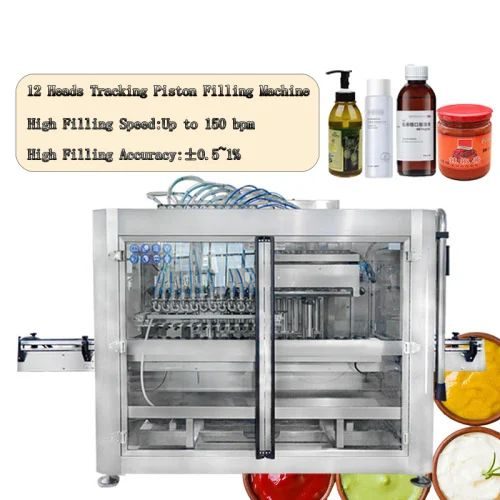
Filler Type Selection: Piston, Gravity, or Overflow
The filler type is the first specification decision on a liquid line, and it depends on the product’s viscosity and foaming behavior:
| Factor | Piston Filler | Gravity Filler | Overflow Filler |
|---|---|---|---|
| Best for | Viscous and semi-viscous liquids | Free-flowing thin liquids | Products filled to a visible level |
| Accuracy | ±1–2ml, volume-dosed | ±2–5ml, time or valve controlled | Level-based, consistent fill height |
| Foaming | Low risk | Can foam on thin products | Low risk, gentle fill |
| Examples | Oil, sauce, honey, cream, water (accurate dosing) | Water, juice, thin beverages | Bottles where fill level is the spec |
For the bottled water application, the piston filler was specified for its dosing accuracy — the customer’s giveaway was worth more than the price difference between filler types. Buyers running free-flowing products in high volume should compare the gravity configuration before defaulting to piston: the same accuracy conversation applies to every line, and the wrong filler type is a giveaway problem that lasts the life of the machine. The selection framework, including the accuracy math, is covered in the liquid filling machine buying guide.
The Case for a Single-Supplier Integrated Line
The customer’s history — a used filler from one source, a hand-fed capper from another, a labeler from a third — is the strongest argument for buying the complete line from one manufacturer. The integration costs that the customer paid in the old configuration were invisible in the purchase price:
Control integration: three machines, three panels, three spare parts sets. The integrated line has one PLC, one HMI, and one diagnostics view — the maintenance team troubleshoots from a single screen instead of walking three machine locations.
Changeover: on the old line, format change took 45 minutes and involved three operators adjusting three machines. The integrated line’s recipe stores the bottle height, fill volume, cap torque, and label position per format — changeover runs under 15 minutes with one operator.
Line balance: the old line’s stations ran at different speeds, so buffers accumulated between machines and one station always starved or backed up. The integrated line’s speeds are matched by design, with the conveyor section sized for the natural variation — the same balance logic applied in the end-of-line automation framework.
Warranty and support: one warranty, one support line, one spare parts contract. When the line has an issue, the question “which supplier owns this problem?” never comes up. SunAura’s 48-hour spare parts dispatch program covers the whole line from one warehouse.
Commissioning Findings From the Bottled Water Installation
Three findings from commissioning apply to most beverage line projects:
Bottle dimensional consistency decides the line’s reliability: the customer’s bottles came from two mold suppliers, and one supplier’s bottles varied in neck finish dimensions. The capping turret torque varied with the neck variation, and the labeler’s positioning drifted on the affected bottles. The fix was a bottle specification agreed with the supplier, and the capper’s torque verification at commissioning. Bottle quality is a line input, not a packaging detail.
Water temperature changes fill volume: the piston filler doses by volume, and the water’s temperature affects the density enough to shift the fill weight. The customer’s plant draws water at different temperatures through the day, so the recipe now includes a temperature compensation factor on the fill volume. Plants filling temperature-sensitive liquids should specify this in the recipe design.
Cap and label changeover is the real format change: the bottle format change is quick; the cap diameter and label size changes take the time. The line’s changeover includes cap turret tooling and label reel swap, and the recipe stores both — the 15-minute changeover figure includes the tooling swap, verified at FAT with the customer’s actual caps and labels.
Integrating the Line With Upstream and Downstream Equipment
The filling line sits between the bottle infeed and the case packing operation, and the integration decisions determine whether the line flows:
Bottle infeed and rinsing: bottles enter from the rinser on a conveyor matched to the filler’s pitch — the conveyor selection method is covered in the conveyor selection guide. On this line, an accumulation buffer of 80 bottles between the rinser and filler absorbs the rinser’s start-stop behavior without starving the filler.
Labeled bottle transport to case packing: the labeled bottles exit to the case packing section, where the same food and beverage packaging line integration applies — case erecting, packing, and sealing at the line’s speed. The customer’s line pairs the filler with an automatic case packer, completing the run from rinser to pallet.
Full production line deliveries: for plants building the complete operation at once, the filling, capping and labeling line is also available as part of a full production line — the same configuration delivered as the fully automatic filling, capping and labeling production line for edible oil and viscous liquids, and the linear configuration covered in the household chemical filling line delivery from earlier this month.
Budget Reality and Payback
A complete filling, capping and labeling line for bottled water runs from roughly $45,000 for a mid-speed linear configuration to $120,000 for a high-speed rotary line, depending on head count, capper type, and labeler configuration. The payback is driven by three numbers:
| Cost Element | Old Patchwork Line | Integrated Line |
|---|---|---|
| Operators | 4 per shift | 1 per shift |
| Fill accuracy | ±15ml on 1.5L | ±2ml |
| Giveaway per 1.5L bottle | Up to 10ml average | Under 2ml |
| Changeover time | 45 min, 3 operators | <15 min, 1 operator |
| Spare parts sets | 3 vendors | 1 contract |
For the customer’s 60 bottles per minute operation running two shifts, the payback projection landed at 14 months — with the giveaway reduction alone contributing about a third of the savings. The OEE calculation guide published this week covers how to measure the availability and performance gains after the line lands, and the new vs used packaging machine guide from today covers whether the refurbished alternative makes sense at this scale.
Maintenance Profile
The integrated line’s maintenance concentrates in the filler’s piston seals, the capper’s torque mechanism, and the labeler’s feed system:
- Daily: flush the filler heads at shift end, clean the capping chute, wipe the labeler’s glue or adhesive rollers
- Weekly: check the piston seal condition, verify the capper torque on a test bottle, clean the label sensor optics
- Monthly: verify the filler’s dose accuracy with a test batch, inspect the capping turret tooling wear, check the label placement tolerance
- Quarterly: replace piston seals on the schedule, calibrate the torque setting, full inspection of the label feed and cut mechanism
The piston seal replacement is the line’s main planned cost — the seals are the consumable that defines the filler’s accuracy, and replacing them on schedule keeps the ±2ml spec. Seals and the other consumables ship under SunAura’s 48-hour spare parts dispatch program, and the full stocking method for a beverage line is covered in the packaging machine spare parts strategy guide.
Frequently Asked Questions
What is the difference between a linear and a rotary filling line?
A linear line moves bottles in a straight line, filling in sequence — simpler, lower cost, and typical to about 40–60 bottles per minute depending on head count. A rotary line fills bottles on a rotating carousel — bottles are filled in parallel, reaching 100+ bottles per minute, at a higher cost and larger footprint. The crossover is roughly 50–60 bottles per minute for most liquid products: below it, the linear configuration is the better value; above it, rotary pays. The linear configuration for this range is covered on the automatic linear filling machine page.
How accurate is a piston filler on thin liquids like water?
A servo-driven piston filler holds ±1–2ml on thin liquids — the accuracy comes from the servo stroke control, not the product viscosity. The common misconception is that piston fillers are only for thick products; in practice, the piston configuration is chosen for accuracy, and it handles water, juice, and thin beverages well. The tradeoff is speed on very high-volume water lines, where gravity or overflow fillers run faster with acceptable accuracy for that product class.
Can the same line fill both water and viscous liquids?
Yes, within the filler’s head configuration — the piston heads handle both, and the recipe stores the fill volume per product. The practical limits are the capper’s cap size range and the labeler’s label format range: a line specified for water bottles (narrow neck, small cap) needs tooling changes for wide-mouth viscous containers. Lines that plan to run both product classes should specify the dual-range capper and labeler at the start — retrofitting a cap size range is expensive.
What is the lead time for a complete filling line?
A standard filling, capping and labeling line runs 6–8 weeks lead time, including the FAT with the customer’s bottles, caps, and labels. Custom configurations — high-speed rotary, dual-range capping, special labeling — extend it to 10–12 weeks. As with most packaging machinery, the critical path is the tooling for the bottle and cap formats, so those specifications should be finalized early. The same lead-time logic applies to the machines in the broader range.
Do I need a checkweigher on a filling line?
For bottled products, the filler’s accuracy is the primary control, but a checkweigher after the capper catches the failures that the filler cannot — missing caps, missing labels, and the occasional dosing error. It costs a fraction of the line and provides the OEE quality data that the availability calculation needs. The customer’s line includes one between the capper and labeler, positioned so a reject can be diverted before the label is applied.
Availability and Support
The fully automatic filling, capping and labeling line is available for order with SunAura’s standard export package: FAT with customer bottles and caps, installation supervision, operator training, CE certification, and an 18-month warranty on servo and mechanical components. To discuss your bottle formats, fill accuracy targets, and line speed with the applications engineering team, contact SunAura Machinery.
About SunAura Machinery
SunAura Machinery is a packaging equipment manufacturer based in Qingdao, China, exporting to more than 100 countries. The company’s liquid filling range covers piston, gravity, and overflow fillers, capping and labeling stations, and the complete filling lines that integrate them — plus the conveying, case packing, and palletizing equipment that completes beverage operations, all CE certified. SunAura is exhibiting the full range this week at All in Print China 2026 in Shanghai.
Editorial note: Specifications and payback figures reflect the referenced installation and are subject to change. Contact SunAura Machinery for current configuration options.