A continuous band sealer combines hot metal blocks, moving conveyor belts, a nip point at the belt entry, an embossing wheel and a 220 V or 380 V electrical load in one open station. The same motion that seals 40–120 pouches per minute also creates burn, pinch and electrical hazards if guards, interlocks and operator procedures are missing. This post maps the hazard classes on a band sealer, the CE machinery-guarding standards that apply, the guards and emergency stops a compliant machine should carry, food-contact material expectations for pouch sealing, and a pre-shift safety checklist operators can run every shift. The machine classes referenced are listed on the band sealer product family page; the mechanical stages that create these hazards are explained in the companion post on how a continuous band sealer works.
Buyers sourcing sealers for EU, UK or food-export markets should treat guarding as part of the machine specification, not a dealer option added after delivery. A frame that runs unguarded in a domestic workshop may fail a customer audit, an internal site review or a CE conformity check before it reaches the packing line. The sections below set out what to look for in the machine itself, what paperwork should accompany it, and what the operator SOP must cover. For the purchase-cost side of the decision, the band-sealer TCO breakdown prices guarding and compliance as a line item; for day-to-day upkeep that keeps guards and heat controls working, see the band sealer troubleshooting and changeover guide.
Hazard classes on a continuous band sealer
A risk review starts by listing the energy sources and moving parts an operator can contact during feeding, jam clearing, cleaning and changeover. Band sealers do not use a reciprocating jaw, but they keep belts, heaters and drive running continuously while bags pass through, which changes the hazard pattern from intermittent jaw crush to constant nip and heat exposure.
Hot-block burn risk
The heater pair holds seal temperature anywhere from 130 °C to 300 °C depending on film structure; PE pouches seal near 130–180 °C, PP and laminated structures near 160–230 °C, and thick foil laminates may run above 230 °C. The aluminum blocks and the first centimeter of PTFE belt backing sit at or near that temperature during running. A hand reaching to free a wrinkled pouch, wipe a film scrape or adjust the seal bar can contact a surface well above the pain and burn threshold. Warm-up takes 3–5 minutes from cold, and blocks stay hot for several minutes after the heater switches off, so burn risk does not end when the machine stops feeding. Surface temperature on uninsulated blocks can exceed 200 °C; even insulated housings near the heater can reach 60–90 °C under prolonged running.
Belt nip and pinch points
The upper and lower PTFE belts converge at the feed throat, wrap around idler rollers, and pull against the drive roller. Fingers, loose sleeve cuffs, hair, gloves or cleaning cloths can be drawn into the nip at belt entry or around an exposed roller. Belt speed runs 0–12 m/min on standard machines, up to 15 m/min on high-volume models; at 10 m/min the belt moves about 167 mm per second, fast enough to pull a loose item into the rollers before the operator can pull back. The embossing or date-coding wheel adds a shear point where the knurled roller meets the belt, and the drive chain or gearbox at the motor end adds another moving-part hazard if left uncovered.
Electrical and thermal hazards
A professional sealer draws a heater pair of 0.7–0.9 kW plus a conveyor motor of 40–90 W, with cooling fans and temperature control wiring running along the frame. Damaged cable insulation, loose terminals, missing earth connection or water ingress during washdown can produce shock risk or overheating. Over-temperature risk sits in the control loop: if the thermostat or PID sensor drifts, a backup over-temperature cut-out should disconnect the heater before the block reaches a temperature that degrades the PTFE belt, melts film onto the bar or starts a smolder in film scraps collected under the track.
Fumes, static and dust
Heated film releases small amounts of polymer fumes; on 60–120 µm laminated pouches, foil laminates, printed film and moisture-rich product residues, those fumes can carry odor and visible vapor at higher temperatures. Dry snack, powder or granule dust collecting under the track raises both a housekeeping issue and, in concentrations the plant should measure, an ignition concern. Static charge on low-humidity film can discharge to the operator or pull scraps toward the belts. These hazards do not replace the guarding review, but they set expectations for local exhaust ventilation, housekeeping frequency and the cleaning procedure after each run.
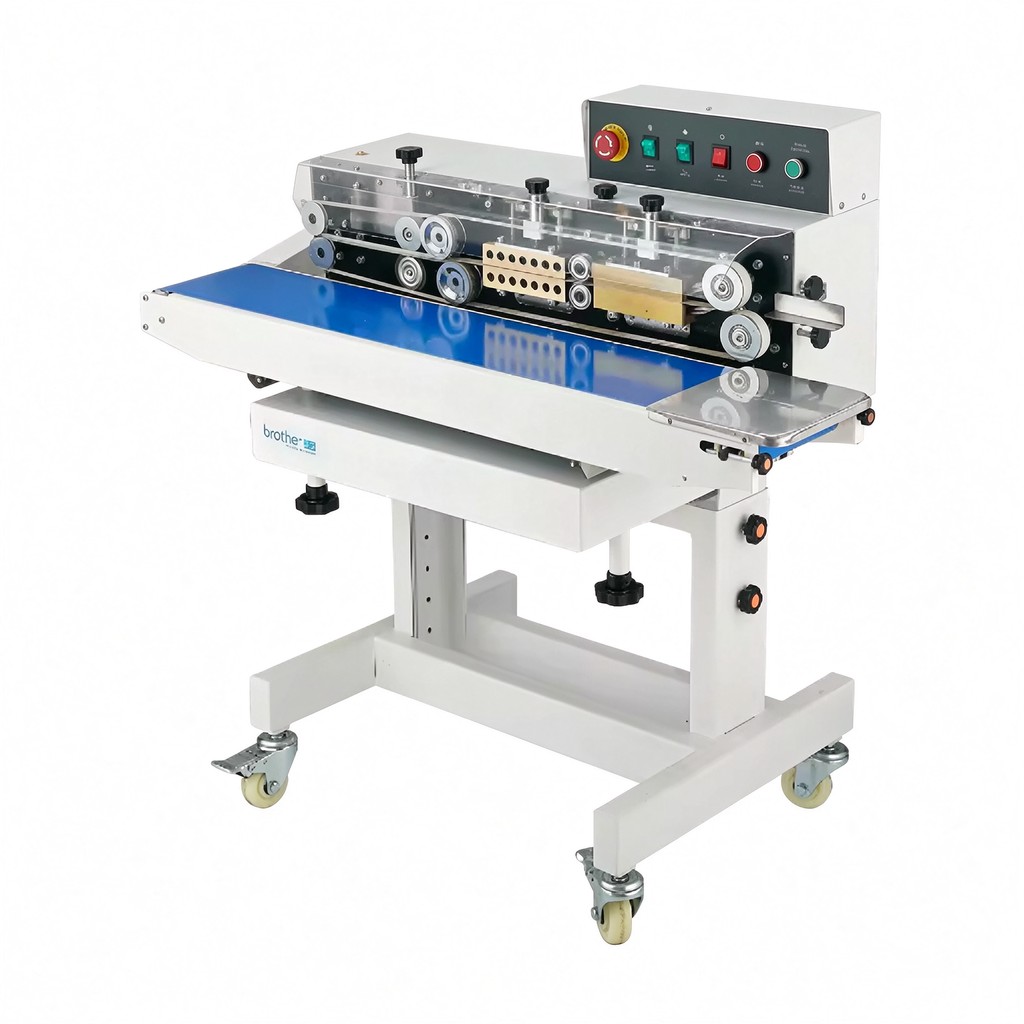
CE machinery compliance and the standards that apply
For machines placed on the EU market, the Machinery Directive 2006/42/EC sets the legal frame: the manufacturer must carry out a risk assessment, reduce identified hazards by design or guarding, compile technical documentation, issue a Declaration of Conformity, and affix the CE marking. Band sealers sold into food packaging typically align with a group of harmonized and related standards that buyers can ask the supplier to reference in the documentation. No single standard certifies a band sealer on its own; the conformity claim rests on the risk assessment plus the guards, controls and documentation listed below.
| Area | Reference standard / expectation | What it requires on the sealer |
|---|---|---|
| Risk assessment | EN ISO 12100: risk assessment and risk reduction | Documented list of hazards (heat, nip, electrical, fumes), estimated severity and exposure, and the measure chosen for each |
| Guarding design | ISO 14120 / EN 953: fixed and movable guards | Guards fastened so removal requires a tool; openings sized below finger or hand access; guards do not create new nip points |
| Safety distances | ISO 13857: distances to prevent reaching hazard zones | Feed and discharge openings sized so fingers cannot reach the heater or nip; guard mesh or slot dimensions matched to hand-access limits |
| Interlocking guards | ISO 14119: interlocking devices associated with guards | A removable guard opens a switch that stops heater and belt before the hazard zone is reachable; the switch cannot be defeated by a simple latch |
| Emergency stop | ISO 13850: emergency stop function | Red mushroom-head actuator on yellow background, reachable from feed and discharge, latches off and resets only by intentional action after the machine is safe |
| Electrical equipment | EN 60204-1: electrical equipment of machines | Isolation means, protective earth bonding, cable strain relief, short-circuit and overload protection, control-circuit safety |
| Safety-related control | ISO 13849-1: performance level for control parts | Interlock and e-stop circuits sized to a performance level matched to the risk; wiring and relays rated for repeated cycles |
| Hot surfaces | ISO 13732-1 / EN 563: surface temperature limits | Accessible housings kept below short-contact touch limits, or marked as hot and guarded; warning labels placed at the heater zone |
The Declaration of Conformity should identify the machine model, the directives and standards applied, the manufacturer, and the place and date of issue. Buyers should ask for it before placing an order, along with the user manual covering installation, guarding, adjustment, cleaning and spare parts. Machines supplied outside the EU carry equivalent national requirements; the same hazard logic applies even where CE marking itself is not required. SunAura publishes its certification background on the certifications and patents page, and model details can be checked against the product listings in the band sealer family.
Guards and interlocks a compliant band sealer should carry
Fixed guards over the heater and belt nip
The heater housing should be enclosed on top and sides so the block cannot be touched during running. The belt entry and the roller ends should be covered by sheet-metal, perforated-sheet or wire-mesh guards; mesh openings follow ISO 13857 access limits, with smaller slots near hotter or sharper zones. Fixed guards fasten with screws or tool-release clips, not friction fits that an operator can lift aside mid-run. The feed throat and discharge opening remain open only as wide as needed for the pouch passing through; a wide open gap over the heater is a common audit finding even on otherwise complete machines.
Interlocked access panels
Where a panel must open for belt replacement, cleaning or element service, the panel should carry an interlock switch that cuts the heater supply and stops the belt when opened. On a compliant circuit, opening the guard does not merely disable a warning light; it removes power from the hazard motion, and restarting requires closing the guard and pressing reset. Interlock switches should be mounted so a bypass cannot be held closed by wedging the panel, and the switch actuator survives repeated opening cycles. Machines sold with an interlocked panel should show that function in the manual and in the control-circuit description.
Emergency stop placement and function
The emergency stop should be reachable by the operator feeding bags and by anyone at the discharge end without stepping around the machine. It takes the form of a red mushroom-head button on a yellow surround, latching in the off position when pressed. Pressing it stops belt motion and cuts the heater; the machine does not restart when the button is released, but waits for an intentional twist or pull to reset. On line-integrated sealers, the e-stop should also signal upstream and downstream equipment per the line’s safety circuit. A second e-stop at the main control box is acceptable when the feed-side button covers the operator’s normal working position; a single button buried behind the heater housing does not meet that expectation.
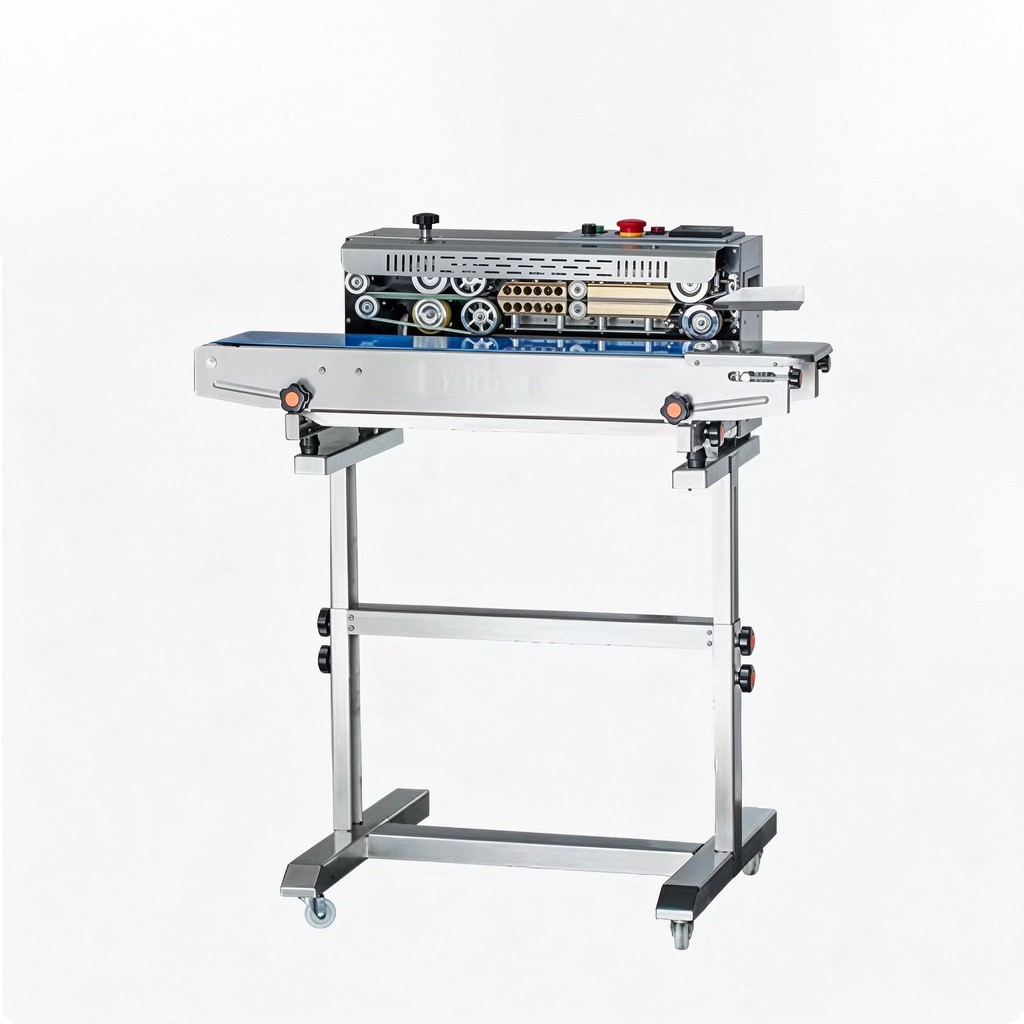
Heat insulation and hot-surface marking
Accessible housings around the heater should carry insulation so touch surfaces stay below the short-contact temperature limit defined in ISO 13732-1; for bare metal that limit sits near 48 °C for brief hand contact, with lower values for prolonged contact and higher-risk materials. Where a guard surface cannot be held below that limit, it should be physically out of reach or marked with a hot-surface warning symbol and text. The manual should state the working temperature range and warn that blocks remain hot after shutdown. PTFE belt backing near the block should be checked for degradation at each service interval; overheated PTFE releases fumes and leaves a glazed surface that no longer seals evenly.
Electrical safety on the sealer
Beyond the directive-level review, the electrical build should show an isolation switch or plug disconnection point, protective earth bonding across frame and panels, and cable runs secured against belt contact and cleaning spray. Heater wiring uses heat-rated insulation kept clear of the block; motor and fan cables run in conduit or clipped looms. The control circuit fuses or breakers match heater and motor current, and the temperature sensor has a separate over-temperature cut-out that trips independently of the main controller. For washdown environments, enclosures carrying electrical parts should match the ingress rating the cleaning method requires; a standard open control box on a machine hosed down after every shift is a shock and corrosion risk.
Voltage and frequency must match the site supply before the first run. A 220 V/50 Hz machine on a 110 V/60 Hz site will under-power the heater and mis-speed the motor; a 380 V three-phase machine needs a confirmed three-phase supply and local protection. Commissioning should include an earth-continuity check and an insulation check where the supplier’s manual calls for one, recorded in the machine’s maintenance file. The troubleshooting guide covers the temperature faults and belt tracking issues that appear when the control loop or drive is not set correctly.
Food-contact materials and hygiene build
For pouch sealing of food, the parts that touch the bag exterior or sit above the product zone should be grade-appropriate: stainless 304 or 316 contact surfaces, food-grade PTFE on the belts, and food-safe lubricants on bearings where lubricant can reach the product zone. The frame should avoid ledges, dead corners and unsealed weld seams where product dust or moisture collects; surfaces should wipe or wash down without disassembly beyond normal guard removal. Sealing itself does not contact the food inside the pouch, but drips, dust and belt fragments can transfer to bag exteriors, so the hygiene standard applies to the whole station, not only the seal bar. Buyers selling into regulated food markets should ask which contact materials the supplier lists in the technical file and whether declarations for those materials are available.
Cleaning frequency follows product type. Dry snack and powder runs need a brush-and-vacuum clean under the track each shift; oily or moist products need a wipe-down with the approved detergent, followed by a rinse and dry. Solvents that attack PTFE or painted finishes should not be used on the belts. Guard panels removed for cleaning go back on before restart; a machine run with a guard propped open after a washdown is a recurring audit finding.
Operator training, SOP and personal protective equipment
Guards reduce exposure; the operating procedure controls the behavior that bypasses them. The SOP should cover start-up after warm-up, feed technique, seal inspection, jam clearing, guard use, cleaning and shut-down. Jam clearing is the highest-risk task: the operator should stop the belt, switch off or isolate the heater, allow blocks to cool to a safe touch temperature, and only then reach into the track to free a wrinkled or folded pouch. Reaching into a running machine to pull a jammed bag is the most common cause of belt-nip and burn incidents on band sealers.
- Loose sleeves, drawstrings, necklaces and long hair are secured before feeding; rolling sleeves and tying hair back are standard requirements.
- Gloves are evaluated against the nip hazard: bulky gloves increase the risk of being drawn into the belt, while heat-resistant gloves are used only for off-line service after isolation, not for feeding a running machine.
- No guard is removed, interlock defeated or e-stop tied down during production; adjustments that need access to the heater or rollers follow the lock-out, cool-down and service procedure.
- Each operator completes a documented training session before running the machine alone; training records list the date, trainer and the tasks covered.
- Spills, film scraps and accumulated dust are cleared on the scheduled housekeeping rounds, not left until the end of shift.
- A damaged guard, failing interlock, loose cable or sticking e-stop is reported and the machine tagged out until repaired.
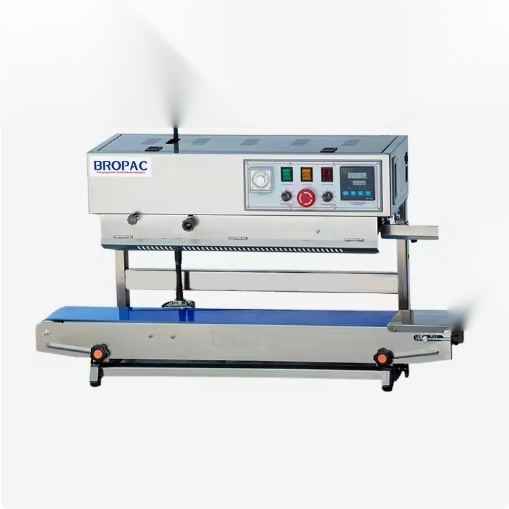
How guarding differs across the three build classes
Guarding expectations scale with how exposed the station is and who operates it. An entry benchtop band sealer in a supervised workshop usually ships with basic heater covers and an exposed drive end; it suits dry, low-duty sealing where a trained operator stays at the machine and no public traffic passes behind it. Buyers should still confirm the heater top is covered, the belt nip has a throat guard, and an e-stop or disconnect is within reach. If the machine later moves to a production floor, the open frame may need added guards and an interlocked service panel before it passes an internal review.
A professional stand model on casters typically carries enclosed heater housings, side guards over the belt track, a control-panel e-stop and guarded roller ends. This class is the common fit for single-shift food and snack packing; the stand height positions the track at operator waist level, which reduces reaching over hot surfaces during feeding. A stainless line-integrated build goes further: interlocked access panels, ingress-rated electrical enclosures, guarded drive chain, and a safety-circuit interface that lets the line controller stop the sealer from upstream or downstream equipment. The stand heat band sealer and the stand 2-in-1 band sealer represent the middle class; the automatic continuous band sealer represents the line-integrated end. When comparing quotes, ask which guards and interlocks are standard and which are listed as optional, because the optional list is where guarding cost tends to hide.
The site file for each sealer should hold the delivery record, conformity documents, manual, training sign-off, e-stop and interlock test results, and the spare-parts list. Auditors commonly ask to see that the safety checks on the pre-shift checklist were recorded over recent shifts, not only at commissioning. Keeping one folder per machine, updated after each service visit, shortens any customer or certification audit and makes it clear when a guard or interlock has been replaced after repair.
Common audit non-conformances and corrections
The table below lists findings reviewers raise most often on band sealers, the expectation they fail, and the correction that closes them. Most corrections are mechanical or procedural; the ones that require new guards or interlocks should be quoted before purchase rather than retrofitted after an audit failure.
| Finding | Expectation failed | Correction |
|---|---|---|
| Heater block exposed along the top and sides | Guarding of hot surfaces, ISO 14120 / ISO 13732-1 | Fit fixed insulation guards over the housing; keep touch surfaces below limit or mark hot zones |
| Belt entry gap wide enough to insert fingers | Safety distances, ISO 13857 | Narrow the throat opening or add perforated guarding sized to block hand access to the nip |
| Service panel opens without stopping heater or belt | Interlocking guards, ISO 14119 | Fit a guard interlock switch wired to cut heater supply and drive; verify reset sequence |
| No emergency stop within reach of the feed side | Emergency stop, ISO 13850 | Mount a latching red mushroom-head e-stop on yellow surround at the feed position |
| Earth bond missing on a removable panel or motor | Electrical protection, EN 60204-1 | Fit earth bonding strap; check continuity before return to service |
| No independent over-temperature cut-out | Thermal over-temperature protection | Add a backup cut-out that disconnects the heater above the rated ceiling |
| Interlock switch wedged or bypassed in production | Safety-related control, ISO 13849-1; SOP compliance | Remove the bypass, train operators, tag-out procedure for service-only guard removal |
| Cleaning spray reaching open electrical enclosure | Ingress rating for washdown | Upgrade enclosure rating or relocate controls; seal cable entries |
| No documented risk assessment or Declaration of Conformity | Machinery Directive 2006/42/EC documentation | Obtain the technical file, risk assessment and DoC from the supplier before installation |
Pre-shift safety checklist
A short checklist run at the start of each shift catches guard, control and housekeeping faults before bags are sealed. The lead operator signs or records the check; any failed item puts the machine on hold until the correction is made.
- Confirm all fixed guards are in place and fastened; interlock panels close fully without wedging.
- Test the emergency stop: press at feed side, confirm belt and heater cut out, reset only after the machine is safe.
- Check cables and conduits for damage, strain relief and belt contact; report frayed insulation before start-up.
- Confirm the temperature readout matches the film recipe; let the machine complete its 3–5 minute warm-up before feeding production bags.
- Inspect PTFE belts for glaze, cuts, fraying or tracking off-center; note wear for the service schedule.
- Clear film scraps, powder and product residue from under the track and around the heater zone.
- Verify warning labels on hot surfaces are legible; confirm spare guards and parts are stored where service staff can reach them.
- Confirm the operator on shift has current training and knows the jam-clearing and lock-out procedure.
How maintenance protects the guarding package
Guards and interlocks degrade the same way belts and elements do: loose fasteners, worn switch actuators, cracked guard panels and cable fatigue accumulate between service visits. The maintenance schedule should include checking guard fixings each week, testing interlock switches and e-stop function each month, and inspecting heater insulation and earth bonding at the annual service. Belt replacement and heater service follow the lock-out and cool-down sequence; guards are refitted and interlocks verified before the machine returns to production. The full service intervals, wear-part life and fault diagnosis are laid out in the maintenance and troubleshooting post.
Machine build class changes the guarding baseline. Entry open-frame benchtop sealers carry the least enclosure and suit dry, low-duty workshop use under supervised operation; professional stand models ship with heater guards and control-panel e-stops as standard; stainless and line-integrated builds add interlocked panels, ingress-rated enclosures and interface signals for the line safety circuit. The automatic continuous band sealer, SF150LD professional band sealer, stand 2-in-1 band sealer, vertical ink coding band sealer and horizontal ink printing band sealer listings show which guarding and control features each build carries.
Cross-checks before machine acceptance
Before signing off delivery, compare the received machine against the order: guards present as quoted, e-stop reachable and functional, interlock switches wired, contact materials matching the food-contact claim, manual and conformity documents in the language required for the site, and electrical rating matching the supply. Run a short trial at the recipe temperature and inspect seam quality and guard temperatures after 20–30 minutes of running. Record the serial number, delivery date, training date and spare-parts list in the site’s equipment file.
The rest of this cluster covers the adjacent decisions: the band sealer vs impulse sealer comparison contrasts constant-motion sealing against manual jaw sealing on throughput and consistency; the technical deep dive walks through heater blocks, PTFE belts, cooling section and date coding with temperature and speed figures; the nitrogen gas-flush band sealer post covers inert-gas purging on the sealing track; the TCO breakdown prices the machine, consumables, power and labor over three years; and the troubleshooting and changeover guide keeps seals consistent through daily operation.
Buyers with guarding, food-contact or certification questions can review the full band sealer product range, check the certifications and patents overview, read equipment updates in the news section, or send site supply, film type and guarding requirements through the contact page. The about-us page describes the workshop and export support behind the machine supply.