
A continuous band sealer costs more than a hand-held jaw sealer on the purchase line, and less than a full pre-made pouch fill-seal line on the capital budget. The number buyers actually need is not the sticker price alone: it is the three-year total spent on the machine, its PTFE belts and seal-bar tape, electricity, film scrap, operator hours and downtime before the next capital review. This post breaks continuous band sealer cost into machine price bands, consumable wear, power draw, labor comparison against manual sealing, and worked payback examples for bakeries, snack co-packers and coffee roasters. The machine family behind every figure here sits on the band sealer product family page, where each build class is listed with its belt speed, seal width and bag range.
The machine pulls a pre-made bag or pouch through two moving PTFE/PFE conveyor belts, past heated blocks that melt the inner sealant layer, then through cooling blocks and a knurled embossing or date-coding wheel. Because the seam is formed in constant motion, one operator feeds bags while the machine seals at a steady belt speed rather than waiting for a jaw to open and close. How that motion translates into price, wear and labor is covered below. If you want the mechanical side first, read the companion post on how a continuous band sealer works; if your decision is jaw sealing against constant motion, the band sealer vs impulse sealer comparison lays out the throughput and seal-consistency trade-offs.
What moves the up-front purchase price
Band sealer pricing in the USD market falls into six recognizable bands. The bands below are reference ranges for standard machines sold to packaging buyers in food, snacks, hardware, cosmetics and pharmaceuticals; exact quotes depend on voltage, coding option, guarding level, certification and freight to the destination port. Within any band, the price moves with four decisions: painted carbon steel versus stainless steel contact parts, analog temperature control versus digital PID, a short cooling section versus an extended one, and plain embossing versus solid-ink or ink-jet date coding.
| Build class | Typical construction and control | Throughput envelope | Reference price band (USD) | Where it fits |
|---|---|---|---|---|
| Manual hand heat sealer | Hinged jaw, impulse heat, no conveyor; operator clamps each bag | 10–20 bags/min; single seal length up to 300–400 mm | $80–$250 | Low-volume batch packing, samples, spare backup |
| Entry benchtop band sealer | Painted frame, analog or basic digital temp, one heater pair, short cooling track | Belt 0–10 m/min; seal width 6–8 mm; 40–60 W motor | $900–$1,700 | Small pouches 60–100 µm, single shift, light duty |
| Professional stand band sealer | Painted or plated steel on casters, digital PID 0–300 °C, embossing wheel | Belt 0–12 m/min; seal width 8–10 mm; heater 0.7–0.9 kW; 60 W motor | $1,700–$3,000 | Medium run rates, snack and dry goods, one operator feeding |
| Stainless, vertical or 2-in-1 build | SS contact parts, vertical feed for stand-up pouches, horizontal and vertical orientation in one frame | Belt 0–12 m/min; bag width up to 300–400 mm; ink coding option | $3,000–$5,200 | Stand-up coffee and snack pouches, washdown zones, mixed bag formats |
| High-volume stainless line model | Longer cooling section, reinforced frame, conveyor interface, variable drive to 15 m/min | Up to 15 m/min; 90 W motor; two heater pairs available | $5,200–$7,000 | Co-pack plants, multi-shift running, integration with feed conveyor and reject |
| Nitrogen gas-flush band sealer | Gas manifold and ring blower on the sealing track, purge before the heated blocks | Gas purge 5–15 L/min N₂; same speed and seal-width envelope as the class above | $6,500–$12,000 | Coffee, nuts, fried snacks where residual oxygen drives shelf life |
A turnkey arrangement that adds an indexing feed conveyor, product counter, reject gate, check weigher or secondary printer pushes the total above $12,000, but that scope belongs to a packaging line rather than a single sealer. For buyers starting from a manual jaw setup, the closest comparison point is the manual hand heat sealer listed in the same family; for a first continuous-motion machine, the automatic continuous band sealer and the SF150LD professional band sealer sit in the middle two bands.
Why two machines in the same band can differ by $1,000
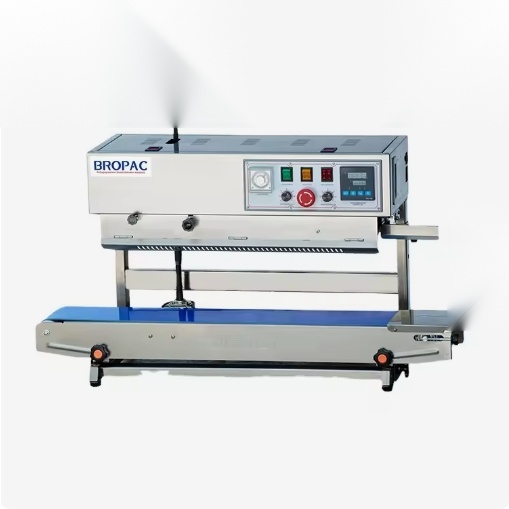
Two sealers quoted side by side can share a belt speed range and a seal width but land in different price bands because of parts the buyer does not see in the showroom photo. The first is contact-material grade: painted steel survives dry goods but corrodes in salty, acidic or humid environments, where stainless 304 or 316 contact parts are the only durable choice and add roughly 15–30% to the price. The second is temperature control: an analog dial holds a setpoint loosely and drifts as mains voltage and ambient temperature change, while a digital PID controller holds within about ±5 °C and pays back in fewer weak seals. The third is cooling length: a short track lets the seal set under belt pressure for one or two seconds; an extended track adds two to four seconds of cooling, which matters for thick laminates and for pouches that are handled immediately after sealing. The fourth is coding: a knurled embossing wheel costs little and presses date codes into the film by pressure, while solid-ink coding adds a ribbon feed and print head, and ink-jet coding adds a fluid system, pump and periodic cleaning.
Certification and market paperwork also move price. A machine built to CE machinery-guarding expectations with interlocked panels and a clearly rated emergency stop carries more fabrication cost than an open-frame domestic build; buyers shipping into the EU should treat this as a line item in the quote, not an afterthought, and the band sealer safety and CE compliance post lists what the guarding review should cover. Voltage and frequency matter as well: a 220 V/50 Hz machine specified for a 110 V/60 Hz site needs a motor and heater rebalance, and a 380 V three-phase supply may require a local transformer the buyer must source. Freight, crating, import duty and dealer markup typically add 15–35% on top of the machine price for international shipments, so a $2,200 machine quoted ex-works can reach $2,900–$3,000 landed.
Total cost of ownership beyond the purchase price
Three-year TCO for a band sealer usually splits into five buckets: capital purchase, electricity, wear consumables, labor, and scrap plus downtime. Buyers who compare only the first bucket routinely underestimate the machine they need, or buy a cheap frame that wears out its belts and heaters twice as fast. The sections below set numbers for a single-shift site running 8 hours a day, 250 production days a year, with a 60–120 µm laminated pouch on a 0–12 m/min professional-class machine. Adjust the figures if your plant runs two or three shifts; consumable life shortens roughly in proportion to open-sealing hours.
Electrical consumption
A professional band sealer draws two electrical loads at the same time. The heater pair runs about 0.7–0.9 kW while bringing the blocks up to temperature, then cycles on and off to hold setpoint; the conveyor motor runs 40–90 W continuously while bags move through. Warm-up takes 3–5 minutes from cold, during which the heater draws full load. Once at working temperature, the average electrical draw drops to roughly 0.25–0.45 kW, depending on seal temperature, ambient air and film thickness. At an industrial rate of $0.12 per kWh, that works out to about 700 kWh per year for 8-hour single-shift running, or roughly $85 per year; including warm-up cycles and cooler ambient months, a realistic annual electricity budget is $110–$150. A high-volume machine with two heater pairs and a 90 W motor lands near the top of that range, and a gas-flush variant adds the ring blower, typically another 60–120 W, plus the nitrogen itself.
Nitrogen is metered separately from the machine’s power bill. The gas-flush band sealer purges a headspace envelope at 5–15 L/min during the pass; at 8 L/min average, an 8-hour shift consumes roughly 3,840 L, about 3.8 Nm³ per day, or 960 Nm³ over 250 days. Whether that gas comes from delivered cylinders or an on-site generator is a supply decision covered in the nitrogen gas-flush band sealer product page and the gas-flush machine news post; buyers should price gas per Nm³ before signing off on the flush option.
Wear consumables: belts, tape, elements and coding parts
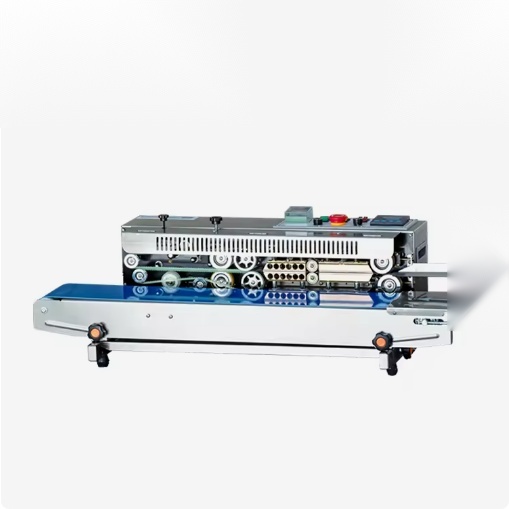
The PTFE/PFE conveyor belts are the first consumable every owner learns to plan for. Each machine runs an upper and a lower belt; they carry the pouch against the heated blocks and protect the film from direct contact with the metal. Belt life depends on seal temperature, film structure, belt tension and cleaning schedule. At 180–220 °C sealing temperature on laminated snack pouches under single-shift duty, a belt typically lasts 6–12 months; above 240 °C, or on two-shift running, that drops to 3–6 months. Replacement belts run $25–$60 each, and a full upper-and-lower swap takes 30–90 minutes depending on frame access. Stocking one spare set on the shelf avoids a stopped line waiting on freight.
Secondary consumables stack up month by month. PTFE sealing tape over the heat bars or belt backing sheets wears through at contact points and costs $8–$15 per roll; a single-shift plant re-tapes roughly once a month. Heating elements draw thermal cycles every run day and typically last 3–5 years, with a replacement element at $30–$70 each; a machine with two elements carries two such line items. The knurled embossing wheel wears its date letters after several hundred thousand impressions and runs $20–$40 to replace. Solid-ink coding adds ribbon or ink cartridge consumption; ink-jet coding adds cleaning fluid and periodic print-head service. None of these items is large on its own, but a machine bought without a spare-parts list accumulates $150–$350 per year in consumables under normal duty, and more at high temperature or multi-shift running.
Film wear and scrap allowance
Sealing film itself is not a machine consumable, but the machine’s setup quality decides how much film becomes scrap. A new operator, a film change or a temperature mis-set produces wrinkled, weak or open seals that must be rejected. Experienced plants budget 0.5–2% of pouches as seal-related scrap; a poorly matched machine or untrained operator can push that to 4–6%, which on an 80 µm laminate at $3.50 per kg and 12 g per pouch is a direct material loss. Changeover scrap is highest in the first 10–30 seals after a setup; the band sealer troubleshooting and changeover guide walks through the seal-by-seal checks that shorten that ramp. Over a year, the difference between a 1% scrap rate and a 4% scrap rate on 500,000 pouches is 15,000 pouches of film and product, often worth more than the machine’s annual consumable budget.
Labor: the largest TCO line for most buyers
Labor is where continuous sealing earns its purchase price. A manual impulse jaw sealer lets one operator seal 12–20 small pouches per minute, and that operator stays at the machine the whole shift: placing the pouch, pressing the jaw, waiting for the cool cycle, removing the pouch, repeating. A band sealer running 8–12 m/min passes 40–120 small pouches per minute on the same single operator, who now feeds bags and inspects seals rather than working the jaw cycle. On a pouch that takes 2.5 seconds to seal manually, the jaw machine needs roughly 24 operator-minutes per 100 pouches; the band sealer needs roughly 0.8–1.5 operator-minutes per 100 pouches at feed speed. At a fully loaded wage of $15 per hour, that gap is about $6 per 100 pouches manually against $0.20–$0.38 per 100 pouches on the band sealer.
The labor comparison changes with pouch size and product handling. A large stand-up pouch that must be held square and checked by hand may still need a dedicated operator even on a vertical band sealer; a tiny snack pouch that slides onto the belt lets the same person pack cases or run a filler between feeds. Before quoting, time the current manual operation with a stopwatch: bags sealed per hour, operator count, rejects per hour, and how often the jaw cool cycle holds the next bag. That measured number, not a catalog bags-per-minute figure, is the labor baseline for the payback calculation.
Spare parts, service and downtime
Downtime cost depends on what the sealer feeds. On a standalone packing station, a broken belt means delayed dispatch rather than a stopped plant. On an integrated line where filler, weigher and sealer run in sequence, one stopped sealer blocks the upstream equipment and idles several operators. Service cost splits into warranty response, travel and labor, and parts availability. Machines sold through a dealer network usually carry a 6–12 month parts warranty; a direct factory relationship shortens the spare-parts route but may mean the buyer handles troubleshooting by phone or video first. Buyers running multi-shift lines should ask the supplier which parts ship from local stock and which come from the factory, because a two-week heater or belt wait on a critical seal station is the single largest downtime cost in the TCO model.
Three-year TCO comparison across sealing methods
The table below puts the four common choices on the same three-year basis for a plant packing about 180,000 pouches per year on one shift. Labor figures use a $15/h fully loaded wage; consumables use the ranges above; scrap is held at the plant’s measured rate. These are planning numbers, not quotes, and they move with local wage rates, film cost and shift count.
| Cost line (3 years) | Manual impulse jaw sealer | Entry benchtop band sealer | Professional stand band sealer | High-volume stainless band sealer |
|---|---|---|---|---|
| Purchase price | $80–$250 | $900–$1,700 | $1,700–$3,000 | $5,200–$7,000 |
| Electricity over 3 years | $10–$25 | $250–$350 | $330–$450 | $450–$600 |
| Consumables over 3 years | $30–$80 (jaw elements, foam pad) | $450–$700 (belts, tape, elements) | $500–$900 (belts, tape, elements, coding) | $700–$1,200 (two belts sets, elements, coding service) |
| Labor over 3 years | $21,000–$30,000 (near-full-time operator) | $3,200–$4,800 (feed and inspect) | $2,800–$4,200 (feed and inspect) | $2,400–$3,600 (line attendant) |
| Scrap allowance | $300–$900 (jaw timing variation) | $400–$800 | $300–$700 | $250–$600 |
| Indicative 3-year total | $21,400–$31,000 | $5,200–$8,300 | $5,600–$9,300 | $9,000–$13,000 |
The manual sealer’s low purchase price disappears under the labor line: it remains the right choice only for low annual pouch counts where the operator has other packing duties to fill the shift. The entry band sealer makes sense where run rates are moderate and the budget cannot stretch to a stand model, but its analog control and shorter cooling track cost more in weak seals as film thickness rises. The professional stand class is where most single-shift food and snack buyers land, balancing purchase price against control quality and parts access. The high-volume stainless model pays back only where multi-shift output, washdown conditions or line integration justify the frame.
Worked payback examples
Small bakery moving from jaw sealing to a professional band sealer
A small bakery packs 600 foil-laminated bread and pastry bags per day across an 8-hour shift, currently sealed on two manual jaw sealers staffed by one operator who splits time between sealing and packing. Measured manually, the team seals about 16 bags per minute and loses roughly 3% of bags to jaw-timing variation or misaligned seams. A professional stand band sealer quoted at $2,400 landed, with spare belts and tape, replaces the two jaw sealers and cuts the sealing portion of the operator’s day from about 3.5 hours to 1 hour. The freed 2.5 hours per day, at $15/h, is about $11,250 over a year; reduced scrap on 150,000 annual bags, dropping from 3% to 1%, saves another $900–$1,400 in film and product. Payback lands in roughly 3–5 months on labor alone, or 6–14 months if the operator cannot be reassigned and the saving counts only scrap and sealing speed.
Snack co-packer adding a second sealing station
A co-packer runs 4,000 snack pouches per day across two shifts, using one entry band sealer that frequently trips weak seals on 100–120 µm laminates at high speed. Replacing it with a high-volume stainless model at $6,000–$6,500, with extended cooling and a 90 W motor, lifts consistent sealing speed from about 8 m/min to 12–14 m/min and cuts reject seals from 4% to under 1.5%. On 1.0 million annual pouches, the 2.5% scrap reduction is 25,000 pouches; at $0.18 product-plus-film per pouch, that is about $4,500 per year recovered, plus the second shift’s labor saved from reworking rejected bags. Payback typically lands between 4 and 9 months once rework labor is counted.
Coffee roaster buying a gas-flush band sealer
A coffee roaster packs 250 g valve bags of roasted coffee and needs nitrogen flush before sealing to slow staling. The gas-flush band sealer lands at $7,000–$10,000 depending on coding and conveyor interface, with nitrogen at the site’s delivered or generated cost. The payback here is not primarily labor: the machine replaces hand-flushed bags sealed on a jaw, but the larger line item is shelf life and returns. Bags sealed without proper flush oxidize faster, producing stale complaints and repeat shipments; roasters who track return rates usually quote the gas-flush option against the value of rejected or discounted product, not against sealing speed alone. The coffee bag sealing machine listing and the gas-flush product page carry the valve-bag orientation and purge details for this case.
Hidden cost drivers buyers miss in the quote
Several costs do not appear on the supplier’s invoice but show up in the first year of operation. The first is undersizing for film: a machine rated for 60–80 µm film will struggle on 120–200 µm laminates, running hotter, wearing belts faster and producing weak seals at the seam center. Match the machine’s heater wattage and cooling length to the thickest film on the packing list, not the thinnest. The second is speed mismatch: buying a 0–10 m/min entry frame for a line that later needs 12 m/min means a second purchase when volume grows. The third is floor layout: horizontal sealers need a feed side and a discharge side with case-packing room; vertical sealers stand taller and need headroom above the frame. The fourth is training: an operator who has never set PID temperature, tracked a belt or adjusted the embossing wheel will burn film and belts in the first weeks; budget a half-day of setup walkthrough at commissioning, whether from the supplier’s engineer or a trained internal lead.
Guarding and compliance are a cost driver as much as a safety one. An open-frame machine bought cheap for a domestic workshop may need panel guards, an interlocked access door and a wired emergency stop before it passes a CE or internal site safety review; retrofitting those after delivery costs more than ordering them built in. The guarding standards and checklist are laid out in the band sealer safety post. The fifth hidden driver is parts availability: non-standard belt widths, custom heater lengths or odd voltage markings mean replacements wait on factory freight. Before purchase, ask which wear parts are standard catalog items and whether the supplier keeps spares for the model you are quoting.
Sizing the machine to the bag and run rate
Price bands aside, the right machine is the one matched to four measurable inputs. Bag material: polyethylene, polypropylene, OPP, PET-aluminum foil laminate or coextruded structures each seal at a different temperature window, typically 130–220 °C for PE, 150–230 °C for PP and laminated structures; the machine’s heater must hold the upper end of that window without cycling off. Bag thickness: 30–60 µm thin films seal at lower temperature and lower pressure, while 100–200 µm laminates need more heat dwell and a longer cooling track to set before handling. Bag dimensions: horizontal sealers carry bags by their lower edge and suit flat pouches; vertical sealers hold stand-up pouches upright and suit bags with gussets, valves or heavy fill weights. Run rate: convert target bags per hour to belt speed using bag length on the seal line; a 150 mm pouch sealed at 10 m/min passes about 110 pouches per minute theoretically, minus feed and inspection gaps, so size the drive for the real feed rate rather than the catalog maximum.
Orientation decides between the horizontal and vertical families in the product range. The stand heat band sealer carries vertical stand-up pouches; the stand 2-in-1 band sealer switches between horizontal and vertical bags on one frame; the vertical ink coding band sealer adds date printing to the upright feed; the horizontal ink printing band sealer does the same on the flat-pouch track. If the line later adds gas flush, the nitrogen variant shares the same frame envelope. For a hands-on comparison of machine classes, the full band sealer product family groups these builds side by side.
Questions to answer before the supplier quote
- Film structure and thickness range: which materials, minimum and maximum µm, and whether foil or metallized layers sit in the seal line.
- Pouch dimensions: length, width, gusset depth, fill weight, and whether the pouch stands upright or lies flat.
- Target output: bags per hour, bags per day, number of shifts, and the seasonal peak that sets the required speed.
- Seal requirements: required seal width in mm, peel strength target such as 4–6 N/15 mm, leak-test method, and whether dates or batch codes must print on the seam.
- Site conditions: mains voltage and frequency, ambient temperature, humidity, washdown frequency, floor space and headroom.
- Compliance target: CE machinery guarding, food-contact material grade, or any customer-specific audit standard the machine must meet.
- Consumable plan: which belts, tapes, elements and coding supplies the supplier stocks, and the lead time for each spare part.
Bringing those answers to the quote stage keeps the comparison on like-for-like machines. A price comparison between an entry frame and a stainless line model tells you little if the film thickness, shift count and guarding level were not stated. Buyers who want the mechanical reference point before pricing can review the heating blocks, PTFE belts and cooling section explanation; buyers deciding jaw versus constant motion can check the band sealer vs impulse sealer comparison; and buyers adding inert gas should read the nitrogen gas-flush band sealer overview before sizing purge rate.
Planning the purchase against the cluster
A band sealer purchase splits naturally into four decisions covered across this cluster: which sealing motion fits the bag, how the machine forms the seam, what safety and guarding level the site requires, and how the team keeps seals consistent through daily changeovers. This post set the cost and TCO frame. The X-vs-Y comparison covers motion choice; the technical deep dive covers the heater, belt, cooling and coding stages with temperature and speed numbers; the compliance post covers hot-block guarding, emergency stops and food-grade build; and the maintenance and changeover post covers weak seals, belt tracking and the maintenance schedule that protects the investment over its service life.
SunAura supplies the continuous band sealer family across horizontal, vertical, 2-in-1 and gas-flush builds, with spare belts, tapes and coding parts listed alongside each model. Prospective buyers can review the band sealer product range, check certification and workshop background on the certifications and patents page, read recent equipment updates in the news section, or send bag dimensions, film spec and daily volume through the contact page for a sized quote and consumable estimate. The about-us page outlines the workshop and export support behind the machine supply.