Two ways to close a pouch: constant-motion band sealing versus manual jaw impulse sealing
A pre-made bag or pouch leaves the filler with an open top seam. Two machine families close that seam on real production floors. An impulse sealer clamps the filled bag between two heated jaws, runs a short current through a nichrome wire to melt the inner sealant layer, holds the jaw closed while the film cools and sets, then opens for the next bag. A continuous band sealer pulls the bag between two moving PTFE-coated conveyor belts, carries it past a pair of heated blocks that stay at set temperature, then through cooling blocks and a knurled embossing or date-coding wheel, and discharges a sealed pouch without any jaw opening or closing. The two machines both produce a heat seal, but the cycle, the operator workload, the seal consistency over a shift, the bag materials they tolerate and the five-year cost sit in different places.
This comparison works from the sealed joint outward: how each machine melts and sets the film, what throughput each sustains in a real shift, which bag films and pouch sizes each accepts, how much the seal depends on the operator, where the money goes over five years, and which plant profile fits which machine. It does not rank one family as universally better. A bench impulse sealer at $150–$300 can be the rational purchase for a workshop that seals 80 bags a day; a band sealer running 0–12 m/min can be wasted capital on the same floor if the line never fills two bags a minute. The decision turns on bag volume, film structure, seal consistency requirements, available labor and the audit standard the sealed pack must meet.
The figures quoted here are the standard bands seen on the SunAura band-sealer range and on common bench impulse sealers: band-sealer belt speed 0–12 m/min, seal width 8–12 mm, working temperature 0–300 °C dial with sealing typically set 120–200 °C, film 60–120 µm laminated pouches and single-layer PE to about 200 µm on matched frames, heater load 0.6–1.0 kW, drive motor 60–120 W, warm-up 3–8 minutes. Impulse sealers run a 300–800 W wire on demand, seal width 3–10 mm, heat dwell 0.5–3 s and cooling dwell 1–4 s per jaw cycle. Any brochure number should be checked against your own pouch and your own sustained rate during a factory acceptance test.
How each machine forms the seal
Impulse jaw sealer. The operator lays the filled pouch across the lower jaw, aligns the seam, and presses the handle or trips a foot pedal. A PTFE-coated cloth strip covers the nichrome wire. A timer closes the circuit for the heat dwell, current heats the wire, and the inner sealant layers of the two film faces melt where they touch the hot strip. The jaw stays closed through a cooling timer while the film sets under pressure, then releases. There is no standby heat: the wire heats only during the dwell, and the machine sits cold between bags. Seal width equals the width of the PTFE strip, usually 3 mm on a bench model and 8–10 mm on a wider two-jaw unit. The joint is a single spot-style seam along the jaw length, with no embossed texture unless a separate embossing wheel is fitted.
Continuous band sealer. Two PTFE/PFE belts carry the pouch seam through the machine in a straight line. The heated blocks press the two belt runs together over a fixed contact length, melting the sealant layer as the bag moves. A thermocouple and thermostat hold the block temperature within roughly ±5–10 °C of the set point across the shift. Behind the heater, cooling blocks or a cooled belt section chill the still-soft joint under pressure so it sets before the pouch leaves the machine. A knurled embossing wheel then presses a texture and often a batch or date code into the seam; ink-coding versions print the date after cooling. The seal forms continuously along the moving seam, and its width is set by the block and belt contact, commonly 10 mm.
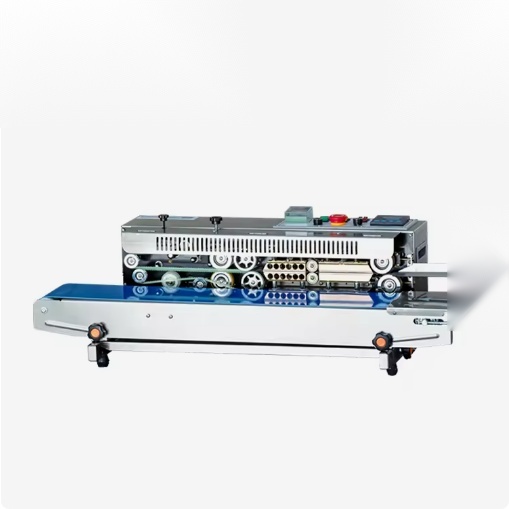
The physical difference behind the seal is dwell and pressure. An impulse sealer applies heat and pressure for a timed stop-start cycle on a stationary bag; the operator controls bag placement and the timer controls heat, but pressure comes from the handle or pedal and can vary by hand. A band sealer applies heat and pressure along a contact length while the bag moves; block temperature, belt tracking and spring pressure are set once and repeat on every pouch that passes. That repeatability is the central trade-off between the two families, and it matters most on laminated films where a 0.5 s dwell error or a 20 °C temperature swing changes whether the seal peels open or burns through.
Throughput: cycle time, bags per minute and the operator workload
An impulse sealer seals one pouch per jaw cycle. A typical cycle runs 3–8 seconds total: heat dwell 0.5–3 s, cooling dwell 1–4 s, plus the operator’s time to place the bag, align the seam and remove the sealed pouch. Sustained output in one pair of hands lands at 6–15 bags/min, with the lower end for large or heavy pouches the operator must hold in place. Two operators can run two machines in parallel, but each machine still carries a person. The machine itself has no moving conveyor, so the rate ceiling is set by hand placement and jaw cycle rather than by belt speed.
A band sealer’s output tracks belt speed and pouch length. At 0–12 m/min belt speed, a 100 mm pouch pitch leaves room for roughly 100–120 bags/min on a clean feed; a 300 mm pouch pitch drops the same machine to about 35–45 bags/min. Real sustained rates run 70–80% of the brochure figure once refill, film wrinkles, misfeeds and short stops are counted, so plan on 20–90 bags/min depending on format. The operator still feeds bags one by one at the inlet, but the machine clamps, heats, cools and discharges without waiting on a jaw cycle; one person can feed at the inlet while another packs finished pouches at the discharge, or the inlet can connect to a filler conveyor.
Where the labor comparison flips is shift structure. At under 200 sealed bags a day, the impulse machine’s operator shares time with filling, labeling and packing, and the cheap machine stays rational. Above about 400–500 bags a day, hand cycling becomes a full-time station: the person spends the shift placing and aligning pouches, and a band sealer removes that repetition while the same operator moves to feeding and inspection. For two-shift or three-shift food packaging, the band machine’s labor saving repeats every shift; the impulse machine’s low purchase price does not.
| Criterion | Impulse jaw sealer | Continuous band sealer |
|---|---|---|
| Sealing motion | Jaw clamps a stationary bag; heat and cooling dwell per cycle | Two moving PTFE belts carry the bag past heated and cooled blocks |
| Typical output | 6–15 bags/min per operator, one bag per jaw cycle | 20–120 bags/min depending on pouch pitch; belt 0–12 m/min |
| Seal width | 3–10 mm, set by PTFE strip on the jaw | 8–12 mm, commonly 10 mm, set by block and belt contact |
| Heat supply | Nichrome wire on demand, 300–800 W, no standby heat | Heated blocks held at set point, 0.6–1.0 kW heater, 3–8 min warm-up |
| Film range | Single-layer PE/PP 30–100 µm; simple laminates with careful dwell | 60–120 µm laminated pouches; PE to about 200 µm on matched frames |
| Pressure source | Handle or pedal; pressure varies by hand and wear | Spring-loaded belt contact; set once, repeats on each pouch |
| Cooling | Jaw closed through cooling timer before release | Cooling blocks or cooled belt section after the heater |
| Date coding | Optional separate emboss wheel; no ink station on most bench units | Embossing wheel standard; ink-coding version prints batch or date |
| Operator role | Place, align, press, remove; cycle dependent on hand | Feed at inlet; machine runs the seal, cool and discharge |
| Purchase band (USD) | $50–$400 bench; $400–$1,200 foot-pedal two-jaw | $1,200–$2,800 entry; $2,800–$6,500 professional stand; $6,500–$12,000+ gas-flush or vertical |
| Main limitation | Rate and consistency tied to the operator; jaw wear uneven pressure | Warm-up, belt and PTFE consumables; wider machine footprint |
Bag material and film compatibility
Film structure decides which machine can hold a seal at all. Single-layer polyethylene bags, 30–100 µm, seal on either family: the impulse jaw melts the PE face in a short dwell, and the band block melts it along the moving seam. Polypropylene and oriented polypropylene need a higher set temperature and a tighter cooling cycle; the band sealer’s held block temperature is easier to tune across a shift, while an impulse timer drifts less per cycle but gives the operator no held reference to return to between bags.
Laminated pouches — PET/PE, PET/AL/PE, OPP/PE, kraft/PE for coffee and snacks — are where the two families separate most clearly. A laminate seal must melt the inner PE or PP sealant without shrinking the PET or printing layer, and it needs even pressure across a 8–10 mm seam so every peel line bonds. An impulse sealer can seal laminates when the jaw strip is clean, the film is flat and the dwell is matched, but seam wrinkles, pouch thickness variation and a worn PTFE cloth show up as weak corners or spotty bonds. A band sealer runs the laminate through a fixed contact length with spring pressure on both belts; the longer contact and consistent pressure suit 60–120 µm laminated stock, which is why snack, nut and coffee lines specify band sealing rather than jaw sealing.
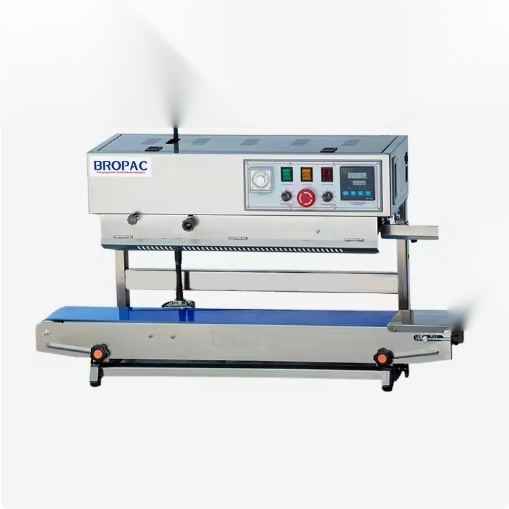
Pouch size and weight matter as much as film. Horizontal band sealers handle pouch widths up to roughly 400–500 mm and pouch thicknesses 5–350 mm; heavy or bulging bags that stand upright go to a vertical frame that supports the bag from below. Impulse jaw length sets the maximum seal width, commonly 200–600 mm on bench and foot units, and the bag hangs from the jaw during cooling, so liquid or heavy fills can pull the seam open before the film sets. If your product drips, holds liquid, weighs over about 1 kg or bulges beyond the belt throat, check the vertical band-sealer option rather than forcing a horizontal or bench model.
Seal consistency and operator dependence
A good heat seal on a laminate shows a uniform 8–10 mm band with no wrinkles, no exposed open channels at the corners, and a peel strength around 4–6 N/15 mm on a tested strip. On an impulse machine, that result depends on the operator each cycle: seam centered on the strip, bag flat against the jaw, consistent handle pressure, timer still matched to the film, PTFE cloth not glazed or torn. A tired operator at the end of a shift shifts the pouch a few millimeters; the corner seal misses. The jaw cloth ages unevenly where the wire presses hardest, and pressure across a long jaw can drop at the ends.
On a band sealer, the variables are set at setup: block temperature, belt speed, belt tracking, spring pressure, embossing depth. Every pouch that enters the throat sees the same contact temperature and pressure for the same contact length. Day-to-day variation comes from belt wear, PTFE glaze, film thickness change and guide misalignment rather than from hand pressure. That does not make the seal automatic quality: a wrong temperature setting burns through the film on every pouch, and a wrinkled feed still wrinkles the seam. The difference is that the machine repeats one tuned condition, while the impulse machine re-decides the condition on every bag.
For audit-facing production — food, nuts, coffee, pet food, export packs where a weak seam means a returned pallet — a recorded and repeatable seal process carries weight. Band sealers log temperature and speed on the control panel, and the embossing or ink code marks each pouch with batch and date. Impulse lines can record the timer setting, but the pressure and placement per cycle are not instrumented, which reviewers notice when seal failures appear in the field. If your quality system requires a documented sealing parameter per film specification, the band family is the easier fit to write that procedure around.
Cost position: purchase, consumables, power and labor
Purchase price is the visible line. Bench impulse sealers run $50–$300 for a hand unit with a 200–400 mm jaw, $300–$1,200 for a foot-pedal or two-jaw unit with wider strip and cooling fan. Continuous band sealers start at roughly $1,200–$2,800 for a compact horizontal bench or entry stand, $2,800–$6,500 for a professional stand model with speed and temperature controls, coding and adjustable guides, and $6,500–$12,000 or more for a nitrogen gas-flush frame or a vertical frame for heavy bags. Freight, installation and the filler or conveyor connection add to whichever machine you choose.
Consumables run in opposite directions. The impulse machine’s PTFE cloth strip and nichrome wire are cheap and replaced in minutes; there is no belt to track and no heater to keep hot between shifts. The band sealer wears two PTFE belts, a set of heating blocks, embossing wheel and drive parts; a belt lasts 6–12 months under normal food-film use, shorter in dusty, oily or heavily printed environments, and replacement means threading and re-tracking. The heating blocks and embossing wheel run 2–3 years before replacement. The detailed five-year outlay — machine, consumables, power, labor and maintenance — is broken out in the band sealer cost and total-cost breakdown, which should be read before signing either quotation.
Power is a smaller but real line. An impulse sealer draws 300–800 W only during the dwell; standby draw is near zero. A band sealer holds 0.6–1.0 kW of heater load through the shift after a 3–8 minute warm-up, plus 60–120 W for the drive motor and a small cooling fan. Idle heat between short runs should be checked: some frames shut the heater down on standby, others hold temperature and bleed power while the line pauses. Labor flips the comparison: the impulse machine needs a person per machine for every cycle; the band machine feeds one inlet for a higher bag count per person-hour. The break-even between the two usually lands where the band machine’s saved labor in one or two shifts a day pays back the purchase and consumable difference inside 12–24 months; below that volume, the impulse machine keeps the cash outlay small.
Footprint, environment and guarding
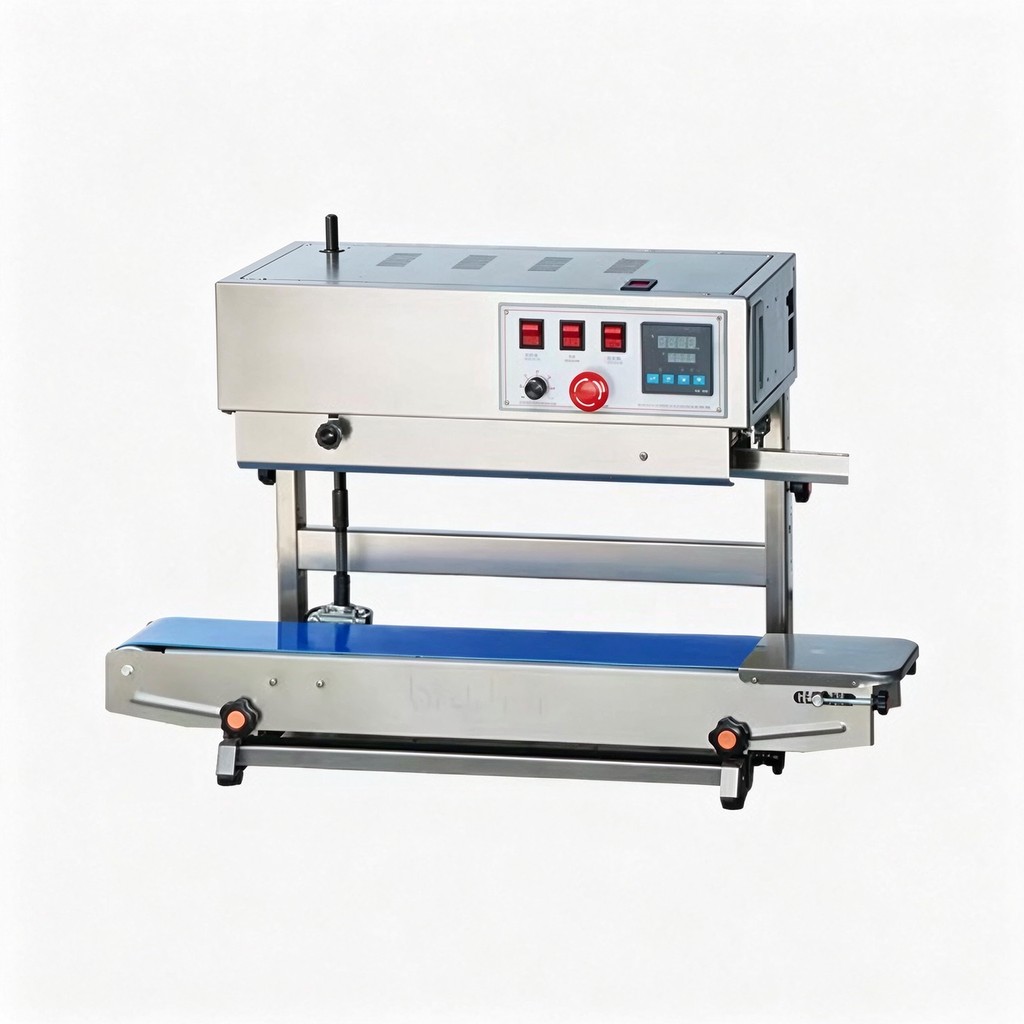
A bench impulse sealer sits on a table and needs no dedicated floor space; it runs on a standard wall socket and works in a dry room, a warehouse packing bench or a small workshop. A band sealer needs a floor or stand position, belt clearance at inlet and discharge for pouch flow, and enough depth for the conveyor run through the heater, cooler and coding wheel. Horizontal frames take up roughly 600–900 mm of belt length plus stand depth; vertical frames stand taller and support heavier bags below the throat.
Environment sensitivity differs in kind. Impulse machines tolerate cold and dusty rooms as long as the electrics stay dry; there is no continuously hot surface to guard between cycles. Band sealers carry hot blocks along the belt run, so inlet and discharge guards, belt covers and an emergency stop are part of the safe installation; food rooms also need stainless or washable finishes where product contact and spills occur. The hot-block burn risk, guarding, interlocks and CE compliance points are covered in the band sealer safety and CE compliance guide. In dusty rooms, film fuzz and product dust glaze the PTFE belts and block cooling; in wet rooms, electrical enclosure rating and belt material must be specified at order stage.
Decision framework: choose in this order
- Count the sustained bag rate: smallest and largest bags per minute across a normal shift, and the number of shifts the line runs. Under about 400–500 bags a day, an impulse or hand unit usually holds; above that, the band machine’s per-person output and consistent seal start to pay back.
- List every film the line seals: single-layer PE/PP, OPP, PET/PE, PET/AL/PE, kraft/PE. Write thickness in µm and sealant material. Laminates over 60 µm and printed or metallized stock point toward band sealing; simple PE bags stay acceptable on impulse.
- Record pouch dimensions and fill weight: width, gusset depth, whether the bag stands upright, liquid or free-flowing fill, and weight per bag. Heavy or bulging bags need a vertical frame; small flat pouches suit a horizontal bench or stand.
- Check the seal standard: peel strength target, batch or date marking, audit documentation, food-contact declarations, washdown or dust rating. Documented repeatability and coding favor the band family.
- Price the five-year position, not the sticker: machine, consumables and wear parts, heater power, labor per station, changeover time and expected belt life. Read the TCO breakdown before comparing quotations.
- Match upstream and downstream equipment: filler outlet height, feed conveyor, accumulation after sealing, labeling and packing stations. A sealer that cannot align with the filler inlet creates the same bottleneck as a slow cycle.
- Send pouch samples to the supplier for a trial seal. Ask for a peel-strength strip and a cross-section of the seam on your own film, run at the proposed speed and temperature, rather than relying on a demonstration bag.
Plant profiles and the usual fit
Workshop, small batch and low-volume packing. A few hundred bags a day, simple PE or PP stock, mixed formats, shared labor. A bench or foot-pedal impulse sealer at $150–$1,200 matches the volume: no warm-up, no belt consumables, moves between tables. The seal quality is accepted when the operator has time to align each bag and check the seam.
Food, snack and nut packaging on a single shift. Laminated pouches, 60–120 µm, target 20–60 bags/min, batch date on every pack. A horizontal band sealer on a stand fits: held block temperature, cooling section, embossing or ink coding, one operator feeding. The stand-mounted heat band sealer and the horizontal ink-printing band sealer cover this range; the coffee bag sealing machine is framed specifically for valve and kraft coffee pouches.
High-volume two- or three-shift packing. Stable pouch format, 60–120 bags/min, stacked pallets, export freight. A professional or automatic band frame feeds from a filler conveyor, runs the seal and cool cycle unattended between inspections, and the labor saving repeats each shift. The automatic continuous band sealer and the SF150LD professional band sealer sit in this band; where oxygen exclusion matters, the nitrogen gas-flush band sealer adds an inert-gas purge ahead of the seal.
Heavy bags, liquid fills and upright packs. Bags over about 1 kg, bulging gussets, soup or sauce packs, pet food. A vertical band frame supports the bag below the throat and seals the upright seam; an impulse jaw lets a heavy or wet fill hang from the seal while it sets, which risks an open corner. The vertical ink-coding band sealer is the frame type to evaluate here.
High-mix catalogue with short runs. Many pouch sizes, frequent film changes, small daily totals. The impulse machine changes format by jaw alignment with no warm-up; the band machine needs a guide and temperature check between films. For a high-mix floor under the rate threshold, the impulse family keeps changeover cheap; once one format runs long enough to amortize setup, the band machine’s consistency wins back the changeover cost.
Common selection mistakes
Buying the cheapest machine for a laminate line. A bench impulse sealer priced under $300 looks economical, but on 80–120 µm PET/PE stock the hand-dependent cycle shows up as weak corner seals and field returns. If the pouch is laminated and the run is regular, the band frame’s consistent contact is the lower-risk purchase even before labor is counted.
Sizing the band sealer to the brochure peak rate. A 120-bag/min rating assumes the shortest pouch pitch and a clean feed. Plan the machine at your real pouch length and at 70–80% of rated output across the shift, leaving headroom for misfeeds and changeovers. A frame held below its comfortable rate on a low-volume line carries the heater standby load and belt maintenance without earning it back.
Ignoring pouch weight and orientation. A horizontal throat cannot hold a heavy upright bag; a vertical frame costs more but prevents the seal from pulling open under the fill. State bag weight and whether the pack stands, hangs or lies flat when the inquiry goes out, so the supplier matches frame orientation rather than the cheapest horizontal body.
Leaving film compatibility to the installation stage. A seal tuned for PE fails on OPP, and a laminate with metallized layer needs its own temperature and speed window. Send sealed bag samples and film rolls with the inquiry; the supplier should run a trial on your stock and hand back a temperature, speed and seal-width setting before order confirmation.
Forgetting coding and inspection needs. A bench impulse unit has no date station; if batch coding is required, a separate marker or a band sealer with embossing or ink coding must be in the spec. Decide whether the line needs embossed batch marks, ink-printed dates, or both, and check which frame option carries it.
What to bring to the quotation
A fair comparison needs the same inputs for every supplier: smallest and largest pouch with width, gusset depth and seal length; film structure and thickness in µm; fill weight and whether the bag holds liquid; sustained bags/min and shift pattern; number of formats and changeover frequency; working environment — dry, wet, cold, dusty; coding requirement (emboss, ink, none); audit or food-contact declarations; and the filler outlet height and downstream conveyor the sealer must match. With those in hand, the supplier can match frame orientation, belt speed, seal width and film setting to the real application.
The SunAura continuous band sealer product family lists the horizontal, stand, vertical, coding and gas-flush frames in the range, alongside the 2-in-1 stand band sealer with digital readouts. Where the volume stays low, the manual hand heat sealer covers bench impulse sealing. For the mechanics behind the constant-motion seal, read the technical walkthrough of how a continuous band sealer works, covering heating blocks, PTFE belts, the cooling section and date coding with temperature and speed numbers.
Related cluster notes: the nitrogen gas-flush band sealer overview explains inert-gas purging ahead of the heat seal for coffee, snacks and nuts; the band sealer cost and TCO breakdown works machine price bands, belt and film wear, power and labor against manual sealing; the band sealer safety and CE compliance guide covers hot-block guarding, belt covers, emergency stops and food-grade sealing; and the band sealer troubleshooting and changeover guide handles wrinkled and weak seals, belt tracking and temperature faults on the maintenance side.
Send pouch samples, target rate and film specification through the contact desk for an application-matched configuration. The certifications and patents section lists the compliance documentation available with the machine, and the company profile summarizes the packaging equipment range built for food, snack and industrial bag lines.