
October 14, 2026 | by Frank, SunAura Machinery Project Engineering
QINGDAO, China — SunAura Machinery has commissioned a rotary-arm pallet wrapping and load-stabilization cell for a dry-mix building materials producer in the Eastern Province of Saudi Arabia, where bags of tile adhesive, masonry mortar and grout were shifting and puncturing on long-haul road deliveries to Riyadh, Jeddah and the Gulf. The installation pairs a rotary-arm pallet wrapper with an electric top-press, powered roller conveyors and a low-level palletizer, replacing a manual stretch-and-strap routine that the customer’s logistics team blamed for roughly 6% of shipments arriving with damaged or reworked pallets.
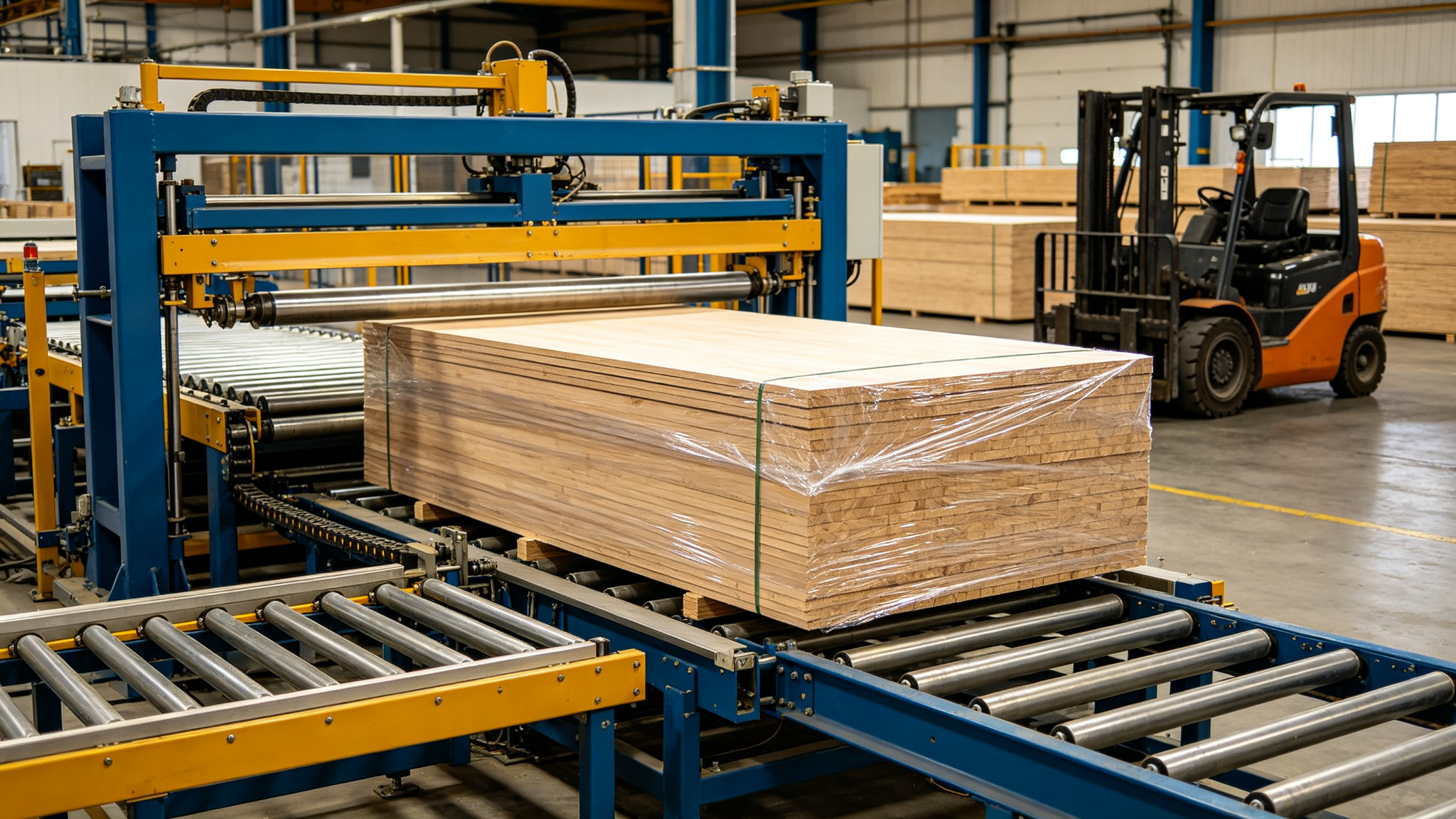
The Problem Was the Pallet, Not the Product
The customer fills 20 kg and 25 kg valve bags of cement-based dry mixes on two existing filling lines. The bags themselves are sound, and the filling accuracy is good. The failure happened downstream: stacked bags were stretch wrapped by hand with a turntable machine, and because the pallet had to rotate, tall, light, slightly unstable loads swayed and pulled against the film before it could be applied. Drivers on the Dammam–Riyadh corridor reported that bags on the top layers leaned or collapsed after hard braking, and the warehouse was re-stacking an average of one pallet in every sixteen.
Two things made a turntable wrapper the wrong choice. First, a turntable rotates the load, which is unsuitable for a tall stack of light bags that is not yet locked together. Second, the manual process could not repeat a consistent number of film wraps or a consistent containment force, so some pallets were over-wrapped (wasting film) and others under-wrapped (arriving loose). The customer asked for a system that held the load still, applied a repeatable wrap pattern, and connected directly to the palletizer without an operator between stations.
Why a Rotary-Arm Wrapper for Unstable Loads
On a rotary-arm wrapper, the film carriage rotates around a stationary load while the pallet stays fixed on the conveyor. This is the key difference for light, tall or unstable stacks: the bags never move during wrapping, so the first film layer can be applied while the load is still in its correct geometry. The chosen machine runs at 60–120 pallets per hour depending on the wrap pattern, comfortably ahead of the two filling lines’ combined output.
- Electric top-press pallet wrapper holds the top layers down during the first wraps, stopping the lightest bags from “walking” before the film locks them.
- Powered pre-stretch up to 250% stretches the film before application, which increases containment force while reducing film cost per pallet.
- Roping and banding options apply tighter film bands where the bags are most likely to shear, and a top-sheet dispenser sheds dust and occasional rain during open-yard handling.
- An online pallet wrapper with conveyor design lets wrapped loads index straight to the out-feed, keeping the cell in line with the palletizer.
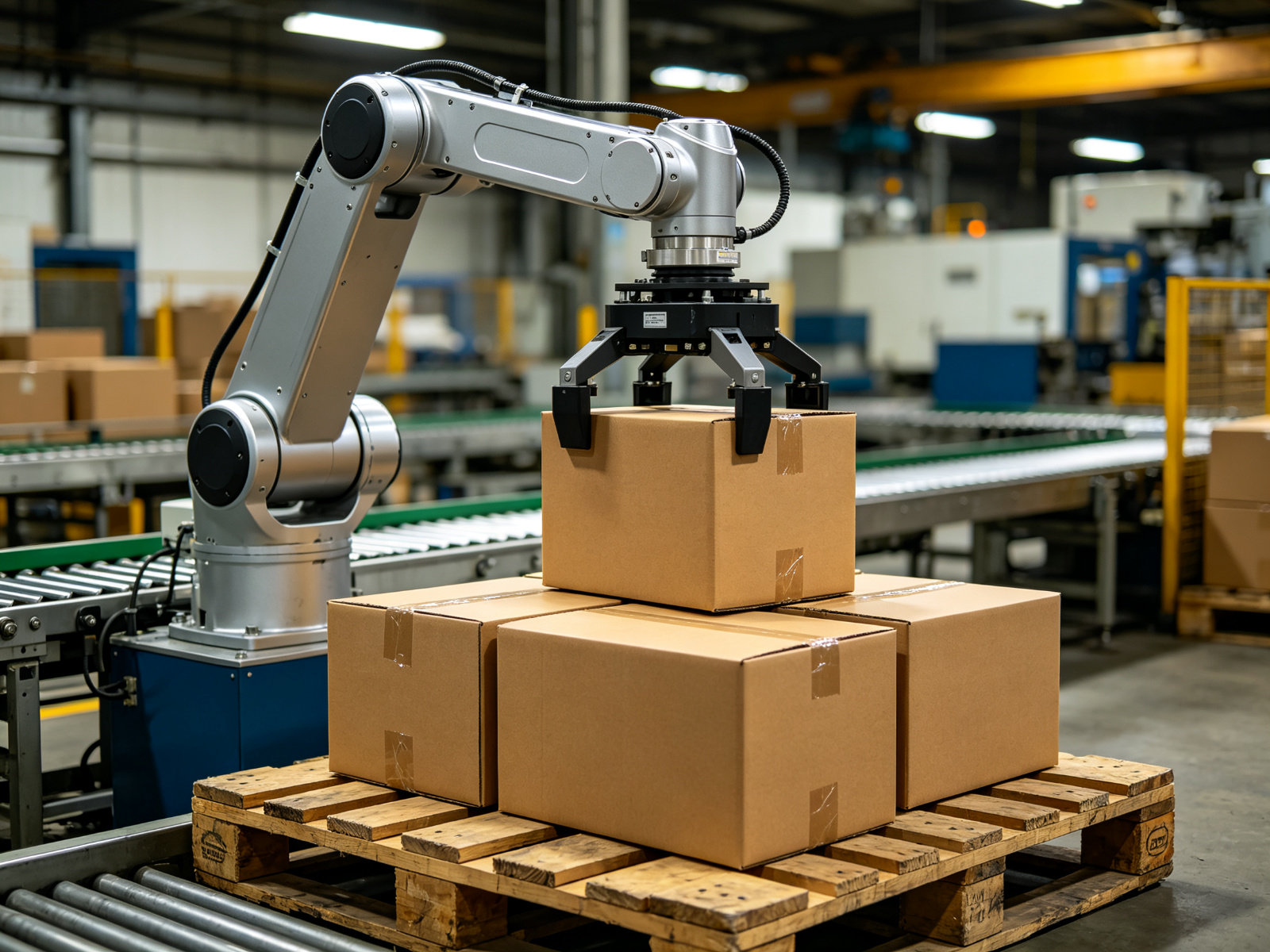
The Integrated Cell
Bags are filled and closed on the existing lines, then conveyed to a low-level case palletizer adapted for bagged product, which stacks a 1.2×1.0 m pattern five layers high. A gravity roller conveyor section buffers up to three pallets before the wrapper, and powered chain conveyors index the load into the wrapping ring. After wrapping, the pallet passes a photoeye count and exits to the forklift pickup lane. For a smaller second line running specialty grouts, the customer also kept a compact palletizer footprint so the same operators can run both.
Where production eventually grows, the same ring layout can be upgraded to a gantry online pallet wrapper for a fully lights-out end of line; the conveyor and electrical interface were installed with that expansion in mind.
Cell Specifications
| Parameter | Specification |
|---|---|
| Load type | 20/25 kg valve bags, dry-mix cement products |
| Pallet size | 1.2 × 1.0 m, up to 1,200 kg, 5 layers |
| Wrapping machine | Rotary-arm, 60–120 pallets/h |
| Top press | Electric, pressure-adjusted per product |
| Pre-stretch | Up to 250% powered pre-stretch |
| Palletizer | Low-level bag/case palletizer with buffer conveyor |
| Film & protection | Containment wrap, roping bands, top sheet |
| Operators | One, supervising two lines and forklift call-off |
Containment Force, Not Film Weight
The most common mistake in pallet wrapping is judging stability by how many times the film goes around or how much the roll weighs. The number that actually predicts whether a load survives transport is containment force — the squeeze the film exerts on the load, measured in pounds or kilograms of force at the film tail. For bagged cement products, we target a firm, even containment force from the bottom to the top of the load, with extra wraps at the base and the top two layers where shear movement starts.
During commissioning we ran an incline/tilt check and a short simulated transport run over the plant’s yard to validate the wrap pattern before the customer signed off. The objective was a pallet that held its geometry without the operator “helping” it with extra hand wraps. Film use per pallet subsequently fell by roughly 28% compared with the manual routine, because the pre-stretch now applies force with less film rather than simply adding layers.
Results After the First Month
- Pallets arriving damaged or re-stacked dropped from about 6% to under 1% of shipments.
- Stretch film consumption per pallet fell by roughly 28% once a repeatable pattern replaced hand wrapping.
- One operator now supervises both filling lines and the wrapping cell instead of two workers hand-wrapping full-time.
- Throughput at the end of line is no longer the bottleneck during seasonal building-material demand peaks.
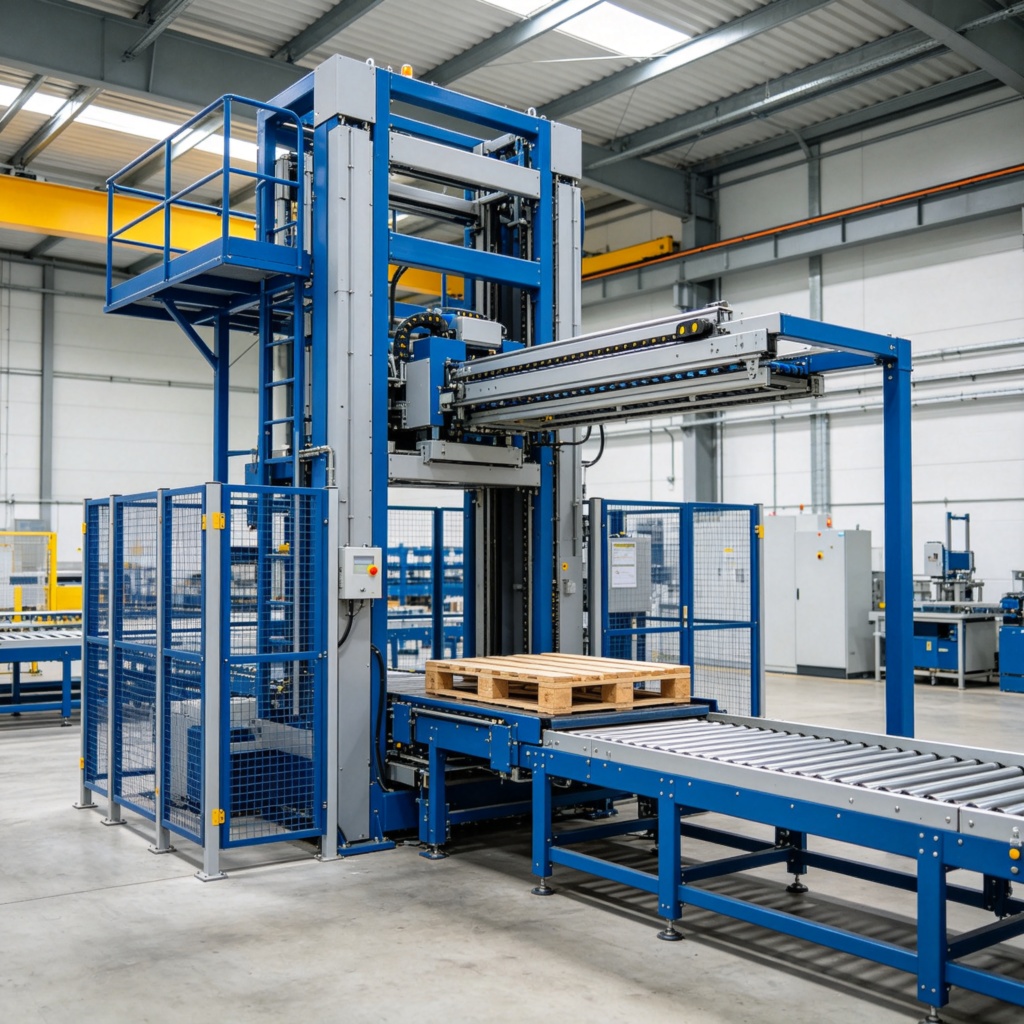
Why Middle-East Building Materials Projects Favor This Layout
Gulf building-materials distribution shares three conditions that make rotary-arm wrapping a natural fit: tall, palletized bag loads that should not rotate; long road legs between coastal plants and inland cities; and high ambient temperatures that soften low-grade stretch film in yards. A stationary-load wrapper, a pre-stretch system that tensions the film correctly, and a top sheet all address these directly. The cell also complements the strapping step the customer retained for export orders — see the automatic strapping machine range for the combination of banding and film we specify when loads are double-handled in ports.
Rotary-Arm, Turntable or Rotary-Ring: A Quick Comparison
Buyers often treat every stretch wrapper as the same machine, but the three main architectures move the load and the film differently, and the choice changes both stability and throughput. The table below is the decision logic we use when scoping a cell.
| Architecture | What rotates | Best for | Watch-out |
|---|---|---|---|
| Turntable | The pallet rotates | Stable, uniform cartons and drums | Unsuitable for tall, light, unstable loads |
| Rotary-arm | The film arm rotates; load is stationary | Light, tall, unstable or bagged loads | Slightly larger footprint and guarding |
| Rotary-ring | A horizontal ring moves around the load | Very high throughput, heavy pallets | Higher capital cost; harder to justify at moderate volumes |
For this customer the rotary-arm was the clear answer because the load was the problem. A turntable would have been the cheaper machine but would have failed on the exact failure mode — the top layers moving before they were locked. We have used turntables successfully on online pallet wrappers for stable carton loads and rotary-ring systems for very high-volume beverage plants, but the bagged dry-mix profile is a textbook rotary-arm case.
Stretch Film Selection for Hot Climates
Film choice is half of pallet stability, and it is easily overlooked when the machine is the focus. In the Gulf, pallets can sit in open yards or unconditioned warehouses where the surface temperature of a black pallet or shrink film can climb well above ambient. A low-grade film that pre-stretches well in a cool European test room can become soft and lose holding force at those temperatures, which is why a load that tests stable in the factory still fails on a Riyadh truck.
- Machine-grade cast film with a guaranteed pre-stretch rating is the default for powered pre-stretch carriages; do not match a 250% carriage to a film rated for 200%.
- Blown film offers higher puncture resistance and better hot-weather holding force for bagged and irregular loads, at a slightly higher price and noisier unwind.
- Gauge should be selected from the containment-force target, not from habit. A correctly pre-stretched thinner film often holds better than a thick film applied with no stretch.
- Top sheets and corner boards protect against dust, moisture and edge crush, and are cheaper per pallet than re-stacking a collapsed load.
During commissioning we tested both a cast and a blown film on the customer’s actual pallet and kept the one that held the target containment force after a simulated hot-holding period. The film specification, pre-stretch percentage and wrap pattern are all stored in the recipe so the result is repeatable across shifts.
Frequently Asked Questions
When should I choose a rotary-arm over a turntable wrapper?
Choose a rotary-arm when the load is tall, light, unstable or wet enough that rotating it would distort the stack before the film locks it. Turntables are the economical choice for stable, uniform, self-supporting loads like cartons and drums.
What containment force do bagged products need?
There is no single number, but the force should be even from bottom to top with reinforcement at the base and the top two layers. The correct setting is validated by a tilt or simulated-transport test, not by counting wraps.
Does a top-press damage the bags?
Not when it is set correctly. The press applies a controlled, low pressure that only settles and holds the top layers; it is adjusted per product and released after the locking wraps, so the bags are not crushed.
Can the cell run without a dedicated operator?
It can run with a single supervising operator who also calls off forklifts and monitors the filling lines. A fully automatic gantry wrapper with pallet dispensers and labeling is the upgrade path when a plant wants a lights-out end of line.
How does this connect to the rest of our packaging equipment?
The wrapper indexes on standard powered conveyors and accepts handshakes from the palletizer and upstream line, so it drops into an existing end of line. The same integrator approach used here applies to food and beverage lines — for example, our turnkey spice and sauce line for Mexico shares the same conveyor, case-packing and HMI architecture.
What safety guarding does a rotary-arm cell need?
Because the film arm rotates around the load, the cell uses perimeter guarding with interlocked access gates and a light curtain at the manual pickup position, plus an emergency stop at both the HMI and the out-feed. The conveyor only indexes when the ring is parked and the gate is closed, which is why a stationary-load wrapper is safer than hand-wrapping inside a forklift traffic lane.
How long does installation take?
With utilities and floor marking prepared in advance, a cell of this size is mechanically installed in three to five days, followed by two to three days of wrap-pattern tuning, simulated-transport testing and operator training. The bulk of the work is the conveyor integration; the wrapper itself is a single, largely pre-assembled module.
Next Steps
The cell is now in full production, and our after-sales and spare-parts team supplies film-carriage parts, pre-stretch rollers and top-sheet consumables under the warranty period. Application engineers keep the wrap recipes on file so a new product can be added without re-engineering the pattern. The customer has since asked us to quote the gantry-wrapper upgrade and an automatic pallet dispenser for a planned second hall, which would remove the last manual step in the end of line.
Are pallets shifting, puncturing or arriving loose? Send us your load dimensions, weight, pallet pattern and a description of the transport damage, and we will recommend the correct wrapper, containment force and conveyor layout. Browse our pallet wrapping machines, palletizers and end-of-line packaging lines, or visit the workshop page and reach us through the contact page. For seal-quality issues on the bagging machines upstream, our flow wrapper sealing troubleshooting guide explains the temperature–dwell–pressure settings that keep filled bags from leaking in the first place.