
Dual-Station Robotic Palletizer
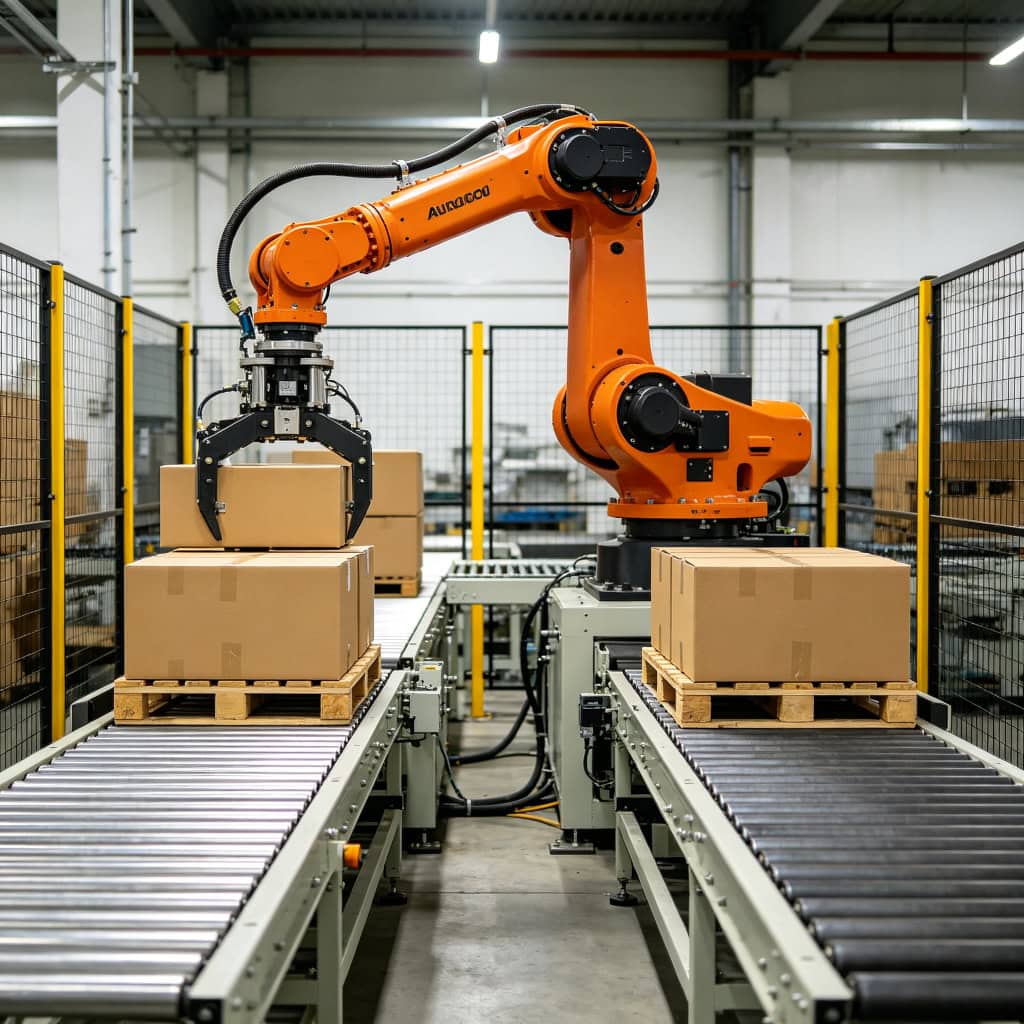
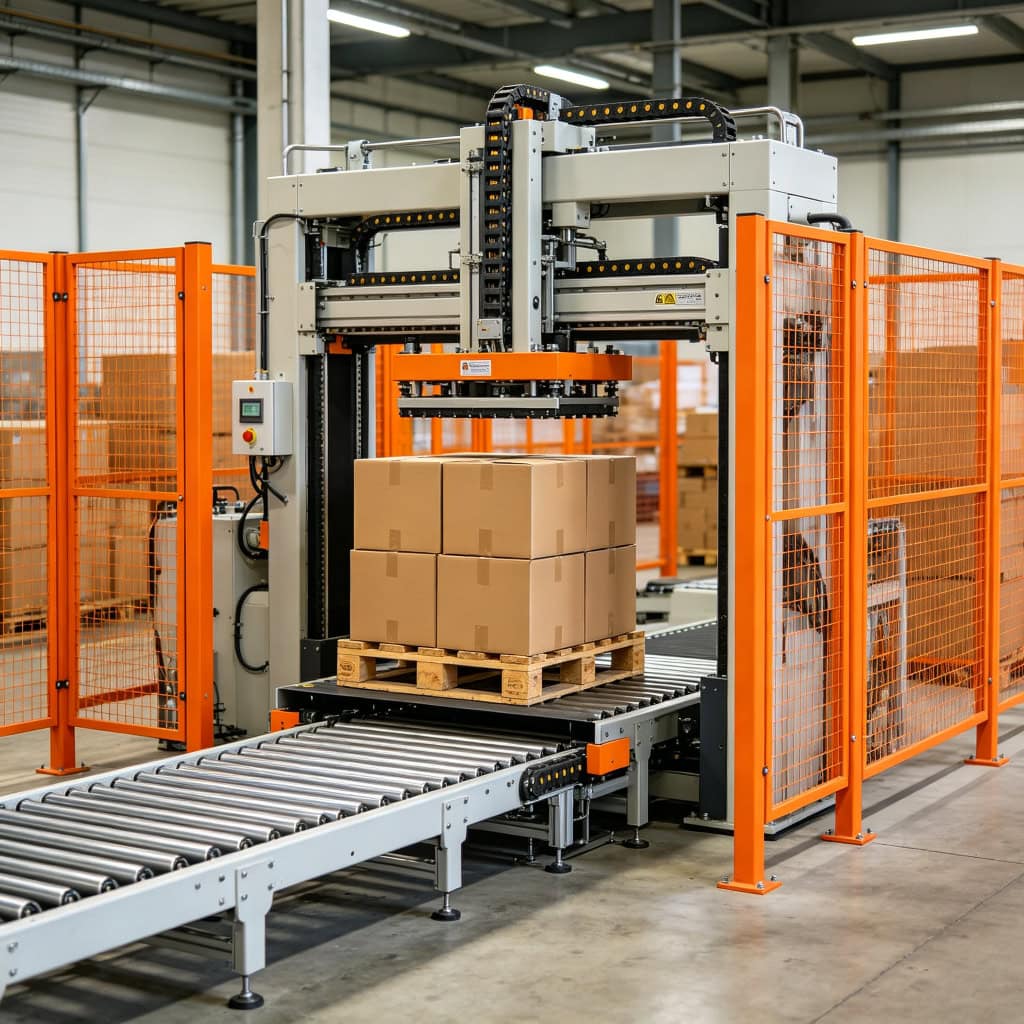
The SunAura dual-station robotic palletizer (SNA-DSP50) eliminates the single biggest throughput killer in end-of-line — downtime while a full pallet is swapped for an empty one. A 4-axis robot with 50kg payload and 2000mm reach operates between two pallet positions on a roller-conveyor infeed. While an operator or forklift changes one pallet, the robot keeps stacking on the other — up to 12 cycles per minute, 380V 3-phase, safety fencing included. CE-certified and factory-direct.

Product Description
The SunAura dual-station robotic palletizer is a mid-to-high throughput end-of-line cell built around one proven idea: never stop the robot to change a pallet. A single 4-axis robot with 50kg payload and 2000mm reach works between two independent pallet stands mounted on roller conveyors. When one pallet reaches its programmed height, the robot simply shifts its stacking target to the second station while the first pallet is rolled out and replaced. The production line keeps running, and the 12 cycles-per-minute output is never lost to a pallet swap.
Cases arrive from the packaging line on a powered roller conveyor with side guides and a centering device. A vacuum or mechanical gripper EOAT (matched to your product) picks each case and builds the chosen pallet pattern — interlocking brick, column, or pinwheel — layer by layer under PLC control. The HMI stores dozens of recipes, so operators can select a product by name rather than re-teach points. Because this is a fast-moving industrial robot rather than a collaborative cobot, the cell comes complete with interlocked safety fencing and a light-curtain access gate to keep people out of the work envelope during operation.
Powered by 380V 3-phase supply, the cell is engineered for food & beverage, consumer goods, and distribution centers running multiple shifts. Every unit undergoes a 48-hour continuous run test before shipment and ships CE certified. Send us your carton samples, pallet size and conveyor height — our engineers will design the infeed/outfeed and pattern around your existing line.
Technical Specifications
| Model | SNA-DSP50 Dual-Station Robotic Palletizer |
|---|---|
| Robot Type | 4-axis palletizing robot |
| Payload | 50 kg (product + EOAT combined) |
| Max Reach | 2000 mm |
| Cycle Rate | Up to 12 cycles per minute |
| Pallet Positions | Two independent stations (continuous operation) |
| Infeed Conveyor | Powered roller conveyor with side guides and centering |
| End-of-Arm Tool | Vacuum or mechanical gripper (selected by product type) |
| Safety | Interlocked safety fencing + light-curtain access gate included |
| Voltage | 380V 3-phase, 50/60 Hz (factory-set to order) |
| Control | PLC + touchscreen HMI, multi-recipe pattern storage |
| Certification | CE Certified, ISO 9001 factory |
Key Features & Benefits
- Zero downtime for pallet changeover: Two pallet positions let operators swap a full pallet while the robot keeps stacking on the second station — the key advantage over a single-pallet cell.
- High 12 cycles-per-minute throughput: A purpose-built 4-axis palletizing arm with 50kg payload and 2000mm reach keeps pace with medium-to-high speed case lines.
- Recipe-driven pattern library: Store dozens of carton sizes and pallet patterns on the HMI. Operators select the product name and press start — no re-programming between SKUs.
- Safety fencing and light curtain included: The interlocked fence and access gate keep staff out of the robot envelope while running; the robot stops instantly if the gate opens.
- Powered roller infeed with centering: Cases arrive squared and centered, so every pick is accurate — fewer drops and cleaner layers.
- Flexible EOAT: Vacuum gripper for rigid cartons and trays; mechanical gripper for bags and rigid packs. Quick tool changeover supports mixed product on one cell.
- 380V 3-phase industrial duty: Built for multi-shift, 5–6 day/week operation in food, consumer goods and distribution environments.
Application Industries
Food & Beverage
Cases of canned drinks, bottled beverages and packaged food — continuous dual-station operation matches fast filling and packaging lines.
Consumer Goods
Cartons of household products, cosmetics and packaged goods — recipe changeovers handle frequent SKU runs without lost time.
Distribution Centers
Case palletizing for warehousing and order fulfillment — no-stop pallet swap keeps truck loading schedules on time.
Pharmaceutical
Cartons of medicine and medical supplies — clean, repeatable patterns support GMP traceability and stable shipping loads.
Paper & Tissue Products
Cases of toilet paper, towels and tissues — gentle gripper handling avoids crushing light, bulky cartons.
Contract Packaging
Co-packers running many products — the recipe library and dual station make short, mixed runs efficient and profitable.
Load compatibility: Rigid cartons, trays, shrink-wrapped packs and light bags up to 50kg per pick. For 120–180kg heavy bags, see our heavy-duty robotic range.
How the Dual-Station Palletizer Works
The dual-station design is what makes this cell productive. The robot never waits on a pallet swap because it always has a second empty pallet waiting:
- Cases arrive on the roller conveyor. Powered rollers carry cases from the packaging line; side guides and a centering device square each case at the pick station.
- EOAT picks the case. The vacuum or mechanical gripper descends, secures the case, and the robot lifts it clear of the conveyor.
- Robot places it on the active pallet. The 4-axis arm moves to the currently selected station (A or B) and places the case in the next position of the stored pallet pattern.
- Station A fills — robot switches to Station B. When station A reaches its programmed layer/pallet count, the HMI signals the robot to target station B. Station A goes into “pallet ready” status.
- Full pallet rolled out, empty rolled in — robot keeps running. An operator or forklift swaps the full pallet at station A while the robot keeps stacking uninterrupted on station B. Once A is reloaded with an empty pallet, the cycle continues.
Is This the Right Palletizer for You?
This dual-station cell is the right fit if your operation matches all four of the following. If you fall outside any of them, our team can recommend a different SunAura model:
- Single loads up to 50kg: This arm handles cartons and bags in the 10–50kg range. If you routinely palletize 120–180kg heavy bags or drums, choose the 120kg or 180kg heavy-duty robots instead.
- Throughput around 10–12 cases/min and growing: The dual station shines when losing even a minute per pallet swap costs you meaningful output. If your line is slower and single-operator, a collaborative or compact cell may be more economical.
- You need continuous, non-stop operation: The whole point of dual stations is no downtime during changeover. If you can tolerate periodic stops to swap pallets, a single-pallet robot or low-level layer palletizer can lower capital cost.
- You have floor space for a fenced cell and 3-phase power: This is an industrial robot behind safety fencing on 380V 3-phase. If you need an unfenced, single-phase, small-footprint solution, our collaborative cobot is the better fit.
Troubleshooting Guide — Common Issues & Solutions
Dual-station cells are reliable, but the extra conveyor and two-station logic introduce their own failure modes. Below are the most common problems we diagnose remotely. Always lock out and tag out energy before entering the fenced cell.
| Problem | Possible Causes | Solutions |
|---|---|---|
| Robot keeps targeting the wrong station | Station-ready sensor not triggered; pallet not centered; recipe selected wrong; switchover logic fault. |
|
| Cases dropped or shifted on the roller infeed | Conveyor speed mismatch; cases nested or tipped; centering device not activating; photo-eye timing off. |
|
| Safety fence / light-curtain stop halts the robot | Access gate not fully closed; someone reached through light curtain; interlock switch faulty; fence door sensor loose. |
|
| Pallet layers misaligned / overhang | Pattern recipe wrong for carton size; layer height offset drifted; pallet not true; slip sheet position off. |
|
| Roller conveyor jam / motor overload | Case jammed between rollers; pallet not advancing; motor breaker tripped; chain/belt tension off. |
|
| EOAT releases case too early / too late | Vacuum/gripper signal timing off; case detection sensor mis-set; program place height too low or high. |
|
If the issue persists after trying these steps, email photos and a short 10-second video to [email protected] — our engineers usually diagnose the root cause within one business day.
Frequently Asked Questions
Why is dual-station better than a single-pallet robot?
On a single-pallet cell, the robot must stop every time a pallet fills so an operator can swap it. That stop can cost several minutes per pallet — easily 10–20% of daily output on fast lines. The dual-station cell keeps the robot running on the second pallet while the first is swapped, so you recover that lost throughput. The extra capital usually pays back within a year on high-volume lines.
How do operators change a pallet safely while the robot runs?
Changeover happens on the idle station, which is outside the robot’s active target. The HMI flags the station as “ready to swap.” The operator or forklift rolls the full pallet out and loads an empty one on the roller conveyor; a sensor confirms the empty pallet is present. Because the robot is stacking the other station, there is no need to open the safety fence or stop the line during normal operation.
How many cases per minute can it handle?
The 4-axis arm completes up to 12 cycles per minute. Real-world case output depends on reach distance, case size and layer pattern — typically 10–12 picks per minute for standard cartons. The dual-station arrangement ensures that throughput is not eroded by pallet-change downtime.
Can it handle bags as well as cartons?
Yes — the EOAT is matched to your product. A vacuum gripper is used for rigid cartons and trays; a mechanical gripper handles bags, pouches and rigid packs. Tell us what you run and we specify the correct tool. For very heavy 120–180kg bags, we recommend our dedicated heavy-duty 120kg or 180kg robots instead.
What is the warranty and lead time?
Every unit carries a 12-month warranty covering parts and labor, plus lifetime technical support by email and WhatsApp. Standard dual-station cells ship in 30–45 days; custom infeed/outfeed configurations take 45–60 days. Each machine runs a 48-hour continuous test and ships with CE documentation.
Why Buy From SunAura Machinery
48,000㎡ Own Factory
In-house manufacturing in Qingdao, China — no middlemen, no trader markup.
CE Certified
All machines meet European safety standards with full documentation.
ISO 9001:2015
Quality management system certified across the entire production process.
SGS Audited Factory
Third-party audited manufacturing facility with 20+ national patents.
12-Month Warranty
Full warranty covering parts and labor from the date of shipment.
Lifetime Support
Technical guidance via email, WhatsApp, and remote video for the machine’s life.
Spare Parts in 48h
Genuine parts shipped worldwide via DHL/FedEx within 48 hours.
100+ Countries Served
Trusted by packaging lines across food, pharma, cosmetics, and chemicals.
Get a Factory-Direct Quote in 24 Hours
Tell us your carton size, pallet dimensions, conveyor height, and hourly output — our engineers reply with a model recommendation, FOB price, and lead time within one business day. Every machine is built in our 48,000㎡ Qingdao factory, CE & ISO 9001 certified.
Email [email protected]Related Palletizers
Browse the full range on the palletizers landing page. Also explore our induction sealers and filling machines to build a complete packaging line.