
QINGDAO, China — October 17, 2026 — SunAura Machinery has delivered a pet food bagging line to a mid-size pet food producer in Poland, combining a 16-head multihead weigher, an automatic vertical bagging section, and a servo band sealer supplied by our sister site SunAura Packaging Machines to pack kibble and treats in 400g to 5kg bags. The line runs at up to 35 bags per minute across eight SKUs, and it replaced a weigh-fill-seal operation that was the plant’s highest-cost and highest-variance step.
Pet food packaging has a set of problems that general bagging guides rarely cover. The product is abrasive — kibble dust wears feeders and seals, and the fat content coats surfaces and attracts the dust into a sticky film. The SKU range is wide, from 400g single-serve pouches to 5kg family bags, and the packaging must hold the product’s aroma and freshness through months of warehouse and retail time. The Polish producer’s manual line handled 12–14 bags per minute at best, with giveaway of 6–10g per bag and a constant battle against the dust that clogged their old sealing machine.
Line Configuration
The delivered line runs weighing, bagging, and sealing in sequence, with the dust management designed in from the start:
| Station | Equipment | Key Specification |
|---|---|---|
| Weighing | 16-head multihead weigher with dust-resistant feeders | ±2g on 400g–5kg formats |
| Bagging | Vertical form-fill-seal bagger | Up to 35 bags/min, pillow and gusseted bags |
| Sealing | Servo band sealer with coding | Bag top seal, ink coding for lot and date |
| Control | Single PLC + HMI | Recipe per SKU, changeover < 12 min |
The weigher’s feeders are sealed against kibble dust — a specification that sounds minor and decides the line’s reliability, because dust in the load cells drifts the accuracy and dust on the feeder paddles slows the dosing. The bagger forms the bag from roll film, fills it from the weigher’s discharge, and the band sealer closes the top with a code printed in the same pass. The complete range is documented on the multihead weighers and band sealers pages.
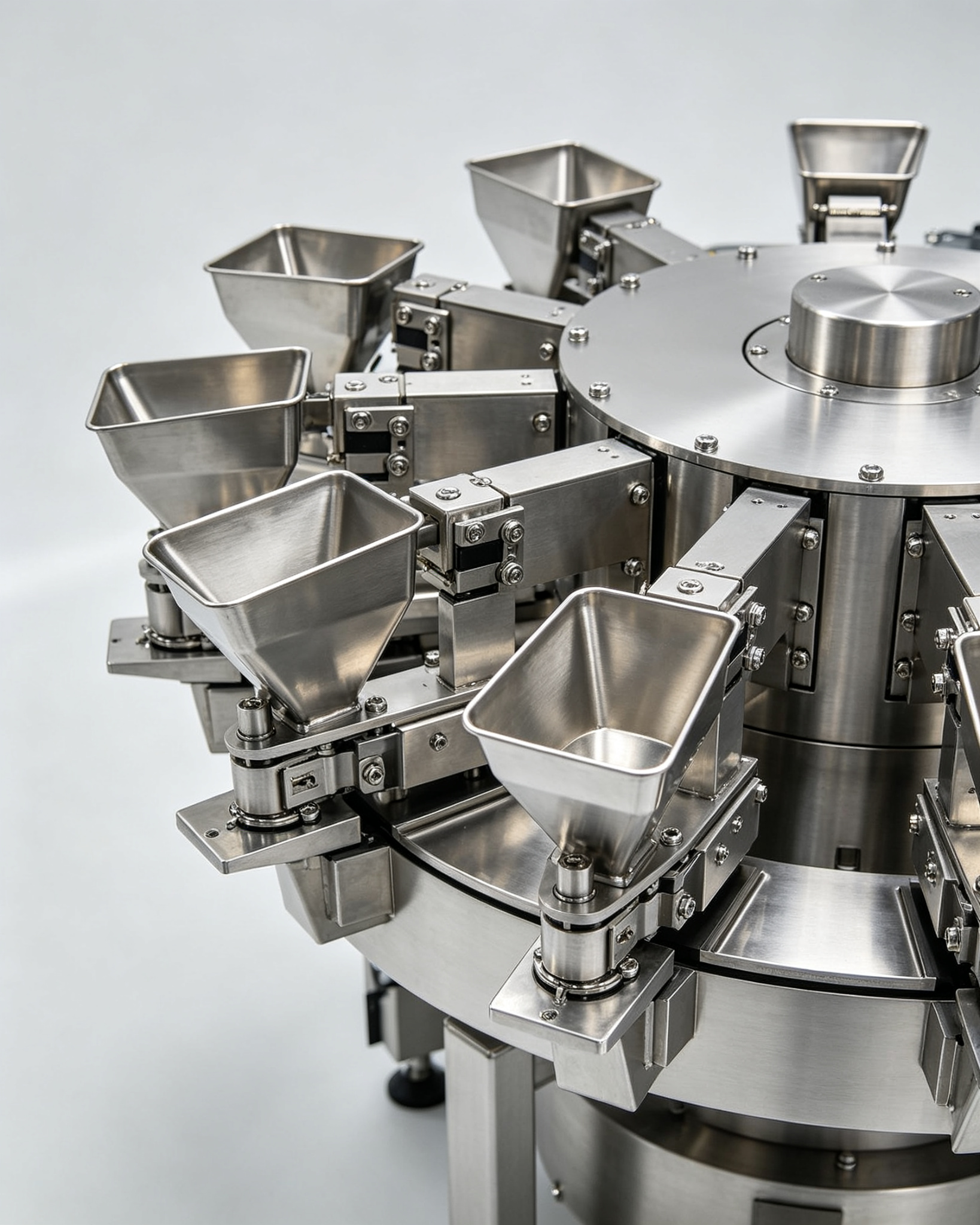
Pet Food Weighing: Accuracy in an Abrasive Environment
The weighing station is where pet food lines earn or lose their economics. The numbers from the Polish installation are typical for the segment:
| Cost Element | Manual Weigh-Fill | 16-Head Multihead |
|---|---|---|
| Giveaway per 400g bag | 4–6g average | Under 1g |
| Giveaway per 5kg bag | 10–20g average | Under 3g |
| Rate | 12–14 bags/min (2 operators) | 35 bags/min (1 operator) |
| Weight drift over shift | Grows with fatigue | None — identical every bag |
| Dust-related downtime | Weekly cleaning of old sealer | Daily wipe-down only |
At the producer’s 6 tons per week, the giveaway reduction is worth roughly $22,000 a year — before the labor saving and the throughput gain. For pet food producers above about 2 tons per week, the multihead weigher typically pays back within 12–18 months on giveaway and labor alone. The head count decision for pet food follows the same logic as other granular products, and the accuracy tradeoffs are covered in the multihead weigher selection guide.
Bag Formats: Pillow, Gusseted and the Changeover
Pet food bags span a wider format range than most product classes, and the bagging spec is the one that decides the line’s flexibility:
Pillow bags are the standard for small formats — the 400g and 800g sizes run as simple pillow bags with a fin or lap seal. The pillow packaging machines range covers the wrapper options, and for small pet food formats the vertical bagger produces the same pillow bag from roll film.
Gusseted bags are the standard for the 2.5kg and 5kg formats — the side gussets let the bag stand on the shelf and carry the brand’s on-pack messaging. The gusseted bag requires a gusset-forming mechanism on the bagger, and the changeover between pillow and gusseted formats is a machine section change, not a recipe recall. The line’s changeover runs under 12 minutes because the gusset section is tooled for the bag sizes — buyers running both formats should confirm the tooled range at the specification stage.
Bag strength: the 5kg bag carries 5kg of abrasive product, and the film spec must include the puncture and drop resistance for the segment. The film decision follows the same discipline as the film thickness guide — and the bagger’s seal window must match the film’s sealant layer.
Sealing and Coding Pet Food Bags
The sealing station closes the bag and carries the traceability information, and pet food’s fat content makes it the station that fails first on a poorly specified line:
Fat residue on the seal bars: kibble dust carries fat, and the residue builds on seal bars and band sealer belts, degrading the seal over a shift. The line’s band sealer is specified with the same servo temperature control as the continuous band sealer series, and the daily cleaning routine — a wipe-down at shift start and a belt clean at shift end — is part of the delivered operator training. Producers running high-fat formulas should confirm the seal bar material is specified for the residue.
Lot coding: the band sealer’s integrated ink coder prints the lot and date on the bag top as it seals, removing a separate coding station and its registration problems. The coding position and print quality are verified in the FAT with the actual bag material — coated films can reject the ink, and the coding spec should be confirmed before the line ships.
Seal integrity testing: the commissioning included a seal integrity test protocol — the standard air-pressure test on a sample of bags per shift, with the acceptable failure rate written into the training manual. The same testing discipline is part of the preventive maintenance checklist published earlier.
Integrating the Line With Case Packing
The bagged pet food moves to case packing for wholesale distribution, and the integration is the same end-of-line pattern as other bagged products:
Bag-to-case packing: filled bags transfer on a short conveyor to an automatic case packer, which counts and packs the bags into cartons. The case erecting and packing range is covered on the case erectors page, and the counting uses a checkweigher that catches underweight bags before they reach the carton — the same quality gate logic as the weigher.
Conveyor design: the transport sections follow the conveyor selection guide, with the dust consideration added — open-frame conveyors are specified so the kibble dust falls through instead of accumulating on rollers.
End-of-line configuration: the complete run — weigher to bagger to sealer to case packer — is the configuration SunAura delivers for pet food, coffee, snacks, and frozen foods, with the end-of-line automation framework covering the crossover points for each product class. The frozen food variant of the same line — including the cold-room specification and condensation-resistant weighing — is covered in the frozen food packaging machinery selection guide.
Maintenance Profile
Pet food lines have a maintenance profile shaped by the dust and fat:
- Daily: wipe the weigher’s feeder surfaces; clean the seal bars and band sealer belts; check the coding head for ink residue
- Weekly: clean the weigher’s load cell housings; verify the seal bar temperature; inspect the bagger’s forming collar for wear
- Monthly: full weigher calibration; inspect the gusset-forming mechanism; check the band sealer belts for stretch
- Quarterly: replace the band sealer belts on schedule; full inspection of the weigher feeders and the bagger’s servo drives
Spare parts for the weigher, bagger, and sealer ship under SunAura’s 48-hour spare parts dispatch program, and the full stocking method is covered in the packaging machine spare parts strategy guide.
Common Line Problems and Quick Fixes
Pet food lines produce a short list of recurring problems, and operators who recognize them fix the line in minutes:
Weight drift over the shift: the classic dust-in-the-load-cells failure, or a feeder paddle coated with fat residue. Clean the load cell housings first — if the drift returns, check the feeder paddles for the sticky film that high-fat formulas build. The daily wipe-down prevents both.
Weak seals on a single bag side: usually a seal bar temperature mismatch or a film tracking issue, not a machine fault. Check the seal bar temperature against a thermometer, then verify the film is tracking straight through the forming collar — a 2mm film shift changes the seal overlap and the seal strength.
Bag jams at the gusset section: the gusset-forming mechanism catching on the film edge, typically after a film roll change. Check the gusset tucker alignment against the film width, and confirm the film roll was loaded square. The jams are rare once the alignment is verified after each roll change.
Ink coding fading on coated bags: the coated film rejecting the ink, or the coding head’s ink drying on the tip. Verify the ink spec against the film type, and add the coding head clean to the shift-start routine. Coated films need the matching ink — the spec should be agreed at the film selection stage.
Each of these is covered in the operator training delivered with the line, and the HMI diagnostics point to the failing station before the operator opens a panel. The maintenance discipline — the daily wipe-down and the weekly calibration check — prevents most of them from happening at all.
Frequently Asked Questions
What is the difference between a multihead weigher and a linear weigher for pet food?
A multihead weigher runs a combination weighing principle — the product is distributed across heads and the control system selects the combination of heads that comes closest to the target weight. A linear weigher fills each head to a set weight, which is slower and less accurate on variable-piece products like kibble and treats. For pet food, the multihead is the standard because kibble pieces vary in weight, and the combination principle is what achieves the ±2g accuracy. The 18-head multihead weigher page covers the head count options.
Can the line handle both kibble and treats?
Yes, within the weigher’s feeder range. Kibble flows consistently, while treats — especially irregular shapes like dental sticks — need a gentler feeder setting to avoid breaking. The recipe stores the feeder vibration and timing per product, and the changeover is a recipe recall. The practical limit is the piece size: very large treats may need a different feeder configuration. The line’s FAT includes a recipe verification with the producer’s actual kibble and treat products.
Is the dust problem really that serious on pet food lines?
Yes — kibble dust is the most common cause of accuracy drift and sealing failure on pet food lines. The dust gets into the weigher’s load cells, where it slowly shifts the calibration, and it builds on seal bars, where it degrades seal quality. The line’s dust-resistant feeder spec and the daily cleaning routine are what keep the ±2g accuracy through a shift. Producers should confirm the dust protection specification in writing, not assume it is standard.
What is the lead time for a pet food bagging line?
A complete weigher-bagger-sealer line runs 6–9 weeks lead time, including the FAT with the customer’s actual kibble, film, and bag formats. Custom configurations — gusseted bag tooling for a wide size range, high-fat formula seal bar options, dual coding — extend it to 9–11 weeks. The critical path is the bag tooling and the film spec, so those decisions should be finalized early.
Can the same line pack both 400g and 5kg bags?
Yes, within the tooled range. The 400g format runs as a pillow bag and the 5kg format as a gusseted bag, and the changeover includes the gusset section tooling plus the film change. The line’s changeover runs under 12 minutes because the tooled range covers the producer’s eight SKUs. Producers planning formats outside the initial range should confirm the tooled range at the specification stage — expanding it later costs more than specifying it at the start.
Availability and Support
The pet food bagging line — 16-head weigher, vertical bagger, and servo band sealer — is available for order with SunAura’s standard export package: FAT with customer kibble and film, installation supervision, operator training, CE certification, and an 18-month warranty on servo and mechanical components. To discuss your bag formats, product range, and target accuracy with the applications engineering team, contact SunAura Machinery.
About SunAura Machinery
SunAura Machinery is a packaging equipment manufacturer based in Qingdao, China, exporting to more than 100 countries. The company’s weighing and bagging range covers multihead weighers, vertical baggers, pillow flow wrappers, band sealers, and the conveying and case packing equipment that completes pet food, coffee, snack, and frozen food lines — all CE certified. The same weighing technology runs on the coffee packaging line delivered for a Scandinavian roastery this month.
Editorial note: Specifications and payback figures reflect the referenced installation and are subject to change. Contact SunAura Machinery for current configuration options.