
Frozen food packaging machinery selection guide: vacuum, thermoformed trays, pillow wrapping, weighing and the cold-chain decisions that decide line reliability.
Frozen food packaging is where general packaging advice stops working. The product is hard, brittle, and temperature-sensitive; the film must survive −18°C storage and the vibration of frozen distribution; and the line itself runs in a cold room where standard machine specifications silently fail. Buyers who apply room-temperature packaging rules to a frozen line discover the failures after the line lands: seals that crack at −18°C, films that shatter in the freezer, weighing drift from condensation, and changeovers that take twice as long in cold conditions. This guide covers the decisions that actually matter when specifying frozen food packaging equipment.
The Cold-Chain Specification Problem
Frozen food lines are specified for the machine’s environment first and the product second. Three environmental factors change every specification:
Low temperature: the line may run in a cold room at 0°C to −5°C, and components specified for 20°C factory floors behave differently. Lubricants thicken, pneumatic components respond slower, and plastic parts become brittle. The machine specification must state the operating temperature range, and the components — seals, hoses, bearings, lubricants — must be specified for that range.
Condensation: the temperature swing between the cold room and the packing area condenses moisture on the machine, and condensation is the classic cause of weighing drift, electrical faults, and corrosion on frozen lines. The control cabinet specification — sealed to IP54 or better, with a cabinet heater — is not an option on a frozen line.
Frost and ice: product frost accumulates on conveyors, feeders, and seal bars, and the line’s cleaning routine must handle it. The machine design should shed frost — open-frame conveyors, drainage on washdown surfaces, and seal bar heaters that burn off residue.
Packaging Formats for Frozen Foods: Which Suits Your Product
Frozen food ships in a limited set of formats, and the format decision drives the whole line specification:
| Format | Best for | Machinery | Key Decisions |
|---|---|---|---|
| Vacuum pouch | Fish, meat, seafood, IQF portions | Chamber or double-chamber vacuum packer (sister site) | Chamber size, pump capacity, seal bar length — see SunAura Packaging Machines |
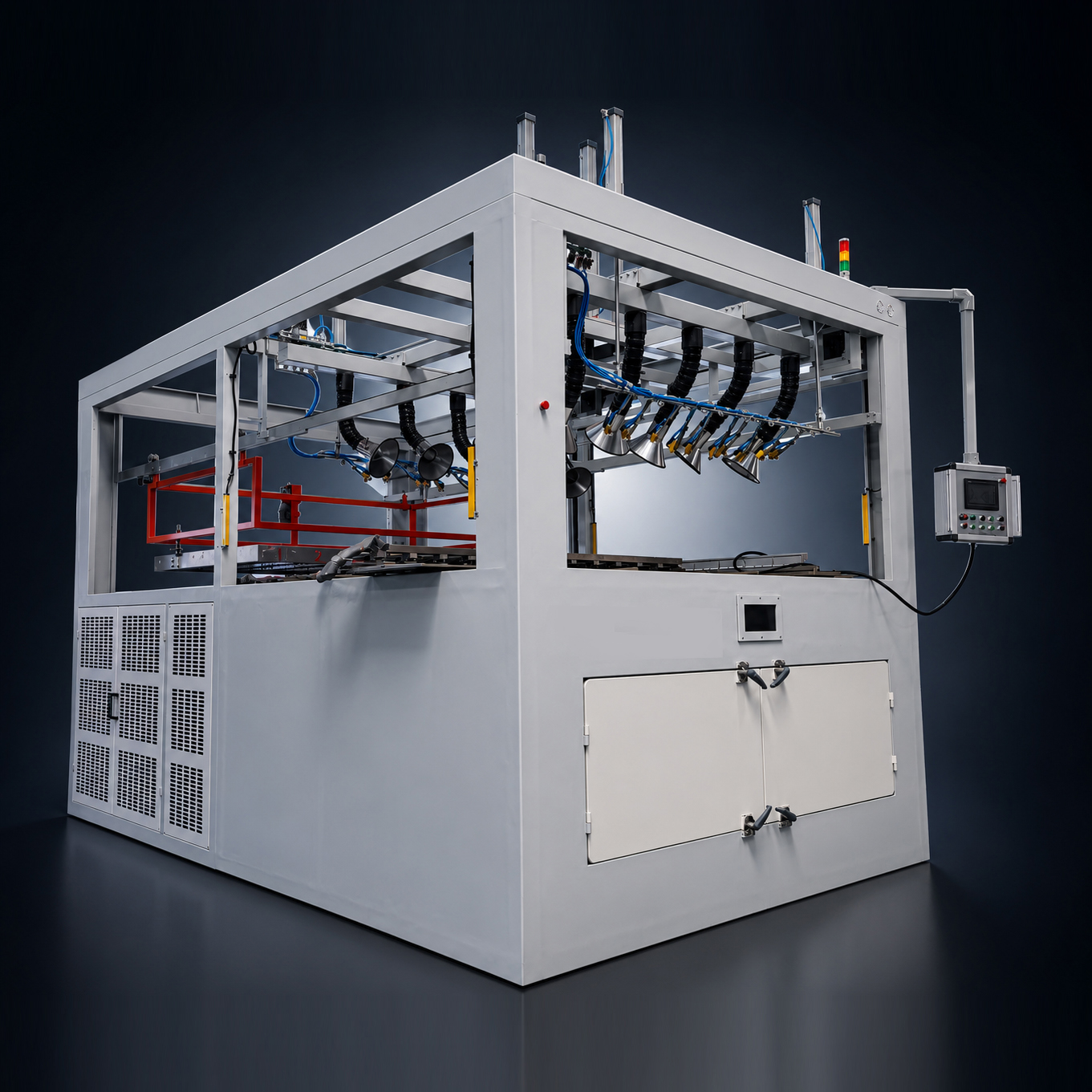
| Thermoformed tray | Ready meals, meat portions, multi-compartment meals | Thermoforming machine with tray sealing | Film gauge, forming depth, MAP gas options |
| Pillow bag | IQF vegetables, fries, dumplings, bakery | Pillow flow wrapper or vertical bagger | Seal temperature profile, film cold-flex spec |
| Carton with film liner | Bulk portions, institutional packs | Case erector, liner application, carton sealer | Liner film, case strength at −18°C |
The format decision is a product and market decision before it is a machinery decision — but the machinery range that supports each format is the practical constraint. The vacuum packing machines range covers the pouch formats, the thermoforming machines range covers the tray formats, and the pillow packaging machines range covers the bag formats.
Vacuum Packaging for Frozen Food: Chamber Size and Pump Decisions
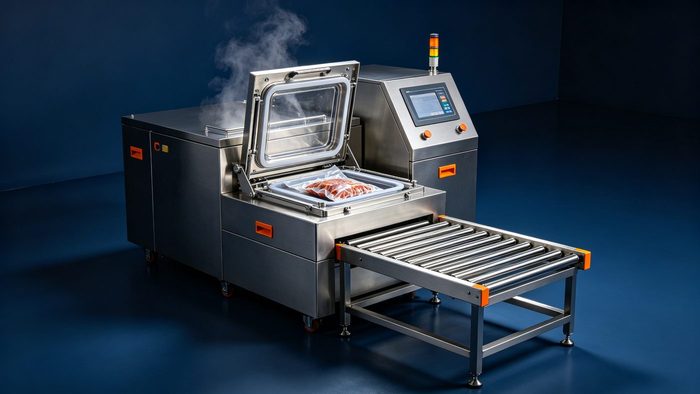
Vacuum packaging is the standard for frozen fish, meat, and seafood, and the chamber machine is the workhorse. Three specifications matter more than the rest:
Chamber size: the chamber must fit the largest pouch flat, with the seal bar long enough to seal across the pouch mouth. Buyers who specify the chamber for the average pouch discover the large-format SKU doesn’t fit — the chamber should be specified for the largest planned format, not the current average. The chamber vacuum range and sizing logic are covered on our sister site SunAura Packaging Machines; this guide focuses on thermoforming, weighing and flow-wrap decisions, where SunAura Machinery is the equipment owner.
Pump capacity: the vacuum pump’s capacity determines the cycle time — the time to draw the chamber down to the set vacuum level. A pump that is undersized for the chamber extends every cycle by seconds, and on a two-shift line those seconds become hours. The pump sizing should be verified at the FAT with the actual pouch sizes and product load, not taken from the brochure.
Seal bar performance on frozen product: the seal bar must seal through the pouch’s top layers — and the pouch’s frozen contents can create a temperature gradient that degrades the seal. The seal bar heater spec and the seal time setting are the parameters that decide whether the seal holds at −18°C. The same seal integrity question applies across all formats, and the MAP vs vacuum comparison covers when the gas flush alternative makes sense for frozen products.
Thermoformed Trays: Forming Depth, Film Gauge and MAP
For frozen ready meals and portioned meat, the thermoformed tray is the format that carries the retail pack. The tray specification is decided by three parameters:
Forming depth: the tray’s forming depth is set by the product portion and the packaging’s fill height. Deeper trays need thicker film and more forming time — the depth should be specified against the actual portion, not a “deep tray” generalization. The forming depth range is a specification on the thermoforming machines range, and the machine should be tooled for the planned depth range.
Film gauge: the tray film must hold its shape at −18°C and survive the distribution stack. The gauge decision follows the film thickness guide — with the frozen factor added: films that are fine at room temperature become brittle in the freezer, so the cold-flex specification matters as much as the gauge.
MAP gas options: modified atmosphere packaging — nitrogen and CO2 flushing — extends the shelf life of frozen portions and reduces freezer burn. The MAP option on the tray sealer adds the gas flush stations and the gas analysis verification. The MAP vs vacuum comparison covers when the gas flush pays for itself, and the gas mix verification is a commissioning step on every MAP line.
Weighing Frozen Product: Condensation-Resistant Design
The weighing station on a frozen line is where condensation does the most damage. The classic failure sequence: the line runs warm product at the feeder, the cold-room air condenses on the load cells, the calibration drifts, and the giveaway climbs through the shift. The specification that prevents it is the same one that keeps multihead weighers accurate on abrasive products — sealed load cells and a controlled environment around the weighing zone.
For IQF vegetables, dumplings, and other individually quick-frozen products, the multihead weigher is the standard — the combination weighing principle handles the variable piece weights and holds the accuracy target. The head count decision follows the same logic as other granular products, covered in the multihead weigher selection guide. The frozen-line addition is the environment spec: the weigher’s load cells should be specified condensation-resistant, and the weighing zone should be positioned away from the cold-room door’s air exchange.
Integration and Layout in a Cold Environment
The frozen line’s layout is dictated by the cold chain: the product comes from the IQF freezer or cold store, packs in the packing area, and returns to cold storage immediately. The layout decisions that matter:
The cold-room boundary: the line should be laid out so the product’s cold exposure is minimized — the freezer discharge, the weighing station, and the pack-out should flow in a straight line, with the least distance between the freezer and the packing line. The layout planning method is covered in the packaging line layout design guide, and the frozen factor is the temperature budget: every meter of conveyor in the cold room is a cost, and every meter outside it is a temperature risk.
Conveyor specification: open-frame conveyors that shed frost, with the drive and control components specified for the cold environment. The conveyor selection method — including the cold-room component spec — is covered in the conveyor selection guide.
Case packing after freezing: the packed frozen product cases move to the case packing and palletizing stations, which can run outside the cold room — the case erecting and palletizing equipment is standard, while the product transport between the cold zone and the packing zone is the cold-chain link. The case packing range is covered on the case erectors page, and the complete end-of-line framework on the end-of-line automation page. The same integration pattern applies to the coffee packaging line and the pet food bagging line delivered this month, where the weighing-bagging-sealing-case packing sequence runs on the same control platform.
Maintenance Profile
Frozen lines have a maintenance profile shaped by condensation, frost, and cold:
- Daily: wipe the weighing zone and load cell housings; check the seal bars for frost residue; verify the cabinet heater operation
- Weekly: check the lubricant condition on cold-specified components; verify the seal temperature on a test pouch; inspect the conveyor drives for condensation
- Monthly: full weigher calibration; check the thermoformer’s forming tooling for frost build-up; inspect the vacuum pump oil
- Quarterly: replace the seal bar heaters on schedule; full inspection of the vacuum pump and the cabinet seal integrity
The maintenance discipline follows the preventive maintenance checklist, with the cold-room tasks added. Spare parts for the vacuum pump, seal bars, and weigher components ship under SunAura’s 48-hour spare parts dispatch program, and the stocking method is covered in the packaging machine spare parts strategy guide.
Frequently Asked Questions
Can a standard packaging machine run in a cold room?
Only with cold-room specification. Standard machines use lubricants that thicken below 10°C, pneumatic components that respond slower, and plastics that become brittle — and the condensation will drift the weighing accuracy and corrode the electrical system. The cold-room specification adds the temperature-rated components, sealed control cabinet with heater, and condensation-resistant load cells. The price difference is modest; the failure cost of a standard machine in a cold room is not.
What is the difference between vacuum packaging and MAP for frozen food?
Vacuum packaging removes the air from the pouch, giving the tightest oxygen barrier and the longest shelf life for most frozen products — the standard for fish, meat, and seafood. MAP replaces the air with a nitrogen-CO2 mix, which suits products where vacuum compression would crush the product or where the presentation matters more than the absolute oxygen barrier. The full technical comparison — gas mixes, shelf life math, and the machinery difference — is covered in the MAP vs vacuum comparison.
How do I stop my frozen seals from cracking at −18°C?
Seal cracking at −18°C traces to two causes: the film’s cold-flex specification and the seal quality at the machine. The film must be specified for cold-flex — films that pass at room temperature can shatter in the freezer. The seal itself must be complete and at the right temperature profile — a marginal seal that holds at 20°C fails at −18°C. Verify both at the FAT with the actual film and a freezer test on sealed samples, not the brochure’s seal specification.
Should I weigh before or after freezing?
After freezing, for accuracy — the product’s moisture content changes during freezing, and the net weight spec applies to the frozen product. Weighing before freezing means the line gives away the moisture loss, which for some products is 1–3% of the product weight. The practical exception is products where the frozen product is too hard for the weigher’s feeders — then the line weighs before freezing and the recipe compensates for the expected moisture loss, verified against the frozen weight.
What is the lead time for a frozen food packaging line?
A complete frozen line — weigher, vacuum packer or thermoformer, and case packing — runs 8–12 weeks lead time, including the FAT with the customer’s actual product and film. The cold-room specification extends the lead time because the temperature-rated components are built to order. The critical path is the tooling for the tray or pouch formats plus the cold-room spec, so both should be finalized early in the project.
Conclusion and Next Step
Frozen food packaging is a cold-chain engineering problem before it is a packaging machinery problem. The specifications that decide a frozen line’s success — the environment spec, the format decision, the condensation-resistant weighing, and the film’s cold-flex performance — are the ones buyers should verify at the specification stage, not discover at commissioning. The SunAura Machinery range covers the vacuum packers, thermoformers, pillow wrappers, weighers, and case packing equipment for frozen lines, each available with the cold-room specification and a FAT run with your actual product and film. To discuss your product formats and cold-room layout with the applications engineering team, contact SunAura Machinery.
About SunAura Machinery
SunAura Machinery is a packaging equipment manufacturer based in Qingdao, China, exporting to more than 100 countries. SunAura Machinery’s front-end range covers thermoforming machines, pillow flow wrappers, multihead weighers, liquid fillers, cappers and induction sealers; end-of-line equipment — vacuum packing machines, band sealers, case packing and palletizing — is supplied by our sister site SunAura Packaging Machines. Conveying and case-packing equipment completes frozen food, coffee, snack, and pet food lines — all CE certified.
Editorial note: Specifications reflect equipment configurations and are subject to change. Contact SunAura Machinery for current configuration options.