
Gantry Palletizer System
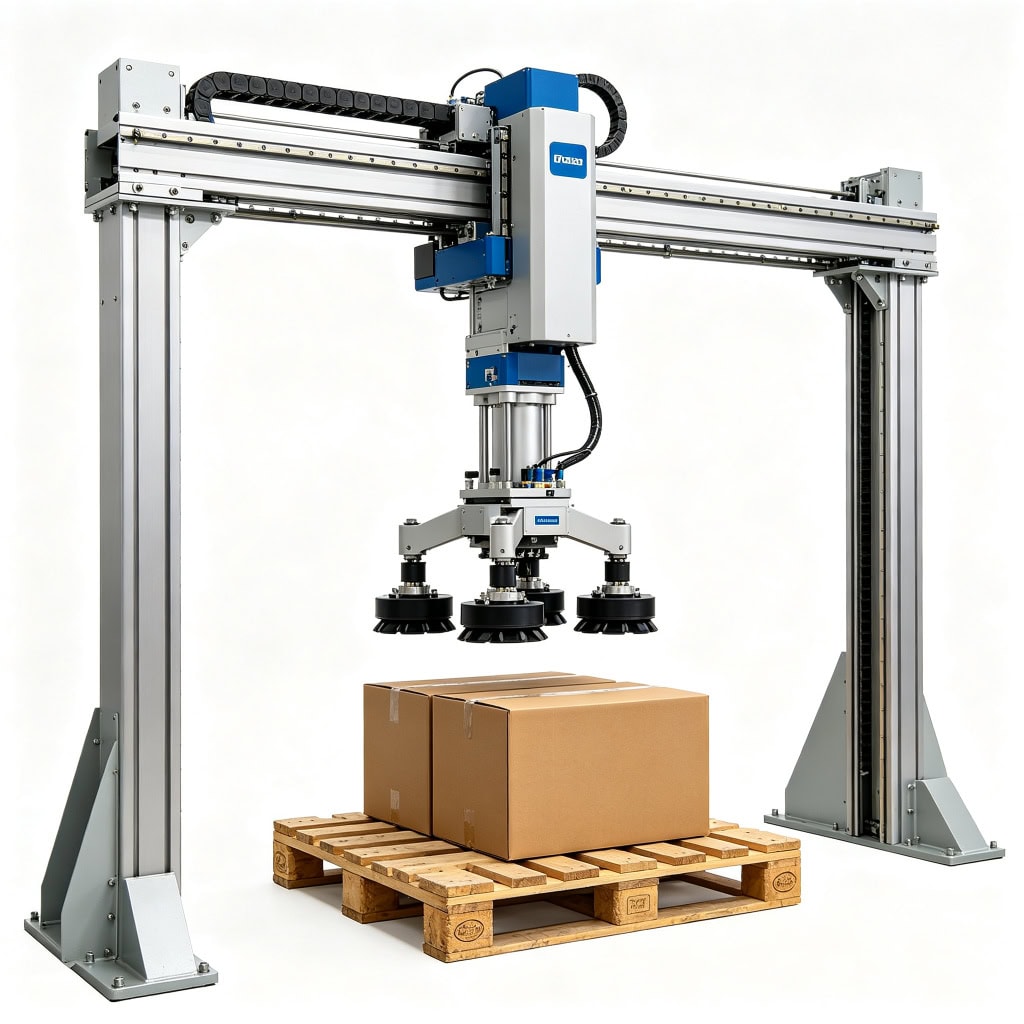
The SunAura SNA-GP2500 gantry palletizer is a servo-driven Cartesian system with a 2500×2500 mm work envelope, 100 kg payload, and up to four pallet positions. Vacuum cup array or mechanical gripper end-of-arm tooling handles cases, trays, bags, and mixed SKUs with ±0.2 mm repeatability. Reconfigure the work area in software — no robot cell or fencing redesign needed.

Product Description
The SunAura SNA-GP2500 is a Cartesian gantry (portal) palletizer that bridges the gap between dedicated layer palletizers and articulated-arm robots. Three servo-driven axes — X (2500 mm), Y (2500 mm), and Z (2000 mm stroke) — carry a 100 kg end-of-arm tool across a large rectangular work area. The gantry frame spans multiple pallet positions (up to four), so one machine can palletize several lines or SKUs simultaneously without moving the base.
End-of-arm tooling is selected at order: a vacuum cup array for cases, trays, and shrink-wrapped loads; or a mechanical gripper for bags and heavy cartons. All axes use servo motors with encoder feedback for ±0.2 mm repeatability. Because the motion is Cartesian — not articulated — the kinematics are straightforward to program, and patterns can be edited directly on the HMI without specialized robot-training software.
The gantry design offers three advantages over an industrial robot: (1) a much larger work envelope at a lower cost per square meter; (2) overhead mounting that keeps floor space clear under the bridge; and (3) easier reconfiguration — adding a fourth pallet position or shifting the pick location is a software change, not a robot relocation. This makes the SNA-GP2500 ideal for logistics centers, multi-product warehouses, and mixed-SKU operations.
Technical Specifications
| Model | SNA-GP2500 Gantry Palletizer System |
|---|---|
| Payload | Up to 100 kg (including EOAT) |
| Work Area (X × Y) | 2500 × 2500 mm (customizable dimensions on request) |
| Z-Axis Stroke | 2000 mm |
| Speed — X / Y Axes | 1.5 m / s |
| Speed — Z Axis | 0.8 m / s |
| Repeatability | ±0.2 mm |
| End-of-Arm Tooling | Vacuum cup array or mechanical gripper (selectable) |
| Pallet Positions | Up to 4 stations within work envelope |
| Drive Axes | Servo-driven, all axes, encoder feedback |
| Power Supply | 380 V, 3-phase, 50 / 60 Hz (factory-set to order) |
| Certification | CE Certified, ISO 9001 factory |
Key Features & Benefits
- 2500×2500 mm work envelope: Covers up to four standard pallet positions — one gantry replaces multiple robots or dedicated palletizers in multi-line operations.
- 100 kg payload with ±0.2 mm repeatability: Handles cases, trays, bags, and mixed loads with precision that beats most articulated robots at a lower capital cost.
- Servo-driven on all axes: X, Y, and Z axes use closed-loop servo motors — smooth motion, programmable speed profiles, and consistent placement cycle after cycle.
- Easy reconfiguration in software: Add a pallet position, shift the pick point, or change the pattern — done on the HMI. No robot teach pendant or systems integrator required.
- Overhead design saves floor space: The bridge spans above the work area, leaving the floor clear for conveyors, forklifts, and operator access.
- Dual EOAT options: Vacuum cup array for smooth-top cases and trays; mechanical gripper for bags and rigid cartons. Tool changeover is quick and tool-less on most configurations.
- Multi-pallet position support: Assign each station to a different product, customer, or shift. The gantry routes loads automatically based on product barcode or recipe.
- CE-compliant integrated safety: Light curtains, interlocked fences, and zone-based speed reduction meet European machinery safety standards for collaborative floor-space operation.
Application Industries
Logistics Centers & 3PL
Multi-SKU inbound and outbound palletizing — the gantry routes different products to different pallet stations automatically.
Multi-Product Production Lines
One machine palletizes output from two or three upstream lines. Recipe switching handles different case sizes and patterns per line.
Warehousing & Distribution
Mixed-SKU pallet building for e-commerce fulfillment — the gantry places individual items onto a mixed pallet in the correct sequence.
Food & Beverage Co-Packing
Contract packers handling multiple brands — reconfigure pallet patterns per customer without repositioning the machine.
Consumer Goods Manufacturing
Appliance parts, household products, and personal care items in cartons — the 100 kg payload covers most consumer-goods case weights.
Pharmaceuticals & Medical Devices
Clean, repeatable placement of cartons and trays — gantry kinematics are easier to validate under GMP documentation requirements.
Load compatibility: Cases, trays, cartons, and bags weighing up to 100 kg including end-of-arm tooling. For very heavy payloads (120–180 kg), see our Four-Axis or Heavy-Duty Robotic Palletizer. For very high-speed single-SKU lines, a dedicated layer palletizer is faster.
How a Gantry Palletizer Works
A gantry (Cartesian) palletizer moves the EOAT along straight X, Y, and Z axes on linear rails — like a 3D printer but scaled up to pallet size. The SNA-GP2500 cycle is straightforward:
- Conveyor delivers product to the pick point. Cases, trays, or bags arrive on the infeed conveyor and stop at a fixed pick position. Sensors confirm the product is present and oriented correctly.
- Gantry moves EOAT to pick position. The X and Y axes position the tool directly above the product. The Z axis descends and the EOAT activates — vacuum cups seal to the top, or the mechanical gripper closes around the sides.
- Product lifted and moved to place position. The Z axis lifts the load clear of the conveyor. X and Y axes move the load to the programmed pallet station and XY coordinate for the current layer.
- Product placed on pallet. The Z axis descends to the programmed layer height. The EOAT releases — vacuum cups vent, or gripper opens — and the product settles onto the layer.
- Pattern repeats across layers. The gantry returns to the pick point and repeats. XY coordinates advance according to the active pattern recipe. When the layer is complete, the Z offset increases by one layer height. The cycle continues to the programmed stack height.
Is This the Right Gantry Palletizer for You?
The SNA-GP2500 is the right fit if your operation matches all four of the following. If you fall outside any of them, our team can recommend a different SunAura model:
- Multiple pallet stations or mixed SKUs: The gantry’s strength is covering multiple positions. If you palletize one product on one pallet at high speed, a dedicated layer palletizer is faster and cheaper.
- Payload under 100 kg: This gantry handles 100 kg including EOAT. If you need 120–180 kg payload, step up to our articulated-arm robotic palletizers.
- Floor space for the bridge: The gantry spans 2500×2500 mm plus support columns. Plan for a 3×3 m minimum footprint. If floor space is extremely tight, a compact or collaborative robot may fit better.
- You value reconfigurability: If your product mix changes quarterly or seasonally, the gantry’s software-driven reconfiguration is a major advantage. If you run one product 24/7, a fixed layer palletizer is simpler.
Troubleshooting Guide — Common Issues & Solutions
Gantry systems are mechanically simpler than articulated robots but their long rail axes and servo drives introduce specific maintenance points. Below are the most common issues our service team diagnoses remotely. Always follow lockout/tagout procedures before working on rail drives or EOAT.
| Problem | Possible Causes | Solutions |
|---|---|---|
| Product placed off-target on pallet | Encoder drift; belt or screw backlash; pallet not aligned; pattern recipe offset. |
|
| Vacuum cups do not seal on pick | Vacuum pump weak; cups worn; product surface dusty or uneven; suction cup array misaligned. |
|
| Axis following error alarm | Servo overload; drive belt slipping; linear guide binding; encoder cable loose. |
|
| Z-axis drops slowly under load | Brake not engaging; ball screw back-driving; counterbalance weak; load exceeding payload. |
|
| Pallet station not recognized | Station sensor misaligned; pallet not in position; I/O channel fault. |
|
| Cycle time slower than expected | Acceleration profile conservative; EOAT release delay; conveyor pick point not synchronized; unnecessary travel distance. |
|
If the issue persists after trying these steps, email photos and a short 10-second video of the problem to [email protected] — our engineers usually diagnose the root cause within one business day.
Frequently Asked Questions
How many pallet positions can the gantry cover?
The standard 2500×2500 mm work envelope covers up to four standard 1200×1000 mm pallet stations arranged in a 2×2 grid. Larger work envelopes (up to 4000×3000 mm) are available as custom configurations. Tell us your station layout during quotation and we will size the bridge accordingly.
What is the difference between a gantry and a robotic palletizer?
A gantry moves on straight X/Y/Z rails (Cartesian motion) with a large rectangular work area at lower cost per square meter. An articulated-arm robot rotates on joints with a circular work envelope and higher flexibility for complex paths. For multi-pallet, multi-SKU operations, the gantry is more cost-effective. For irregular paths or very high payloads, the articulated robot wins.
How fast is it compared to a layer palletizer?
The gantry picks and places one item per cycle at roughly 600–900 cycles/hour depending on travel distance. A dedicated layer palletizer runs faster (1200–1800 cases/hour) because it builds complete layers at once. The gantry trades raw speed for flexibility across multiple stations and SKUs.
Can it handle bags as well as cases?
Yes, with the mechanical gripper EOAT. The vacuum array is best for cases, trays, and shrink-wrapped loads with flat tops. The mechanical gripper handles bags and rigid cartons. We configure the EOAT based on your product mix — send us samples and we will select the right tool.
How difficult is it to reconfigure for a new product?
Adding a new product pattern is done on the HMI — enter the product dimensions, pallet size, and layer count, and the controller calculates the placement coordinates. No robot teaching or offline programming is needed. Most operators create a new pattern in 10–15 minutes after a short training session.
What is the lead time for a custom gantry system?
Standard 2500×2500 mm systems ship in 35–50 days. Custom work envelopes, special EOAT, or integrated conveyor lines add 10–20 days. We provide a factory acceptance test video before shipment so you can verify the motion and patterns before the machine leaves Qingdao.
Why Buy From SunAura Machinery
48,000㎡ Own Factory
In-house manufacturing in Qingdao, China — no middlemen, no trader markup.
CE Certified
All machines meet European safety standards with full documentation.
ISO 9001:2015
Quality management system certified across the entire production process.
SGS Audited Factory
Third-party audited manufacturing facility with 20+ national patents.
12-Month Warranty
Full warranty covering parts and labor from the date of shipment.
Lifetime Support
Technical guidance via email, WhatsApp, and remote video for the machine’s life.
Spare Parts in 48h
Genuine parts shipped worldwide via DHL/FedEx within 48 hours.
100+ Countries Served
Trusted by packaging lines across logistics, food, pharma, and consumer goods.
Get a Factory-Direct Quote in 24 Hours
Tell us your product dimensions, number of pallet stations, and expected output — our engineers reply with a model recommendation, FOB price, and lead time within one business day. Every machine is built in our 48,000㎡ Qingdao factory, CE & ISO 9001 certified.
Email [email protected]Related Palletizers
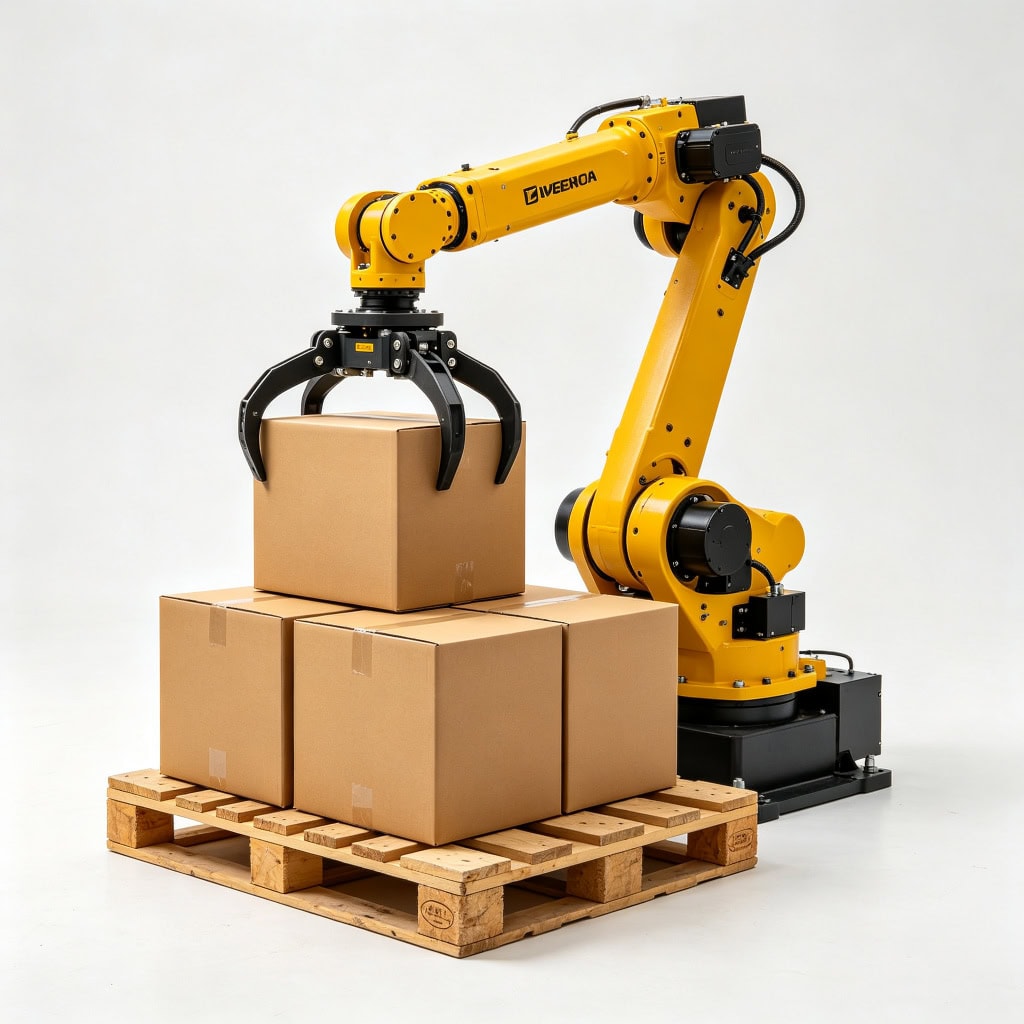
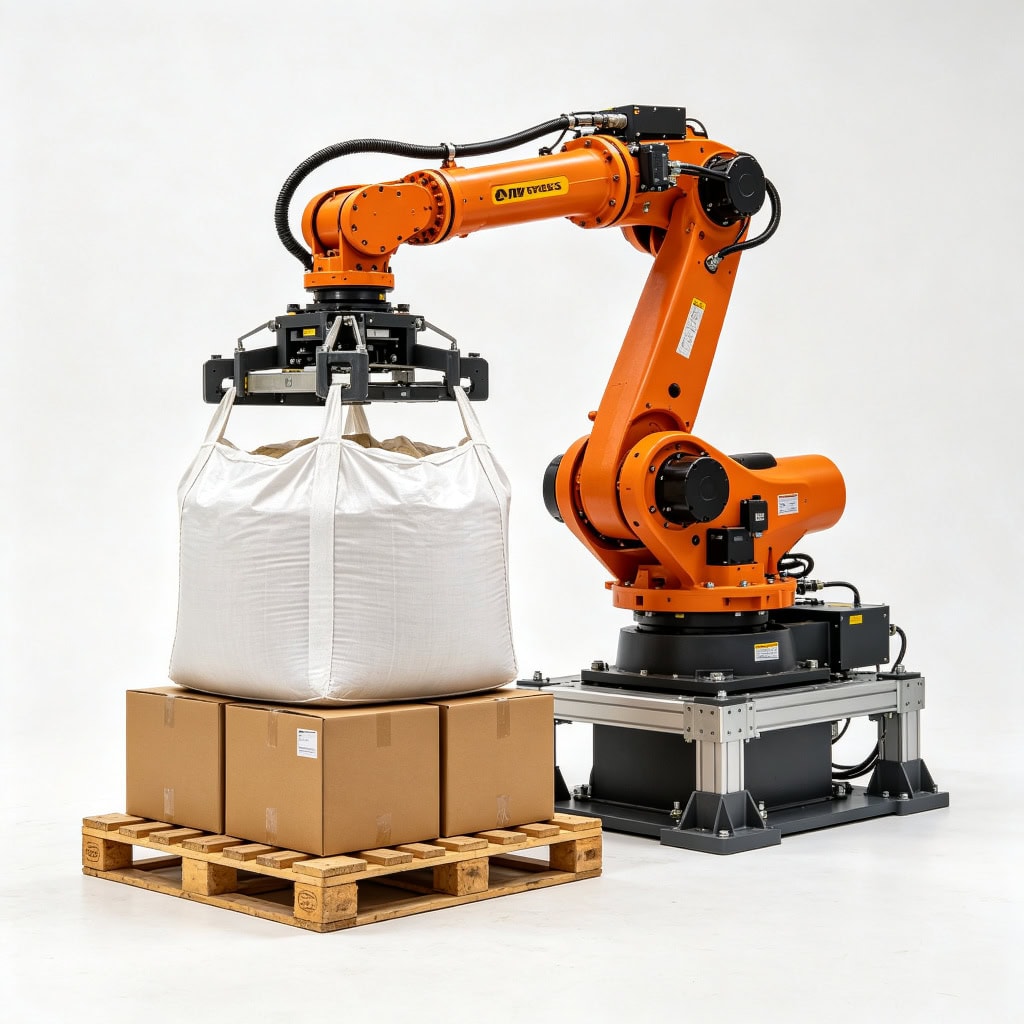
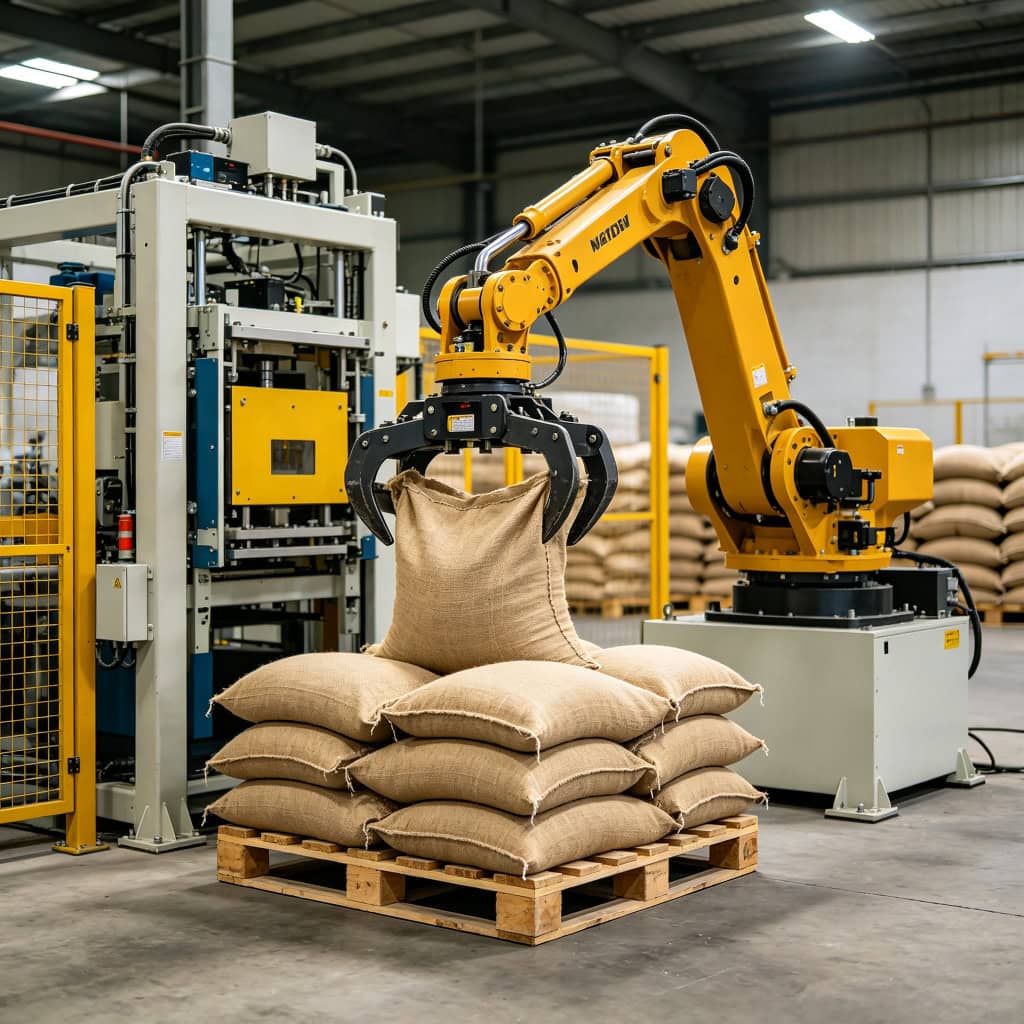
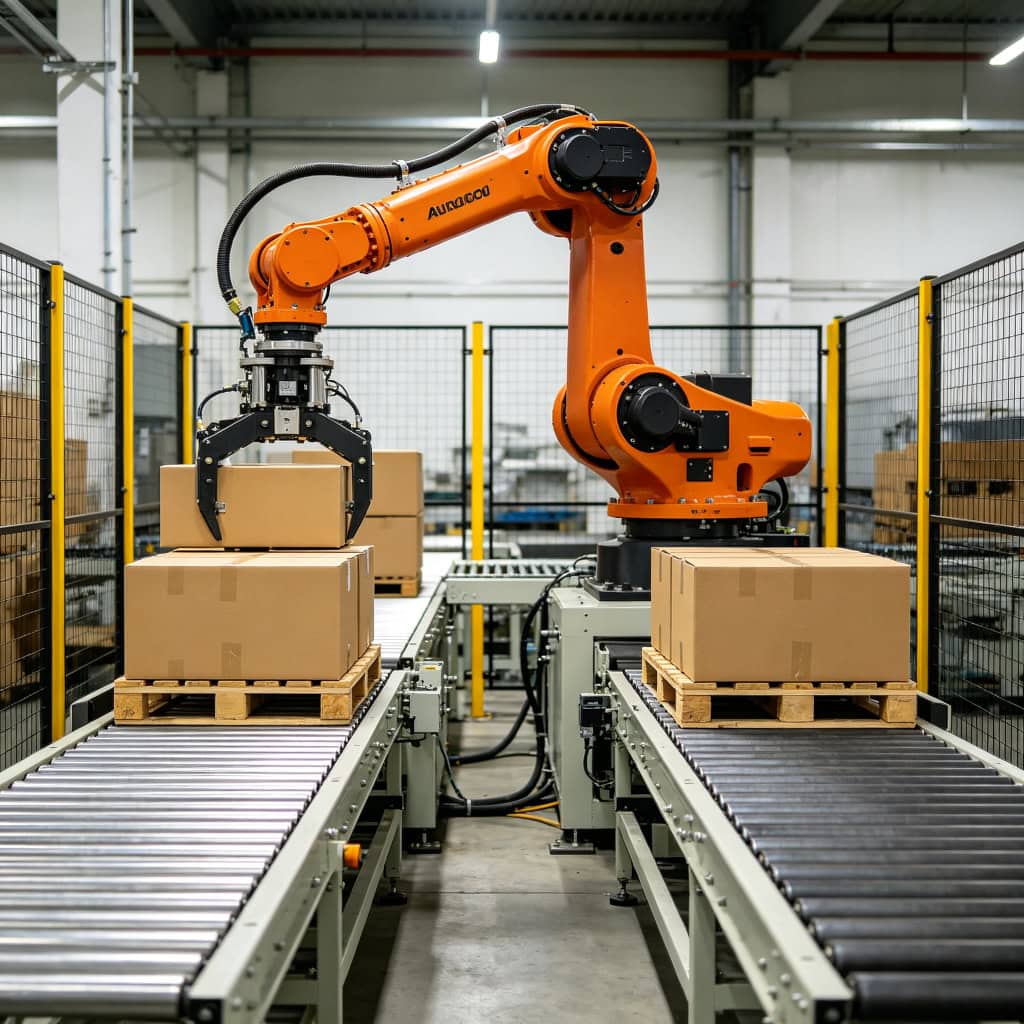
Browse the full range on the palletizers landing page. Also explore our compact carton palletizers and low-level case palletizers to build a complete end-of-line solution.