Gantry vs Robotic Palletizer: What the Comparison Actually Decides
At the end of a packing line, after cases are sealed, labeled and grouped into layers, the load has to be stacked on a pallet before stretch wrapping and dispatch. The choice between a gantry palletizer and a robotic palletizer should be made on measured parameters rather than the machine’s shape in a brochure. This gantry vs robotic palletizer comparison walks through footprint in square meters, horizontal travel in millimeters, payload in kilograms, sustained cases per minute, cycle time in seconds, guarding distance in millimeters, and SKU changeover without manual setup. Figures sit inside the planning bands we use during line layout; treat them as ranges to verify at factory acceptance, not fixed quotes.
A gantry system moves its gripper along a rigid Cartesian frame: a longitudinal rail, a cross rail and a vertical Z axis, all driven by servo or pneumatic actuators along straight lines. A robotic palletizer, by contrast, uses an articulated arm with rotary joints, most often a four-axis arm built for palletizing, bolted to a floor pedestal and sweeping a circular work envelope. Both architectures can stack cartons onto a 1200 × 1000 mm or 800 × 1200 mm pallet, but they occupy different space envelopes, tolerate different product mixes, impose different ceiling heights, and cost different amounts to install and guard. The rest of this article sets out the engineering bands behind each choice, names the cases where one architecture is the wrong tool, and points to the matching machine families on the palletizer index.
How a Gantry Palletizer Is Built
The gantry palletizer system sits over the line on a fixed frame. Two or four upright columns carry a longitudinal beam; a carriage travels along that beam, and a cross member with the vertical Z axis travels across it. The gripper — usually a vacuum beam with suction cups, sometimes a fork or a clamp bar for bags — hangs from the Z axis and descends onto each product. Motion is restricted to three straight axes, so the machine moves in programmed straight lines between fixed positions rather than tracing arm arcs through open space. Typical horizontal travel on a standard gantry palletizer spans 3–4 m, enough to cover an infeed conveyor and one or two pallet build positions side by side.
The gantry’s mechanical character follows from that construction. The frame is rigid by design, so residual sway after a stop is small and the gripper settles quickly over the pickup or drop point. Because the rails are fixed, the guarding envelope is easier to define: the overhead frame and vertical travel define a volume that can be fenced without mapping an arm sweep. The trade-off is layout rigidity. Move the conveyor or add a third pallet station five years from now, and the rail span has to be extended or rebuilt; the frame does not reposition itself the way a pedestal-mounted arm can be shifted or reprogrammed. Machine-only pricing for a gantry cell typically sits in the $80k–140k EXW band, before freight, installation and SAT, which add roughly 12–22% on top.
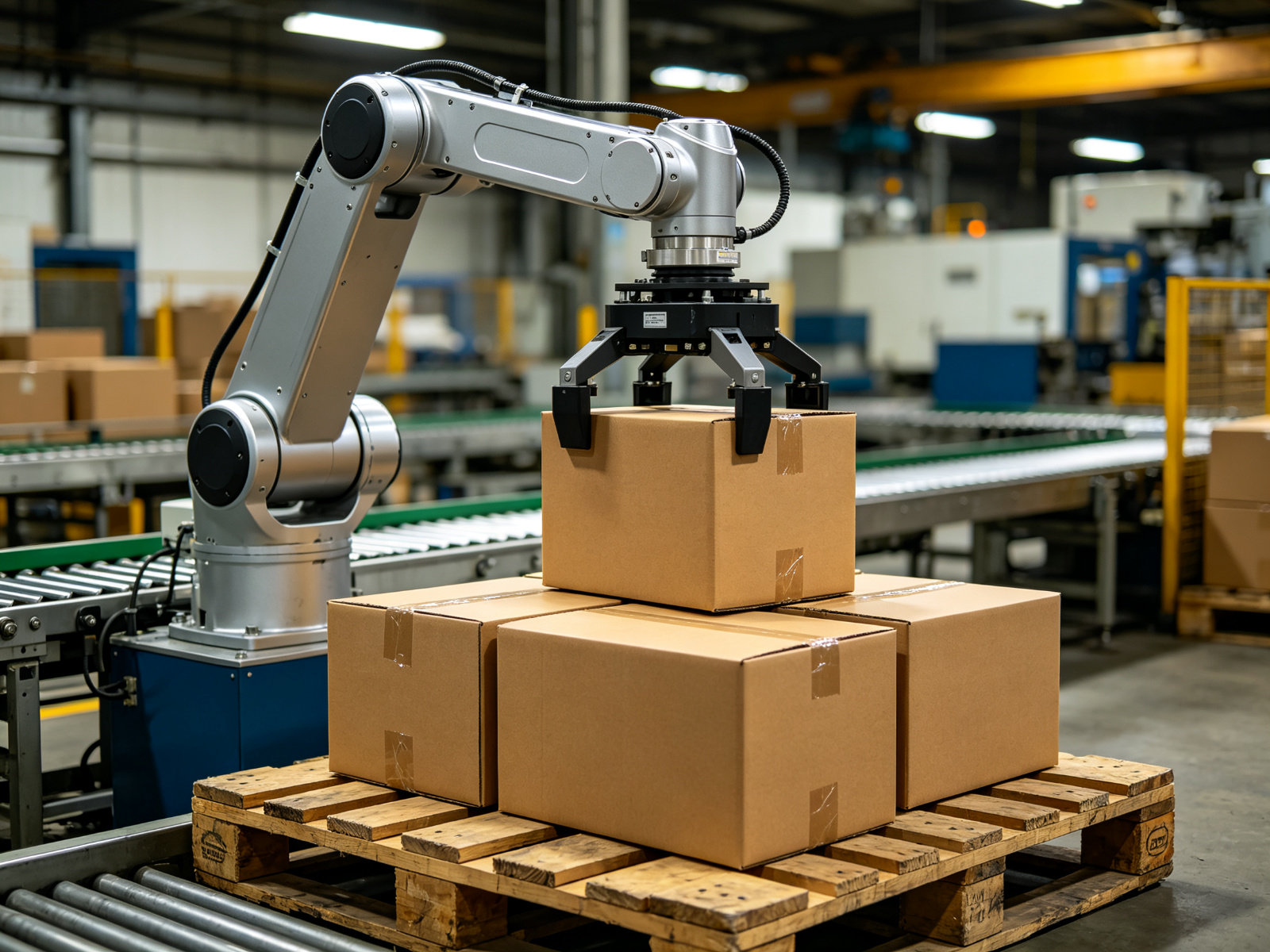
On the SunAura line, the gantry palletizer system is the reference machine for this architecture: a silver Cartesian frame with a vacuum gripper working over a row of boxes, where the straight-line motion and rigid Z axis are visible in the frame itself. It suits lines where the product flow, pallet positions and layer pattern stay stable over long production runs, and where low residual motion matters more than rapid recipe changes.
How an Articulated Robotic Palletizer Moves
The four-axis palletizing arm
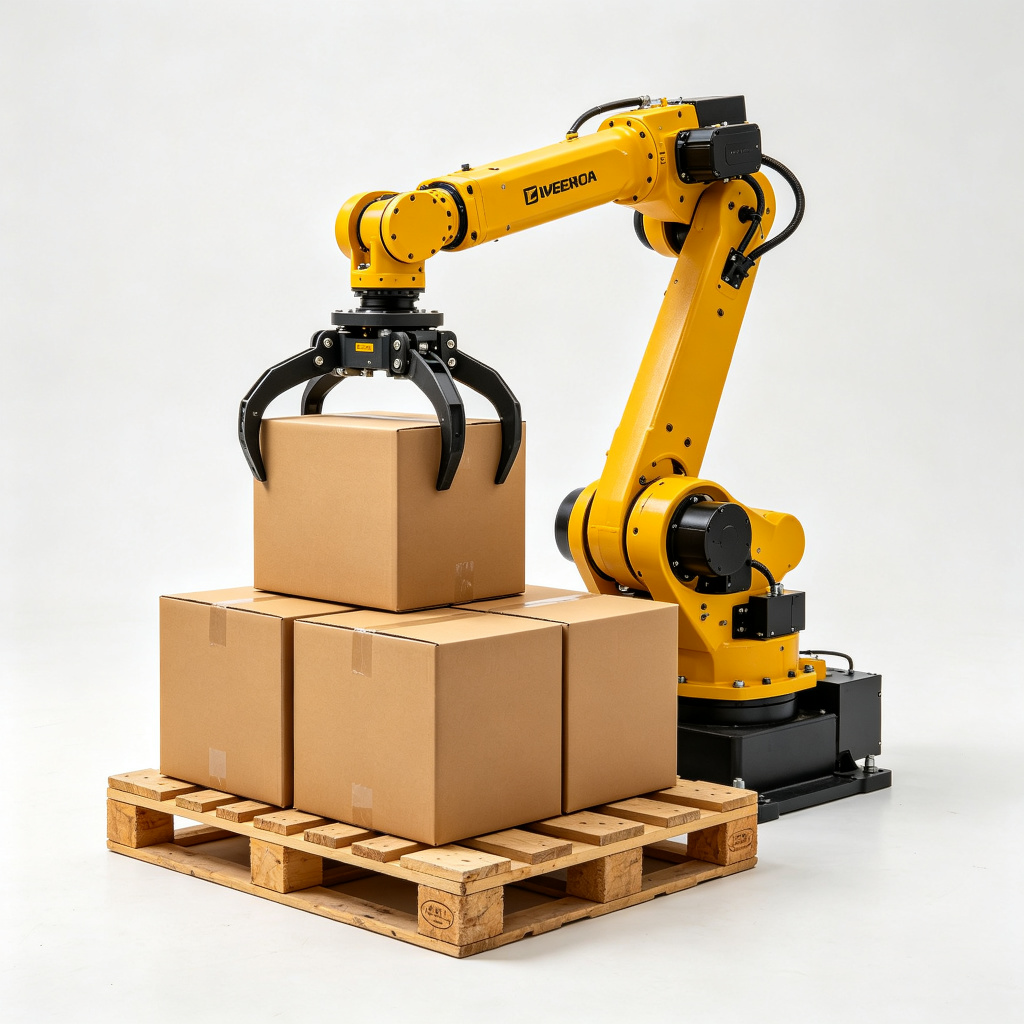
The robotic palletizer uses an articulated arm mounted on a fixed pedestal. A palletizing-class arm carries four axes: base rotation, shoulder, elbow and a wrist that keeps the gripper level through the lift. The arm sweeps a circular envelope around the pedestal, and the controller coordinates the joints so the gripper travels in straight-line paths between conveyor pickup and each pallet cell. Two payload classes dominate the range: a 120 kg class for cartons, trays and bags, and a 180 kg class for heavier bags, FIBC bulk bags and dense bundles. Horizontal reach runs roughly 2.4–3.2 m depending on model, which sets how many pallet stations and conveyors the arm serves from one pedestal.
The articulated arm’s strength is geometric freedom. From one pedestal it can reach an infeed conveyor, two or three pallet build positions, and sometimes a discharge conveyor, all within the same envelope. Layer patterns are stored as recipes in the controller, so a change between carton SKUs usually means selecting a different pattern file rather than re-mechanizing the machine. The limits are equally clear: anything outside the rated reach cannot be served without moving the pedestal; payload de-rates at the far edge of the envelope; and the arm’s rotary sweep means the guarding has to follow the full arc of the arm, not just a fixed frame volume.
The four-axis robotic palletizer 120 kg covers the standard carton, tray and woven-sack range, while the heavy-duty robotic palletizer 180 kg steps up to bulk bags and dense loads where the tooling plus product together approach the higher payload rating. A standard articulated robot cell typically lands in the $55k–90k machine-only EXW band, again before the 12–22% installation and commissioning allowance.
Side-by-Side Comparison Table
The table below condenses the planning bands for the two architectures. Figures are typical ranges for case and bag palletizing; verify the final envelope, payload and cycle against the load drawings at factory acceptance.
| Parameter | Gantry / Cartesian palletizer | Articulated robotic palletizer |
|---|---|---|
| Motion axes | Fixed X, Y, Z straight rails | 4-axis rotary arm, circular envelope |
| Horizontal travel / reach | 3–4 m rail travel, fixed to frame | 2.4–3.2 m reach from pedestal |
| Payload class | Matched to rail and Z axis; often medium loads on a fixed beam | 120 kg standard class, 180 kg heavy class |
| Typical throughput | 10–25 cases/min depending on axes and gripper | 700–900 picks/h single pick, up to ~1200 picks/h with optimized motion; 3.5–6 s cycle |
| Floor footprint | Rectangular frame volume tied to rail span | Pedestal plus arm sweep radius around it |
| Residual motion after stop | Low; rigid frame settles fast | Small but present; arm joints can drift slightly before settle |
| SKU flexibility | Best on steady single-SKU runs; pattern changes limited by fixed positions | Pattern library in controller; recipe changes between SKUs |
| Guarding envelope | Fixed frame volume, simpler to fence | Full arm sweep arc must be guarded |
| Layout reconfiguration | Rails and columns must be extended or rebuilt | Pedestal can be repositioned; patterns reprogrammed |
| Machine-only price band (EXW) | $80k–140k | $55k–90k standard cell; dual-station variants $85k–130k |
Floor Space and Footprint
Measuring floor space means measuring the whole cell, not just the machine footprint the vendor quotes. For a gantry, the footprint is a rectangle defined by the rail span and the depth of the pallet build positions: columns sit at the corners, beams bridge between them, and the conveyor enters along one open side. Because the frame is fixed, the rectangle rarely shrinks after layout. Add pickup and discharge clearance at each end, and a gantry cell commonly occupies roughly 4.5–6.5 m long by 2.5–3.5 m deep, depending on whether one or two pallets are built under the frame.
For an articulated arm, the footprint starts with the pedestal bolted to a reinforced floor pad, then expands outward to the arm’s sweep radius. The conveyor approaches from one side, one or two pallet stations sit inside the reach, and discharge clearance is left where the finished pallet leaves. A single-station arm cell often fits a roughly 3.5 × 3.5 m working zone; a dual-station cell spreads wider, because two build positions sit opposite each other around the pedestal. The circular envelope leaves corner dead space that can hold pallet stacks, slip-sheet dispensers or guarding hardware.
Before choosing either layout, measure the following on the actual line:
- Center-to-center distance between the infeed conveyor pickup point and each pallet center, in millimeters.
- Pallet footprint plus 100 mm clearance on each side for forklift or pallet-jack entry.
- Height from floor to the lowest overhead obstruction: pipe runs, lighting, crane beams, mezzanine underside.
- Clearance for empty pallet stacking and finished pallet discharge, including the exchange cycle when a full pallet leaves and an empty one arrives.
- Door and aisle width the machine must pass through during installation, and floor loading capacity in kg/m².
Reach and Work Envelope
Reach is where the two architectures stop looking interchangeable. A gantry’s 3–4 m travel is a straight-line measurement along the rails; every point under the beam shares the same Z access, but nothing outside the rail span can be touched. The envelope is a rectangular volume under the frame, and positions in that volume are fixed in the layout. An arm’s 2.4–3.2 m reach is a radius measured from the pedestal center: the envelope is a cylinder swept by the arm, with a top height limit defined by the arm’s vertical lift and a payload de-rating that drops as the load moves toward the far edge.
Two details matter when converting those numbers into a layout. First, reach is rated at full payload; at the outer 20% of the envelope, the arm may shed payload or slow down, so pallet centers should sit inside the comfortable reach band rather than at the rated maximum. Second, the top of the built stack counts against vertical reach. A 1200 mm pallet loaded to a 1800 mm finished stack, plus gripper height and lift clearance, leaves only part of the arm’s vertical travel for the approach; on a gantry, the Z stroke covers the same stack height from the raised rail, so column height is specified against that number directly.
Throughput: Cases per Minute and Picks per Hour
Throughput is usually quoted in cases per minute, picks per hour or layers per minute, and the number only means something when tied to cycle time and product weight. On the gantry side, a standard Cartesian machine handles roughly 10–25 cases/min, depending on how many axes move in parallel, how far the gripper travels between pick and place, and whether the product is picked one case at a time or a whole layer at once. On the articulated side, a single-pick arm runs 700–900 picks/h in normal duty, climbing toward roughly 1200 picks/h when motion is optimized, the pallet positions are close to the conveyor, and the gripper cycles fast. That corresponds to a typical cycle of 3.5–6 s per pick: descend, grip, lift, transfer, place, release, retreat.
Worked example: a 12 cases/min carton line
Take a carton line producing 12 cases/min, which is 720 cases/hour. At a 4.5 s average cycle, one arm completes 800 picks/hour, leaving headroom for pallet exchange, pattern rotation and occasional repositioning. A single-station arm cell can hold this rate, but every pallet exchange pauses the pickup until the empty pallet is in place; if exchange takes 40–60 s and happens once per finished load, the lost time cuts into that headroom. A gantry on the same line would sit near the middle of its 10–25 cases/min band, with the fixed rail keeping the gripper on a short shuttle between conveyor and pallet. The deciding factor here is not speed — both clear 12 cases/min comfortably — but how many SKUs run on the line and how often recipes change.
Worked example: a 20 cases/min high-rate line
A 20 cases/min line runs 1200 cases/hour. At that rate the arm needs close to its optimized motion band, with pallet stations close to the conveyor and a gripper matched to the case face; a single station that stalls on exchange becomes a bottleneck, so a dual-station arrangement that keeps the arm building one pallet while the other is exchanged is the usual answer. Two build positions can lift effective output to roughly 1.6–1.9 times a single station at the same pick rate. A gantry at 20 cases/min sits near the upper end of its band and needs parallel axis motion; on a single-SKU steady run, the rigid frame and short shuttle sustain the rate without joint settle time eating into the cycle. On three or four carton sizes alternating shifts, the arm’s pattern library wins back the setup time the gantry would spend on fixed-position changes.
Residual motion and settle time
Throughput numbers on paper assume the gripper is settled before it grips or releases. The gantry’s rigid frame gives the shortest settle time after each stop, which helps when pick and drop points are tightly spaced. An arm can have small joint drift after the stop, especially with a long gripper beam carrying a wide load; the controller adds a short dwell before descent to let it settle. On lightweight cartons that dwell is barely visible; on a wide vacuum beam spanning two cases, it can add tenths of a second per cycle and should be allowed for in the cycle calculation.
Load Types Each Architecture Handles
- Cartons and trays: vacuum grip on the top face, one case or a layer per pick. Gantry works on steady runs; arm adapts when sizes and orientations change.
- Woven and paper bags: gripper usually a clamp or a fork-style tool that closes around the bag body. Bag shapes are irregular, so arm motion that can rotate and square the bag over the pallet tends to build straighter layers; a gantry can stack bags only when the bag feed is regular and the drop positions are fixed.
- Drums and jugs: handled with a clamp or a dedicated harness; the gripper must center the load before lift. Reach and payload matter more than frame shape here.
- FIBC bulk bags: demand the 180 kg heavy class, with a frame tool that engages the bag loops. The heavy-duty 180 kg robotic palletizer is the reference for this load; check the combined weight of bag, product and tooling against the payload rating at the chosen reach.
Porous or dented corrugated changes the vacuum calculation regardless of architecture: a suction cup that seals on a flat board may leak on a recycled or printed face, and the vacuum supply needs to hold the case through the lift. Pneumatic vacuum grippers on either machine draw roughly 40–80 Nl/min average at a 5–6 bar supply, so compressed air capacity on site should be sized for the gripper plus any other pneumatic actuators in the cell.
SKU Mix and Layer Patterns
A layer pattern is the arrangement of cases on a pallet layer: how many cases across, how many deep, which way each case faces, and where rotated cases break the joints between layers. On a single-SKU line running one carton size for weeks, the pattern is fixed and simple, and neither architecture earns its flexibility on it. The comparison opens up when the line runs two, three or four SKUs of different dimensions on alternating shifts or even alternating pallets.
An arm stores each pattern as a recipe: case dimensions, grid positions, rotation angles per cell, layer count, and the next recipe to call when pallet count reaches target. A recipe changeover is a selection on the teach pendant or line HMI, typically single-digit minutes once the gripper suits the new case face. A gantry’s fixed rail positions can hold multiple patterns in the controller too, but the physical pickup and drop points do not move; patterns needing a shifted case position or a second pallet center may require mechanical adjustment to the frame or feed guidance. Frequent short runs, seasonal packaging changes or mixed pallet orders sit closer to the arm’s ground; one product to a fixed schedule matches the gantry’s fixed geometry.
Guarding and the Safety Envelope
Guarding cost and layout follow the machine’s motion volume. A gantry’s working volume is the space under the fixed frame; access is controlled with perimeter fencing, barred openings at the pallet exchange side, and interlocked service gates. An arm’s working volume is its full sweep arc, so fencing follows that arc around the pedestal, and any open access point needs light curtains or safety scanners that stop motion when a person reaches in. The arm envelope also extends over floor space operators might otherwise walk, pushing guard rails further into the aisle.
Sizing the guard distance is a standards exercise, not a guess: approach speeds, sensor response times and stopping performance combine into minimum distances in millimeters, and the cell should be checked against the relevant machinery safety framework during design. The compliance and guard-distance detail is covered separately in the palletizer safety and CE compliance guide, including fencing, light curtains, interlocks and force limits for collaborative cells. For the gantry vs arm decision, note early that an arm cell generally carries a larger guarded footprint than a gantry cell of comparable throughput, and that this footprint must be reserved in the layout before the machine order is placed.
Installation, Ceiling Height and Utilities
Installation starts with floor preparation. The arm pedestal bolts to a reinforced pad that takes the reaction force of a 120–180 kg load at reach; the gantry columns anchor to a frame spreading load across the rail span, and the floor must carry that distributed load without settlement. Ceiling height matters to both, but differently. A gantry’s overhead beam and Z axis sit above the working stack, so the lowest obstruction must clear the rail carriage plus gripper retraction height; a high-level conventional machine needs even more headroom, around 4.5 m plus for its mezzanine. An arm’s profile is lower at the pedestal, but its vertical lift reaches over the stack, so overhead clearance is checked against the top of the finished pallet rather than a fixed beam.
Utilities for either cell include a compressed air supply at 5–6 bar sized for vacuum generation and clamp actuators, an electrical feed matched to the arm or rail drives and control cabinet, and a link to the line PLC for case presence, pallet count and fault signals. Installation, freight and site acceptance testing run roughly 12–22% on top of machine-only price, depending on distance, rigging access and conveyor integration. Reserve SAT time in the schedule: dry runs with empty cases, then real product at production rate, before sign-off.
When the Gantry Wins
The gantry is the right choice when the line matches its fixed geometry:
- Long steady runs of one or two SKUs, with stable case dimensions and a fixed layer pattern.
- A rectangular layout where conveyor and pallet positions line up along a straight rail span of 3–4 m.
- Short settle time matters: heavy beams, wide vacuum tools or stacked layers where residual sway would disturb the load.
- The guarding envelope should be a simple fixed volume that operators and maintenance can read at a glance.
- Overhead space is available and floor space is tight, so lifting the motion onto a frame frees the floor under the rails.
- Maintenance expectations lean toward rails, bearings and drive belts rather than joint gearboxes and arm cable harnesses.
It is the wrong purchase when the product mix will change often, when pallet positions sit around a curve the beam cannot reach, or when the line may move to a new layout in a few years and the frame would have to be rebuilt to follow.
When the Articulated Arm Wins
The arm earns its place when geometry and mix are the moving variables:
- Multiple SKUs on one line, with recipes selected at changeover rather than mechanical adjustments.
- Two or three pallet stations arranged around the pedestal, with the arm serving them in one sweep.
- Irregular loads — bags, bundled products, mixed-orientation cases — that need wrist rotation and square-up before placement.
- Future flexibility: the cell may serve a new conveyor, a second product family or a relocated line, and the pedestal plus controller can follow with re-programming instead of re-steel.
- Lower ceiling height than an overhead gantry beam allows, while still reaching the finished stack.
It is the wrong purchase when the line is a fixed single-SKU run where the frame’s rigidity and simpler guarding would do the job at lower guarding cost, or when the required load sits outside the 120 kg or 180 kg payload class at the planned reach.
Where Cobots and Conventional Layer Machines Fit
The collaborative robot palletizer uses a cobot arm in the 10–25 kg payload range, most commonly 16–20 kg, with a throughput ceiling around 8–12 cases/min and roughly 6–8 cycles/min. Because it works under power-and-force limits defined for collaborative operation, it can run without a full perimeter fence when the application is assessed against the relevant collaborative safety standard. It fits low-rate, mixed small-box cells; it is not a substitute for a 120 kg or 180 kg arm on heavy bags or high-rate carton lines, and it should not be compared on the same cases/min band as a gantry running 10–25 cases/min.
Conventional layer machines — the high-level layer palletizer and the low-level case palletizer — build product in layers on a layer plate rather than picking individual cases with a gripper. They run roughly 1–3 layers/min, suit steady single-SKU high throughput, and the high-level version needs ceiling height around 4.5 m plus a mezzanine. Where a gantry and an arm grip and place one pick at a time, a layer machine collects a full layer, squares it and deposits it as one slab. At layer-oriented rates and one SKU, the conventional machine can be the lower-mechanical-complexity option; for mixed SKUs or low-rate starts, it sits outside the gantry-vs-arm comparison.
Three Buyer Scenarios
Scenario 1: Single-SKU carton line, 180 cases/hour
A food plant runs one carton size, 400 × 300 × 250 mm, on two shifts, about 180 cases/hour, one pallet pattern unchanged for the product’s life. Conveyor and two pallet positions sit in a straight row; measured travel from pickup to pallet center is under 3 m, overhead clearance is ample, and no second SKU is planned for at least three years. The gantry’s fixed rail, short settle time and simple guarding envelope match the line; the arm’s pattern-library flexibility sits unused. A conventional layer machine is worth comparing only if the run rate climbs toward layer-per-minute territory; on 180 cases/hour the gantry cell is the tighter fit.
Scenario 2: Three bag SKUs, alternating pallet recipes
A chemical packaging line fills three woven-sack sizes on alternating batches, building one pallet per recipe before switching. Sack weights run 25–40 kg, pallet positions sit on two sides of the feed conveyor, and changeover happens several times per shift. The arm stores three bag patterns, rotates each sack to square the layer, and serves both build positions from one pedestal; a dual-station arrangement keeps it stacking while an exchanged pallet leaves. A gantry would handle regular bags only with fixed guidance and would lose time on every recipe change. The 120 kg class arm covers these sack weights with room for the clamp tooling; verify combined bag-plus-tool weight against the payload rating at planned reach.
Scenario 3: Heavy FIBC loads, limited headroom
A bulk-material operation fills FIBC bags up to 150 kg including the frame tool, in a warehouse with low overhead beams and a restricted ceiling. The load demands the 180 kg heavy-duty arm class, engaging bag loops with a frame tool and placing bags onto one or two pallets inside a 2.4–3.2 m reach. A gantry overhead beam would collide with the low obstruction, and the rail height for the Z stroke is not available. The arm’s lower pedestal profile and vertical lift fit the space; guarding follows the arm sweep, and payload de-rating at reach is checked against heaviest bag plus tooling before order confirmation.
Decision Checklist Before You Specify
- Record case or bag dimensions, weight per pick, and combined weight of product plus gripper tooling.
- Measure pickup-to-pallet center distances in millimeters and confirm they sit inside reach or rail travel with margin.
- List every SKU that will run on the cell over the next three years, with expected changeover frequency.
- Fix the target throughput in cases/min or picks/hour, then back-calculate cycle time and allowed pallet-exchange downtime.
- Measure overhead clearance, floor load capacity and access routes for installation.
- Confirm compressed air at 5–6 bar and the vacuum gripper’s Nl/min demand against site capacity.
- Sketch the guarding envelope for both architectures and reserve that floor area before layout sign-off.
- Ask the vendor to show cycle and settle times on a FAT with your product, not only on demo cases.
Maintenance and Changeover After Installation
Once the cell runs, the two architectures age differently. A gantry concentrates wear on rail bearings, carriage drives, belt or screw drives and the Z axis guide; an arm concentrates wear on joint gearboxes, cable harnesses, wrist bearings and gripper tooling. Dropped cases, skewed layers, vacuum faults and gripper misfires are the fault families on either machine, and the right response depends on whether the cause is product-side, tooling-side or controller-side. The robotic palletizer troubleshooting and changeover guide walks through fault-to-cause-to-fix cases, a changeover procedure with target minutes, and a preventive maintenance schedule that applies to arm cells and can be adapted to gantry rails and actuators.
For the arm side, understanding how the machine sequences each pick — axes, payload handling, reach limits, pattern math and air consumption — helps when reading cycle reports and fault logs. The technical sequence is covered in the companion deep dive on how a robotic palletizer works, including the timing breakdown of a pick-and-place cycle and the numbers behind picks-per-hour calculations.
Bottom Line: Match the Architecture to the Geometry and the Mix
The gantry vs robotic palletizer decision does not reduce to one machine being faster or cheaper. A gantry wins when the layout is a straight fixed rectangle, the product mix stays steady, low residual sway matters, and the guarding envelope should be a simple fixed volume; its 3–4 m rail travel and rigid frame serve that geometry. An articulated arm wins when pallet positions wrap around the pedestal, SKUs change on a recipe, loads need wrist rotation, and the line may reconfigure later; its 120 kg or 180 kg payload class and 2.4–3.2 m reach cover most carton, bag and bulk-bag cells. Compare the two on footprint, reach, payload, cases/min, cycle time, guarding area and changeover frequency, then put the chosen architecture against your measured product and layout numbers before ordering. The full machine range, payload classes and gripper options are listed on the palletizer product index.