
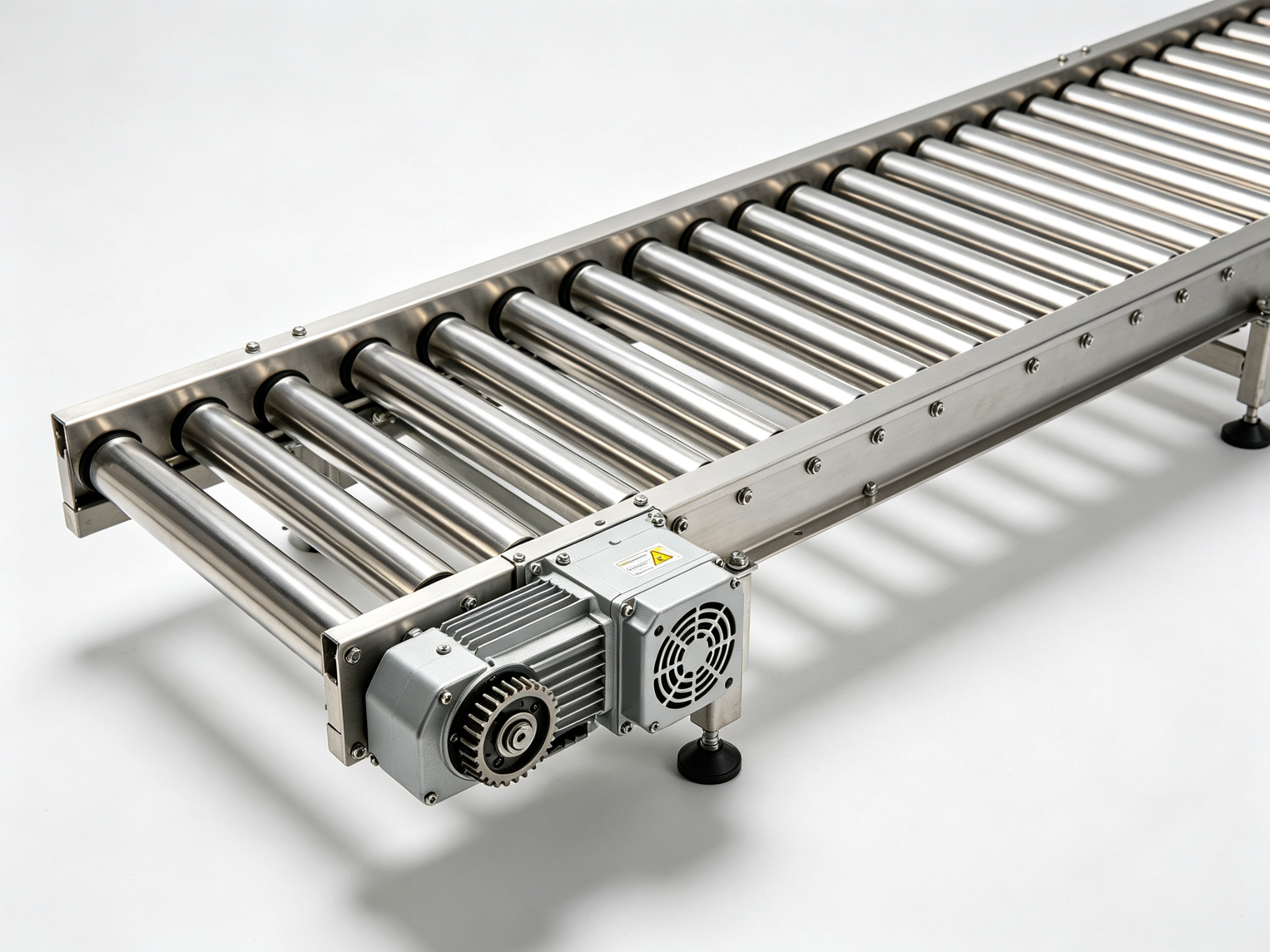
Telescopic Gravity Roller Conveyor | Extendable Loading Conveyor
A Telescopic gravity roller conveyor sized for the loads, speeds and transfer points of a packaging line rather than for a single machine.
| Output | see specification |
|---|---|
| Type | Single station |
| Accuracy | per specification |
| Price band (FOB) | US$ 6,000 – 30,000 |
| Lead time | 25 – 45 days |
1. Who this machine is for, and who should not buy it
This equipment is bought by plants that already have machines and now need the material to move between them without manual handling. The decision is rarely about the conveyor itself: it is about pitch, accumulation, transfer points and what happens when the downstream machine stops.
It is the wrong choice when the load varies in weight and shape beyond the range you can state, when the line runs in a wet or flour-dusted room without the right frame finish, and when the conveyor is expected to buffer production. A conveyor moves product; it does not store it.
The realistic buyer is laying out or extending a line with three to eight machines, knows the product weight and rate, and needs the conveyor to hold a fixed pitch into the next machine rather than to run at its own maximum speed.
2. How it works
An unpowered extending roller bed used where the load can roll and the operator controls the speed by hand. The frame carries the load, the drive moves it, and the transfers are where most line stops actually happen.
Pitch and speed are the two settings that decide whether the next machine sees a steady stream or a burst. A conveyor run 10 % faster than the filler accumulates gaps; one run 10 % slower builds back-pressure and topples light containers.
Accumulation is a separate design decision. Low-pressure accumulation with zone sensors lets product queue without crushing; a single-motor conveyor with no zones simply pushes everything against the stop, which is acceptable for rigid containers and destructive for light ones.
3. Configuration matrix: what changes and what it costs you
The same base frame is sold in several configurations, and the differences matter more than the marketing names suggest. The table below maps each configuration to the buyer profile it actually fits, so you can rule out options before they appear in a quotation.
| Configuration | Heads | Typical output | Container range | Best for | Trade-off |
|---|---|---|---|---|---|
| Gravity roller | none | By decline | Cartons, trays, pallets | No power, no controls | Needs a slope and manual control |
| Belt, fixed speed | 1 motor | 10 – 40 m/min | Bottles, jars, cartons | Simple, quiet | No accumulation without sensors |
| Roller, zone accumulation | 1 motor per zone | 10 – 60 m/min | Cartons, trays, pallets | Low-pressure queue | More sensors and wiring |
| Chain plate | 1 – 2 motors | 10 – 50 m/min | Heavy or hot loads | Flat, durable surface | Noisy, higher power |
| Telescopic powered | 1 motor + extension | Variable | Loading bays | Reaches into trailers | Longer lead time |
The frame and the transfer points cost more than the drive, and they are what decides whether the line runs quietly. Buyers who compare conveyors on price per metre usually discover the difference at the first 90-degree transfer.
4. Technical specifications
Figures below are the standard build. Every value can be changed, but each change moves price, lead time and the commissioning effort, so read the notes column before asking for a variant.
| Parameter | Standard | Optional / range | Why it matters |
|---|---|---|---|
| Type | Telescopic gravity roller conveyor | Custom | Fixed at order |
| Load | Up to 50 kg/m | Up to 200 kg/m heavy duty | State the real load, not the average |
| Speed | 5 – 60 m/min | Variable by inverter | Must be matched to the line |
| Width | 200 – 1,200 mm | Custom | Product width plus clearance |
| Frame | Aluminium profile | Stainless 304 for washdown | Decided by the room, not the product |
| Drive | Geared motor | 24 V roller motors for zoning | Zoning changes the wiring |
| Transfer | Dead plate | Pop-up transfer, pusher | Transfers are the stop points |
| Control | Fixed or inverter | PLC with zone logic | Zone logic needs sensors |
| Guarding | Side rails | Full guards at drives | CE requires nip guarding |
| Noise | 65 – 75 dB(A) | Lower with plastic chain | Chain plate is loudest |
| Power | 0.37 – 2.2 kW | Per zone on accumulation | 380 V three-phase |
| Finish | Powder coated | Stainless / IP65 | Wet rooms need stainless |
5. Throughput and capacity planning
Throughput is speed divided by pitch, not speed alone. A conveyor at 30 m/min with 150 mm pitch moves 200 containers a minute; the same conveyor with 300 mm pitch moves 100. Buyers who quote a rate without a pitch are quoting an unusable number.
Plan the conveyor at the speed of the slowest machine it serves, plus a margin for recovery after a stop. A conveyor sized to the fastest machine spends most of its life running empty, and an empty conveyor with photo-eyes triggers false stops.
Where the line has a buffer requirement, size it in metres of accumulation, not in minutes. One metre of roller conveyor holds about six 150 mm cartons, so a two-minute buffer at 60 cartons per minute needs twenty metres, which is usually more floor than the layout has.
| Shift pattern | Gross output | OEE at 65% | Annual bottles (300 days) |
|---|---|---|---|
| 1 × 8 h | 60 bph | 39 bph | 93,600 |
| 2 × 8 h | 60 bph | 39 bph | 187,200 |
| 3 × 8 h | 60 bph | 39 bph | 280,800 |
Size the machine on the middle of the range, not the top. A unit sold at 60 bottles per hour that runs at 60 for six hours a day is being asked to live at its mechanical limit; the same unit at 45 bottles per hour has headroom for viscosity drift, cap changes and the occasional slow batch.
6. Product and container fit
Fit is decided by the container base and the transfer pattern. A bottle with a small base on a roller conveyor tips at every stop; the same bottle on a slat chain with guide rails runs without incident.
The number of transfers matters more than the length. Every transfer is a potential jam, so a layout with six transfers has six failure points, and each one needs either a dead plate, a pop-up unit or a powered curve to work reliably.
| Product type | Viscosity band | Fit | What to watch |
|---|---|---|---|
| PET bottles | light, small base | Slat chain with rails | Rollers cause tipping |
| Glass jars | heavy, stable | Roller or belt | Watch accumulation pressure |
| Cartons and cases | regular | Roller with zones | Dead plates at transfers |
| Pallets | heavy, palletised | Chain or heavy roller | Drives sized for 1,000 kg |
| Trays and cups | light, unstable | Belt with flights | Rollers not suitable |
| Hot or wet product | varies | Stainless chain plate | Belt may deform or slip |
7. Selection decision framework
Use these rules in order. Each one is a hard filter, not a preference, and each is written so that two buyers with different constraints reach different answers rather than the same recommendation.
Rule 1: Product base first
A base under 40 mm on rollers needs a slat chain or a belt. This single decision removes most tipping problems before they occur.
Rule 2: Pitch second
Set the pitch from the downstream machine, not from the conveyor speed. A machine that needs 150 mm spacing will not accept a conveyor delivering 300 mm.
Rule 3: Accumulation third
If the line has any machine that stops for changeover or cleaning, zone accumulation pays for itself. Without it, every stop empties the whole line.
Rule 4: Transfers fourth
Count them. Six transfers means six jams unless each has a proper transfer device. Reducing the transfer count by two usually saves more downtime than any drive upgrade.
Rule 5: Finish fifth
A washdown room needs stainless and IP65. A dry room does not, and paying for stainless there is money spent on nothing.
Rule 6: Guarding sixth
Drives, pulleys and nip points need guarding for CE. Ask for the guard drawing, not just a declaration.
8. Alternatives compared head to head
The conveyor competes with manual handling and with a different conveyor principle, and the choice is usually decided by load and transfer count.
| Criterion | Telescopic Gravity Roller Conveyor | Extendable Loading Conveyor | Conveyor (powered) | Manual handling / carts | Gravity conveyor |
|---|---|---|---|---|
| Labour | None in normal run | 1 – 3 operators | None | see specification |
| Speed | 10 – 60 m/min | Depends on the route | By decline only | see specification |
| Layout flexibility | Fixed frame | High | Fixed frame | see specification |
| Accumulation | With zone control | By queuing carts | Limited | see specification |
| Cost | US$ 1,200 – 4,500 per metre | Low capital, high labour | US$ 600 – 2,000 per metre | see specification |
| Best fit | Continuous lines | Short runs, many SKUs | Short drops, stable loads | see specification |
Manual handling is cheaper to install and more expensive to run: one operator per shift costs more than a conveyor within two years on most lines. Gravity is the cheapest option and only works where the layout has height to give away.
9. Line integration
Upstream, the conveyor must accept the output of the slowest machine without back-pressure. Downstream, it must deliver at the pitch the next machine expects, with a photo-eye or an encoder to confirm product presence.
If the conveyor crosses a walkway, the layout needs a lift gate or a removable section; retrofitting one means cutting the frame and re-wiring. If it runs beside a filling machine, expect splash and specify the finish accordingly.
Signals worth agreeing: run, fault, product-present and, where accumulation is used, zone-full. A conveyor without a fault output hides a jam until the line stops and somebody walks the length of it.
10. Hygiene, materials and compliance
Conveyors are cleaned more often than machines and are harder to clean. A frame with open profiles and no flat ledges cleans in minutes; a frame with box sections and bolted guards takes an hour and collects product in the joints.
In washdown rooms the specification is stainless 304 or 316, IP65 motors, and a slope on every horizontal surface. In dry rooms powder-coated steel is adequate and much cheaper.
Where product is exposed, the belt material needs a food-contact declaration, and the belt must be removable for cleaning without dismantling the drive.
11. Installation and commissioning
| Stage | Duration | Who does it | Deliverable |
|---|
Installation is two to four days per line section and depends on the floor being level and the machines already in place. Most delays come from discovering that the floor falls 20 mm over ten metres, which the conveyor frame cannot absorb without shims.
12. Maintenance, spares and uptime
Belts, chains and bearings are the wear items. A belt that has stretched produces pitch drift that shows up as jams two machines downstream, so belt tension is checked monthly rather than at failure.
Keep one spare belt or a length of chain, two bearings and a drive coupling. These are the parts that stop a line, and they are inexpensive relative to the downtime.
| Wear part | Interval | Cost band | Downtime if ignored |
|---|---|---|---|
| Belt | 12 – 24 months | US$ 80 – 400 | Pitch drift, slipping |
| Chain section | 24 months | US$ 150 – 600 | Worn links, noise |
| Roller bearing | 12 – 24 months | US$ 8 – 30 each | Seizure, noise |
| Drive coupling | 24 months | US$ 30 – 90 | Vibration, loss of drive |
13. Cost structure and total cost of ownership
A conveyor is cheap to run and easy to undersize. The hidden costs are the operators who walk the line to clear jams and the product damaged at transfers, and both grow with the number of transfer points.
Compare layouts on cost per metre including transfers, guards and controls, not on the frame price. A layout with two fewer transfers usually costs less to buy and less to run.
| Cost line | Typical band | Notes |
|---|---|---|
| Conveyor, FOB | US$ 1,200 – 4,500 per metre | Type and finish |
| Transfers and curves | US$ 800 – 3,000 each | Each is a potential jam |
| Controls | US$ 600 – 2,500 | Zone logic adds cost |
| Power | US$ 0.05 – 0.20 per hour | Small relative to machines |
| Spares, year 1 | US$ 300 – 900 | Belts, bearings |
| Install | US$ 400 – 1,200 per section | Floor level matters |
14. RFQ checklist
A quotation is only as precise as the inputs behind it. Buyers who send these fourteen data points in the first email typically receive a firm price and a layout drawing on the first reply; buyers who send "a filling machine, about 5,000 an hour" spend three rounds establishing what that means.
15. Quality assurance and FAT documentation
Factory acceptance runs the conveyor with a representative load for an hour and checks speed, pitch at the discharge and transfer behaviour. The report records the speed setting and the pitch measured at three points.
Ask for the transfer test to be photographed or videoed, because a transfer that works on the bench with a sample carton often fails with the real product at the real rate.
16. Frequently asked questions
Can I extend the conveyor later?
Yes, if the frame is modular and the drive is sized with headroom. Ask for the drive margin at order; extending a line with an already fully loaded motor means a second drive.
Why does product tip at transfers?
Usually a gap between sections, a speed mismatch or rollers under a light product. A dead plate and a matched speed solve most cases.
Do I need accumulation?
If any machine on the line stops for changeover or cleaning, yes. Without zones, one stop clears the whole line and restarting takes ten to twenty minutes.
What finish do I need?
Stainless and IP65 in washdown rooms; powder-coated steel elsewhere. The room decides, not the product.
How do I set the conveyor speed?
To the slowest machine it serves plus about 10 %. Faster than that builds gaps, slower builds back-pressure.
Is a gravity conveyor cheaper?
Yes, roughly half the cost, but it needs height and cannot accumulate or control pitch.
17. Footprint, utilities and infrastructure
Site planning fails more often on ceiling height and drain position than on floor area, so check these three numbers before the layout is drawn: the height needed for nozzle lift plus the tallest container, the distance from the machine to the nearest drain, and the free capacity on your compressed-air ring main at shift start, when every other machine is also drawing air.
| Item | Requirement | Note |
|---|---|---|
| Floor area | 2.4 x 1.3 m for the machine, plus 1.2 m service access on each side | Access is for the mechanic, not for the operator |
| Ceiling height | 1.9 m minimum above the frame | Nozzle lift plus container height |
| Power | 3 kW, 380 V three-phase, 50 or 60 Hz | Separate circuit with earth, not shared with welders |
| Compressed air | 0.6 MPa, 0.4 m3/min free capacity | Dry air; moisture causes valve sticking |
| Drain | Within 1.5 m of the machine | For washdown and for the drip tray outlet |
| Noise | Under 75 dB(A) at 1 m | Most of it comes from the vacuum pump or blower, not the filler |
A common mistake is to install the machine against a wall to save floor space. The service access on the left side is where the mechanic reaches the drive and the valve manifold; blocking it turns a fifteen-minute job into a two-hour dismantling job, and in practice it also means the machine is never serviced properly.
18. Application scenarios by industry
The same machine is bought for very different reasons, and the configuration that suits one industry is often wrong for another. These four patterns cover most of the enquiries we receive, and each one points to a different set of options.
Food and beverage producers usually need washdown-capable surfaces, food-contact declarations and a changeover fast enough to run three products in a shift. Their decision is driven by the retailer audit, and the machine is specified with stainless frame, IP65 electrics and removable nozzles. Their biggest hidden cost is not the machine but the changeover labour they did not plan for.
Cosmetic and personal-care producers fill smaller volumes at lower output, and their constraint is appearance: no drips on the bottle shoulder, no product in the thread, consistent fill line across a batch. They need a back-suction or suck-back nozzle and a slower final approach more than they need speed, and they usually regret buying a machine sized for output rather than for cleanliness.
Pharmaceutical and diagnostic producers buy documentation as much as hardware. The filling head is secondary to the material traceability, the validation package and the ability to prove that cleaning was effective. Their machine is 316L, their seals are PTFE, and their acceptance test is a written protocol rather than a visual check.
Chemical and household producers fill corrosive or volatile liquids where the wetted material and the seal elastomer decide the machine life. They need Viton or PTFE seals, a stainless frame, and often an extraction hood over the filling zone. Accuracy is less critical than containment, and the machine should be specified accordingly.
19. Supplier evaluation: seven questions with answers you should accept
Buying a filling machine is a comparison between suppliers as much as between machines, and the difference shows up in the second year rather than the first. These seven questions are the ones that separate a supplier who builds machines from one who resells them, and each has an answer you can check against a document.
1. Can you show the calibration record for every head?
A serious supplier weighs thirty bottles per head and reports mean and standard deviation per head, not a single number for the machine. If a head is 2 % off while the average looks fine, the record exposes it and the machine should not ship.
2. What is the spare-part lead time for wear items?
Nozzle seals and valve seats should be shippable in under a week from stock. If the answer is "we order from the OEM", your machine stops for two weeks the first time a seal fails, and seals always fail.
3. Who signs the acceptance test, and against what criteria?
The criteria should be written before the order, in numbers: output over four hours, volume tolerance, drip count, reject rate. A supplier who will not commit to numbers is telling you the numbers are not stable.
4. What is the changeover procedure, and who can perform it?
An operator should be able to change format in under ten minutes with a recipe call and one tool. If the answer involves a mechanic and a spanner, add the labour cost to your five-year total before you compare prices.
5. Which parts are bought in, and from where?
Servo drives, PLCs, pneumatic valves and load cells are branded components, and their availability in your region decides whether a breakdown is a two-day or a two-month event. Ask for the brand list and check local distribution before you sign.
6. What does commissioning include, and what costs extra?
Installation, calibration, training and a production trial should be itemised. The expensive surprises are usually crane hire, extra engineers beyond the agreed days, and re-commissioning after your utilities turn out to be out of specification.
7. Can we speak to a customer running the same product?
A supplier with a real installed base can name two or three references on request. Vague answers here are the single strongest signal to slow down.
20. The first 90 days after arrival
The first three months decide whether the machine settles into a rhythm or becomes a source of daily firefighting. Most of what goes wrong in this window is procedural rather than mechanical, and it is fixable if it is watched.
Days 1 to 10: install, level and align to the conveyor, verify rotation direction and air pressure, then run empty containers through every station by hand before powering the filling circuit. Record the as-built settings in the manual rather than on a note taped to the frame.
Days 11 to 30: calibrate each head on your own product at your own filling temperature, then run a full shift at 70 % of rated output and log volume every hour. The drift pattern in this shift predicts the maintenance interval better than any manual.
Days 31 to 60: train a second operator and one mechanic, not just the person who will run the day shift. Single-person knowledge is the most common cause of a line that cannot run at weekends or during holidays.
Days 61 to 90: review the reject log, count the stops and their causes, and set the first preventive-maintenance dates from the real failure pattern rather than the generic intervals in the manual. Order the first spare kit before the end of this window, because the first seal failure usually arrives around month four.
21. Specification mistakes that cost buyers money later
Nearly every unhappy installation traces back to a decision made in the quotation stage, when a number was accepted without being checked. These six mistakes appear often enough to be predictable, and each is cheap to avoid at order and expensive to correct after arrival.
Accepting output quoted without container details
A speed quoted in bottles per hour means nothing until it is tied to a fill volume, a neck diameter and a product viscosity. Ask for the test conditions in writing: 500 ml, 28 mm neck, water at 20 °C is a very different machine from 1 L, 18 mm neck, syrup at 12 °C.
Buying the maximum head count the budget allows
More heads raise output, but they also raise air consumption, spill risk, calibration work and the cost of every future seal replacement. A machine with eight heads running six days a week at 80 % utilisation beats a twelve-head machine running three days at 45 %.
Forgetting the conveyor pitch
The filling machine, the capper and the labeller must share a container pitch and a conveyor height. When they do not, the integrator builds a transfer plate and a pitch change, and the buyer pays for it in commissioning time and in jams that never quite disappear.
Under-specifying the electricals
IP65 electrics, a separate earth and a dedicated circuit cost a few hundred dollars at order. Retrofitting them into a running line costs a shutdown, a new cabinet and an electrician, and until it is done the machine is a washdown hazard.
Buying seals by price
A seal that costs two dollars less and lasts half as long doubles your maintenance labour and adds a failure mode in the middle of a production run. Specify the elastomer by product compatibility, not by unit cost.
Treating training as a formality
Two days of training with written SOPs is the cheapest reliability investment available. Buyers who skip it usually spend the same money later on a service visit to fix problems the manual already described.
22. Comparing quotations line by line
Three quotations for the same nominal machine can differ by 40 % and still describe the same hardware, because what sits inside the price is different. The line-by-line comparison below is the one we recommend to buyers, and it is also the format our own proposals follow so that the differences are visible rather than buried in a total.
What should be inside the base price
The base price should include the machine as specified, one set of tooling for the agreed format, the control system with its recipe memory, guards and interlocks, an English manual, a tool kit and a spare seal set. If any of those appear as separate lines in a competing quotation, the totals are not comparable and the cheaper number is usually the one with more excluded.
What should be quoted separately, and why
Freight, insurance, duties, installation, training beyond the included days, custom tooling and optional inspection equipment should be separate. That is not a trick; it lets you see the cost of each decision. The trick is the opposite: a single lump sum that hides a two-week commissioning visit inside a number you cannot audit.
Warranty terms
Compare the duration, what is covered, who pays the freight on a warranty part, and what voids the warranty. Twelve months on parts with buyer-paid freight is very different from twelve months including freight and labour. Ask for the wording, not the summary.
Payment schedule and risk
Thirty per cent deposit and seventy per cent against documents is the common structure for export. A supplier asking for the full amount before dispatch is asking you to carry all the risk; a supplier accepting ten per cent deposit is carrying it themselves. The schedule tells you something about who expects to have problems.
Lead time and its components
Ask for the split between engineering, procurement, assembly, testing and packing. A lead time of forty days that is thirty days of waiting for a servo drive is a different risk from forty days of assembly. When a date slips, the split tells you whether to push the supplier or the component.
23. Questions procurement teams ask us most often
Can you supply the same machine on 415 V, 60 Hz?
Yes. Voltage, phase and frequency are specified at order because they change the motors, the drives and the transformer sizing. Changing them after the machine is built means replacing components, and it is one of the few specifications that cannot be adjusted on site.
What is the actual delivery time to our port?
Production lead time is 25 to 45 days, sea freight to most destinations is 18 to 35 days, and port-to-door adds three to ten days depending on customs. The total is what your planning needs, and it is usually 8 to 12 weeks from order to a machine running in your plant.
Do you provide a local installation service?
We send engineers from the factory for installation and commissioning, and for repeat buyers we can arrange a local partner for routine service. Installation by the factory team is the option we recommend for a first machine, because it transfers the process knowledge as well as the hardware.
What happens if a part fails in the first year?
Warranty parts ship by air within three working days of a confirmed diagnosis, and we ask for photographs and the fault code so the diagnosis is right the first time. For critical wear items we recommend holding a local kit, which costs a few hundred dollars and removes the air-freight delay entirely.
Can the machine be audited before we release the balance?
Yes. The factory acceptance test is the natural point: you or your third-party inspector attend, watch the run, review the calibration data and the material certificates, and the balance is released against a signed report. Buyers who skip this step sometimes discover a specification mismatch only after the container arrives.
24. Service levels, response times and what we commit to in writing
Service is the part of a machine purchase that buyers cannot inspect before they pay, which is exactly why it deserves a place in the comparison spreadsheet. What follows is what we put in the contract rather than what we say in a sales meeting, and we recommend asking every competing supplier the same four questions.
Response time
First technical response within one working day of a written query with photographs and the fault code. Remote diagnosis within two days. Where a site visit is needed, an engineer is dispatched within five working days, or sooner if the line is stopped.
Spare parts
Wear items from stock, shipped within three working days by air. Non-stock parts are quoted with a lead time in writing. The recommended spare kit is listed in the manual with part numbers, so you can reorder from any distributor rather than only from us.
Warranty
Twelve months on parts and labour for defects in manufacture, twenty-four months on the frame. Consumables and wear items are excluded, which is normal, but the exclusion list is written down rather than implied. Warranty freight is covered by us for the first shipment of a replacement part.
Training and knowledge transfer
Two days of on-site training are included with commissioning: one day for operators covering start-up, changeover, cleaning and the first line of fault finding, and one day for the mechanic covering adjustment, wear inspection and the spare-parts replacement procedure. Both days end with a written SOP that your team keeps.
What we do not promise
We do not promise a response time measured in hours, because a promise that cannot be kept is worse than a realistic one. We do not promise that a machine will run at its maximum output indefinitely; we promise the tested output on the format and product used at acceptance, and we document the conditions. Buyers who want a guarantee on through-life output should buy a service contract, and we quote those separately so the cost is visible.
27. Handover, acceptance and what to verify on site
Handover should end with a signed layout and a speed log, not with a handshake. The log should record the speed at which each transfer was tested, the load used, and the pitch measured at the discharge. Without that record, the first jam two weeks later is impossible to attribute.
On site, verify four things before accepting: that the frame is level within 2 mm over ten metres, that every guard closes a safety circuit rather than a timer, that the photo-eyes are positioned so a clear container cannot be missed, and that the drive can be isolated and locked out. The first and the last are the two that cause the most trouble later.
Ask for the wiring diagram and the spare parts list as electronic files at handover. A conveyor is a long asset with many small parts, and a plant without the diagram spends its first breakdown tracing wires by hand.
Send your container and product details
Send the layout sketch, product weight and base size, line rate and transfer count. We will confirm the frame type, drive sizing and transfer devices, and send a priced layout with a transfer test protocol.